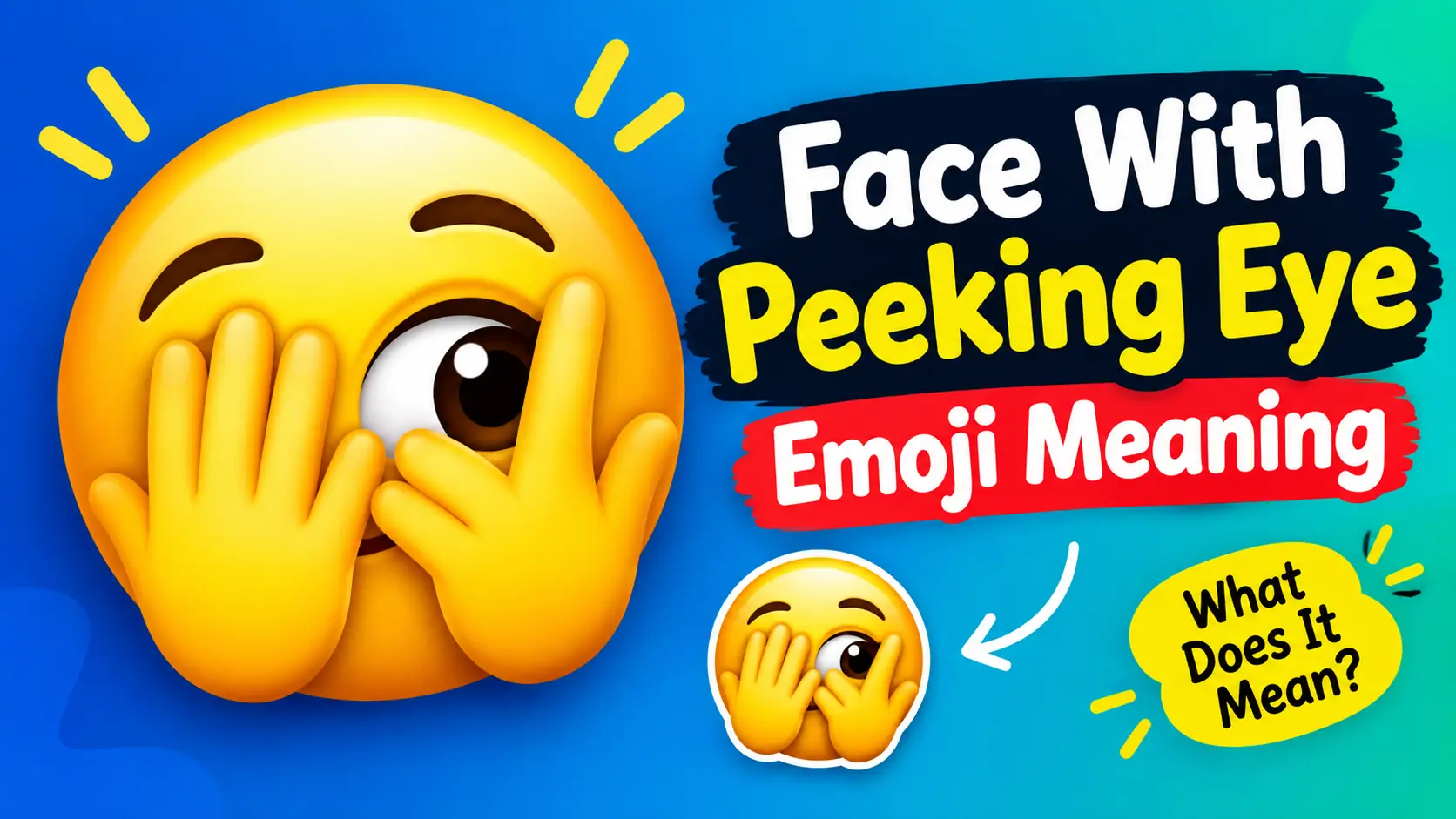
The 🫣 emoji has a funny way of saying, “I’m looking, but I’m also a little nervous.” Known as the Face With Peeking Eye emoji, it shows a face hiding behind its hands while one eye peeks through.
People often use it when they feel shy, embarrassed, awkward, scared, or curious about something. The Face With Peeking Eye Emoji Meaning can change depending on the conversation.
A friend might send 🫣 after making an embarrassing confession, while someone may use it to show nervous excitement before sharing something personal. It can also express playful curiosity, especially when someone wants to see what happens next but feels hesitant.
What Does the Face With Peeking Eye Emoji Mean?
The face with peeking eye emoji 🫣 generally represents a feeling of shyness, embarrassment, nervousness, awkwardness, curiosity, or anticipation.
The emoji visually shows a person hiding their face with their hands while peeking through their fingers. Because of this, it can communicate the feeling of wanting to look at something while simultaneously feeling shy or uncomfortable about it.
Depending on the context, 🫣 can mean:
- “I’m too shy to look.”
- “I’m embarrassed.”
- “This is awkward.”
- “I’m nervous.”
- “I’m secretly watching.”
- “I can’t believe I’m looking at this.”
- “I’m curious.”
- “I’m hiding, but I still want to see.”
- “This is making me nervous.”
- “I’m waiting to see what happens.”
The emoji does not have only one fixed emotional meaning. Its interpretation changes according to the words around it.
Face With Peeking Eye Emoji Meaning in Simple Words
In simple terms, 🫣 often means:
“I’m shy, embarrassed, nervous, or curious, but I still want to look.”
For example:
“I finally texted my crush 🫣”
Here, the emoji may show nervousness and embarrassment.
Another example:
“Did you really send that message? 🫣”
Here, it may express shock, awkwardness, or embarrassment.
What Does 🫣 Mean in Texting?
In texting, 🫣 is usually used to add an emotional reaction to a message. It can make a sentence sound more playful, shy, nervous, or embarrassed.
For example:
“I think I actually like him 🫣”
The emoji suggests that the person feels shy or embarrassed about admitting their feelings.
Another example:
“Okay… I checked their profile again 🫣”
In this case, 🫣 can suggest that the person knows they are being a little obvious or nosy but is admitting it playfully.
The emoji is particularly useful when words alone might sound too serious.
Compare these two messages:
“I looked at your pictures.”
versus:
“I looked at your pictures 🫣”
The second message sounds more shy, playful, or embarrassed.
Face With Peeking Eye Emoji Meaning in Different Situations
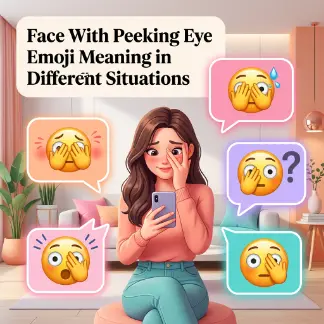
The meaning of 🫣 can change depending on the situation. Understanding context is important if you want to interpret it correctly.
1. Shyness
One of the most common meanings of 🫣 is shyness.
Someone may use it when they want to admit something but feel too shy to say it directly.
Example:
“You looked really good today 🫣”
The emoji can make the compliment feel shy and slightly flirtatious.
2. Embarrassment
The emoji can also represent embarrassment.
Someone might use 🫣 after making a mistake, saying something awkward, or admitting something they would normally keep private.
Example:
“I accidentally liked a post from 2019 🫣”
Here, the emoji communicates embarrassment.
3. Nervousness
Sometimes 🫣 means that someone is nervous about what is happening next.
Example:
“Waiting for their reply now 🫣”
The person may be anxiously waiting and unsure about the response.
4. Curiosity
The peeking eye itself suggests curiosity. Someone may be interested in something even though they are pretending to hide.
Example:
“What are you two talking about? 🫣”
This can playfully mean:
“I’m curious. Tell me what’s happening.”
5. Awkwardness
The emoji can also express an uncomfortable or awkward reaction.
Example:
“He confessed his feelings in front of everyone 🫣”
Here, 🫣 may mean:
“That was so awkward to watch.”
6. Anticipation
Someone may use 🫣 when waiting to see what happens.
Example:
“Let’s see what she says 🫣”
The emoji adds a sense of nervous anticipation.
7. Flirting
In romantic conversations, 🫣 can have a playful or flirtatious meaning.
Example:
“Maybe I do have a crush on you 🫣”
Here, the emoji softens the confession and makes it sound bashful.
However, 🫣 does not automatically mean flirting. The surrounding conversation determines whether the message is romantic or simply shy.
🫣 Emoji Meaning From a Girl
If a girl sends 🫣, it can have several meanings depending on the conversation.
She may be:
- Feeling shy
- Embarrassed
- Nervous
- Teasing you
- Reacting to a compliment
- Showing romantic interest
- Curious about something
- Feeling awkward
- Waiting nervously for your response
For example:
“Stop making me blush 🫣”
This clearly communicates shyness or embarrassment.
However, it is important not to assume that 🫣 automatically means romantic interest. An emoji by itself is not enough to determine someone’s intentions.
🫣 Emoji Meaning From a Boy
A boy can use 🫣 in much the same way.
For example:
“Okay, I was checking your profile 🫣”
This could indicate playful embarrassment.
Or:
“I might actually miss you 🫣”
In a romantic conversation, it can make the statement sound shy or vulnerable.
Again, context matters more than the gender of the person using the emoji.
🫣 Emoji Meaning From a Crush
When a crush uses 🫣, the emoji may feel more significant because it often communicates nervousness or bashfulness.
For example:
“You looked amazing today 🫣”
This could be a shy compliment.
Or:
“I was hoping you’d text me 🫣”
This may express nervousness or romantic vulnerability.
Still, an emoji cannot prove that someone has romantic feelings. Look at the complete conversation rather than interpreting one symbol by itself.
Is 🫣 a Flirty Emoji?
Yes, 🫣 can be used as a flirty emoji, but it is not exclusively flirty.
Its shy and embarrassed appearance makes it popular in romantic conversations.
For example:
“You really know how to make me blush 🫣”
The emoji adds a playful romantic tone.
Another example:
“Maybe I was hoping you’d ask me out 🫣”
Here, it can suggest bashfulness and romantic interest.
But the same emoji can be completely non-romantic:
“I watched the horror movie alone 🫣”
In that context, it may simply communicate fear or nervousness.
Therefore, context determines whether 🫣 is flirting or simply expressing an emotional reaction.
Is 🫣 a Shy Emoji?
Yes. The face with peeking eye emoji is commonly associated with shyness.
The visual design itself suggests someone who is hiding their face but still looking through their fingers. This makes it a natural choice when someone wants to communicate:
“I’m shy, but I’m still looking.”
It can be used after compliments, confessions, awkward moments, or personal admissions.
Examples of Shy Uses
- “I actually like your outfit 🫣”
- “I was waiting for your message 🫣”
- “Don’t look at me, I’m blushing 🫣”
- “I finally asked them out 🫣”
Is 🫣 a Nervous Emoji?
It can be.
The emoji is often used to show nervous anticipation, especially when someone is waiting for something to happen.
For example:
“I sent the application. Now we wait 🫣”
The person may be nervous about the outcome.
Similarly:
“I just sent the text… 🫣”
This suggests:
“I sent it, and now I’m nervous about what happens next.”
Is 🫣 Used for Embarrassment?
Yes. Embarrassment is another major interpretation.
People often use 🫣 when they want to admit something embarrassing without making the conversation overly serious.
For example:
“I called my teacher ‘Mom’ today 🫣”
The emoji communicates embarrassment while keeping the story humorous.
Another example:
“I waved back at someone who wasn’t waving at me 🫣”
The emoji emphasizes the awkwardness of the situation.
🫣 Meaning on TikTok
On TikTok, 🫣 can be used in captions, comments, and replies to express different emotions.
Its meaning may include:
- Shyness
- Embarrassment
- Awkwardness
- Curiosity
- Attraction
- Nervousness
- “I shouldn’t be watching this, but I am”
- Playful hiding
- Anticipation
For example, someone might comment:
“Me watching the whole drama unfold 🫣”
Here, the emoji suggests curiosity and amusement.
Another example:
“Why is this actually relatable 🫣”
This can show playful embarrassment or an admission that the content hits close to home.
🫣 Meaning on Instagram
On Instagram, the emoji commonly appears in comments, DMs, captions, and reactions.
Someone might comment:
“Okayyy you look good 🫣”
This could have a flirty or admiring tone.
Someone could also say:
“I shouldn’t have checked their profile again 🫣”
Here, the emoji expresses playful embarrassment.
Instagram users may also use 🫣 when reacting to gossip, relationship posts, romantic content, or awkward situations.
🫣 Meaning on Snapchat
On Snapchat, the face with peeking eye emoji may appear in direct messages or captions.
For example:
“So what happened last night? 🫣”
This can suggest curiosity.
Or:
“I may have sent that snap to the wrong person 🫣”
Here, it communicates embarrassment.
Because Snapchat conversations are often casual and personal, 🫣 can work as a playful emotional reaction.
Face With Peeking Eye Emoji vs Eyes Emoji 👀
The 🫣 and 👀 emojis can both communicate looking or watching, but their emotional tones are different.
| Emoji | Common Meaning | Emotional Tone |
| 🫣 | Shy, embarrassed, nervous, curious | Bashful or awkward |
| 👀 | Looking, watching, interested | Curious or attentive |
| 🙈 | Embarrassed, hiding, “I can’t look” | More strongly embarrassed |
| 😳 | Shocked, embarrassed, blushing | Surprised or intense |
| 🫢 | Shock, surprise, covering mouth | Startled or shocked |
The key difference is that 🫣 combines hiding with peeking.
👀 simply shows eyes and often means:
“I’m watching.”
Meanwhile, 🫣 can suggest:
“I’m hiding, but I’m still looking.”
🫣 vs 🙈: What’s the Difference?
These two emojis are easy to confuse.
🫣 Face With Peeking Eye
Usually suggests:
- Shyness
- Nervousness
- Curiosity
- Embarrassment
- Anticipation
- Secretly watching
🙈 See-No-Evil Monkey
Usually suggests:
- “I don’t want to see this.”
- Embarrassment
- Awkwardness
- Playful shame
- “I can’t believe I saw that.”
For example:
“I sent the message to my crush 🫣”
This suggests nervousness or shyness.
“I accidentally sent the message to the wrong person 🙈”
This can emphasize embarrassment and the desire to hide.
🫣 vs 😳
The 🫣 emoji and 😳 emoji can both be used when someone feels embarrassed or overwhelmed.
However, 😳 usually expresses a more direct reaction of shock, surprise, blushing, or embarrassment.
The 🫣 emoji has more of a:
“I’m hiding, but I still want to look”
feeling.
For example:
“You actually said that? 😳”
sounds shocked.
While:
“You actually said that? 🫣”
can sound more awkward, shy, or amused.
🫣 vs 🫢
The 🫢 emoji generally represents surprise, shock, or covering the mouth after hearing or saying something unexpected.
The 🫣 emoji is more associated with hiding, peeking, shyness, and nervousness.
For example:
🫢: “Wait, what did you just say?”
🫣: “I can’t believe I’m watching this.”
Understanding these subtle differences can help you choose the right emoji for your message.
How to Use the 🫣 Emoji
You can use 🫣 in many casual conversations. Here are some practical examples.
When You’re Shy
“I don’t know what to say 🫣”
When You’re Embarrassed
“I just realized I sent that to the group chat 🫣”
When You’re Flirting
“Maybe I was hoping you’d notice me 🫣”
When You’re Nervous
“I have to present in five minutes 🫣”
When You’re Curious
“Okay, tell me what happened 🫣”
When You’re Watching Drama
“I’m staying out of this, but I’m watching 🫣”
When You’re Waiting for a Reply
“Well… now I wait 🫣”
When You Want to Make a Confession
“I kind of missed you 🫣”
Examples of 🫣 in Text Messages
Here are some realistic texting examples:
Person A: “Did you talk to your crush?”
Person B: “Maybe 🫣”
Here, 🫣 suggests shyness.
Person A: “Did you really read the entire conversation?”
Person B: “Yes 🫣”
Here, it may suggest embarrassment.
Person A: “Are you waiting for their reply?”
Person B: “Obviously 🫣”
Here, it communicates nervous anticipation.
Person A: “Did you like the photo?”
Person B: “Maybe a little too much 🫣”
This can sound playful or flirtatious.
Person A: “What are they arguing about?”
Person B: “I have no idea, but I’m watching 🫣”
Here, the emoji represents curiosity and playful observation.
How to Reply to 🫣
Your response should depend on the context.
If someone sends:
“I finally told them how I feel 🫣”
You could reply:
- “Aww, you did it!”
- “What did they say?”
- “Now I’m invested 👀”
- “Tell me everything!”
If someone sends 🫣 after flirting, you can respond playfully:
- “Why are you hiding?”
- “You don’t have to be shy.”
- “I saw that 👀”
- “Caught you!”
If the conversation is serious, avoid assuming that the emoji means flirting. Respond to the actual message rather than the emoji alone.
What Does 🫣 Mean From a Crush?
When a crush sends 🫣, it may communicate a combination of shyness, nervousness, attraction, embarrassment, or playful teasing.
For example:
“You looked really cute today 🫣”
The emoji may make the compliment sound bashful.
However, one emoji should not be treated as definite evidence of someone’s feelings. Consider the entire conversation, their words, and the context.
A useful rule is:
Words provide the main meaning; emojis add emotional tone.
Does 🫣 Mean “I’m Watching You”?
Sometimes.
Because the emoji is literally peeking through its fingers, it can jokingly communicate:
“I’m watching.”
For example:
“I’m not getting involved… but I’m watching 🫣”
This is usually playful rather than threatening.
Another example:
“Me checking the comments 🫣”
Here, the emoji simply indicates curiosity.
Does 🫣 Mean “I Can’t Look”?
Sometimes, but usually with a playful twist.
The person may technically be saying:
“I don’t want to look.”
But the peeking eye suggests that they are still interested enough to look anyway.
That contradiction is part of what makes the emoji useful.
It can communicate:
“This is awkward, but I can’t look away.”
Does 🫣 Mean Love?
Not necessarily.
The 🫣 emoji is not specifically a love emoji. It can appear in romantic conversations, but it does not directly mean “love.”
For love or affection, people are more likely to use emojis such as:
- ❤️
- 🥰
- 😍
- 💕
- 💗
The 🫣 emoji may accompany these emojis when someone feels shy about expressing affection.
For example:
“I really like you 🫣❤️”
Here, ❤️ communicates affection while 🫣 adds shyness.
Does 🫣 Mean Someone Is Embarrassed?
It can.
The emoji is particularly useful for situations where someone feels embarrassed but wants to keep the conversation light.
For example:
“I accidentally called my boss ‘Dad’ 🫣”
The emoji tells the reader:
“That was embarrassing, but I’m laughing about it.”
Common Mistakes When Interpreting 🫣
Although emojis can add meaning to conversations, it is easy to overinterpret them.
Mistake 1: Assuming It Always Means Flirting
Not every 🫣 is romantic.
Someone might use it because they are embarrassed, nervous, curious, or watching something awkward.
Mistake 2: Ignoring the Message
Never interpret an emoji separately from the surrounding words.
Compare:
“I have an exam tomorrow 🫣”
with:
“You’re looking good today 🫣”
The first likely expresses nervousness.
The second may sound shy or flirtatious.
Mistake 3: Assuming the Person Is Actually Scared
🫣 can represent nervousness, but it is often playful rather than genuine fear.
Mistake 4: Treating Every Emoji as a Secret Code
Emojis usually add tone rather than completely changing the meaning of a sentence.
The surrounding conversation remains the most important clue.
When Should You Use the 🫣 Emoji?
Use 🫣 when you want to communicate a combination of hiding and looking or a feeling such as shyness, awkwardness, embarrassment, curiosity, or nervous anticipation.
It works especially well when:
- You are making a shy confession.
- You are embarrassed about something.
- You are waiting nervously for an answer.
- You are teasing someone.
- You are reacting to romantic content.
- You are watching drama unfold.
- You are admitting something awkward.
- You are curious about something.
- You want to make a message sound less serious.
When Should You Avoid Using 🫣?
Although 🫣 is useful in casual conversations, it may not be suitable for every situation.
Avoid using it in:
- Formal business emails
- Professional reports
- Academic writing
- Serious official communications
- Situations where your meaning must be completely unambiguous
For casual texts and social media, however, it can add personality and emotional context.
Face With Peeking Eye Emoji Meaning: Quick Reference
| Situation | Possible Meaning |
| After a compliment | Shyness or blushing |
| After a confession | Nervousness or embarrassment |
| During gossip | Curiosity |
| While waiting for a reply | Nervous anticipation |
| During flirting | Bashfulness or playful attraction |
| After a mistake | Embarrassment |
| Watching drama | Curiosity or amusement |
| After an awkward event | Awkwardness |
| During a scary situation | Nervousness |
| After revealing a secret | Shyness or embarrassment |
Why Is 🫣 So Expressive?
The strength of the 🫣 emoji comes from its visual contradiction.
The face appears to be hiding, but one eye is still looking.
That creates an emotional combination:
Hide + Look + Curiosity + Shyness
This is why the emoji can fit situations where someone is interested in something but feels embarrassed, nervous, or uncomfortable.
For example, imagine someone says:
“I definitely didn’t check their profile again.”
Adding 🫣 can turn that into a playful admission that they probably did.
The emoji allows people to communicate emotions without explaining them in a long sentence.
Frequently Asked Questions
1. What is the face with peeking eye emoji meaning?
The 🫣 emoji commonly means shyness, embarrassment, nervousness, curiosity, awkwardness, or anticipation. Its exact meaning depends on the context.
2. Is the 🫣 emoji flirty?
It can be flirty when used in a romantic conversation, especially after a compliment or confession. However, it can also simply mean shy, embarrassed, curious, or nervous.
3. What does 🫣 mean from a girl?
A girl may use 🫣 to express shyness, embarrassment, nervousness, curiosity, or playful flirting. The surrounding conversation is necessary to understand the intended meaning.
4. What does 🫣 mean from a guy?
A guy may use 🫣 to show that he feels shy, embarrassed, nervous, curious, or playful. In romantic conversations, it can sometimes add a bashful or flirtatious tone.
5. What does 🫣 mean on TikTok?
On TikTok, 🫣 can express shyness, awkwardness, curiosity, embarrassment, attraction, or the feeling of secretly watching something. Its meaning changes according to the video or comment.
6. What is the difference between 🫣 and 👀?
🫣 usually combines hiding with peeking and can suggest shyness or embarrassment. 👀 is more directly associated with watching, noticing, or showing interest.
7. Does 🫣 mean love?
No. 🫣 does not specifically mean love. It can be used in romantic conversations to show shyness or nervousness, but the emoji itself has broader meanings.
Conclusion
The face with peeking eye emoji meaning 🫣 is mainly connected with shyness, embarrassment, nervousness, curiosity, awkwardness, and anticipation. Its distinctive design shows someone hiding their face while still peeking through their fingers, which explains why it works so well for situations where a person wants to look but feels shy or uncomfortable.
In texting and social media, 🫣 can make a message feel more playful and emotionally expressive. It may be used after a romantic confession, an embarrassing mistake, an awkward situation, a curious question, or while waiting nervously for someone’s response.

I am David Wilson, a passionate writer dedicated to creating informative, engaging, and valuable content for readers. I enjoy researching different topics and sharing well-crafted articles that provide helpful insights, practical knowledge, and meaningful information. I am committed to maintaining high-quality writing standards with a focus on accuracy, clarity, and reader satisfaction.