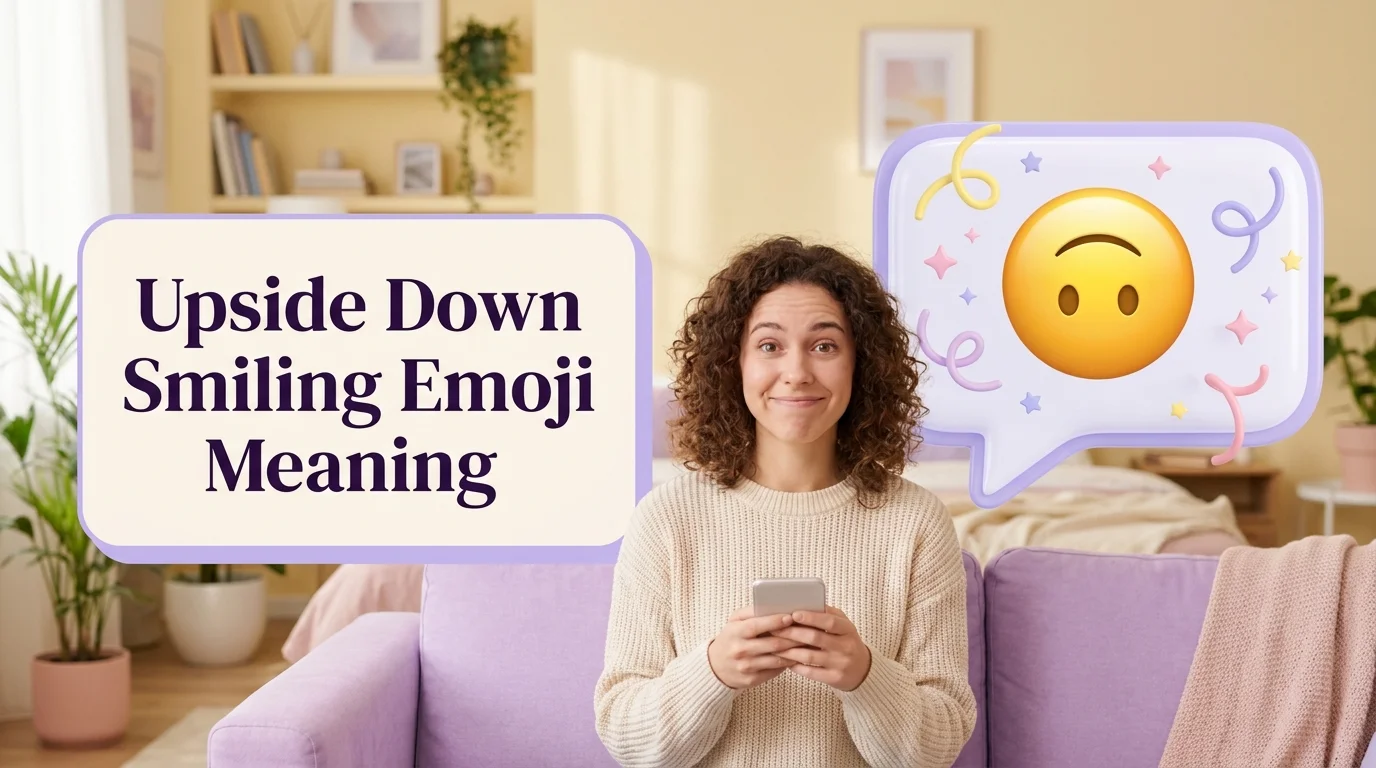
Sometimes, a simple smile can hide a completely different emotion, and the 🙃 emoji captures that feeling perfectly. The upside down smiling emoji meaning often relates to sarcasm, awkwardness, playful humour, or pretending everything is fine when a situation feels anything but normal.
Its cheerful smile combined with an upside-down face gives messages a funny, ironic, or slightly confusing tone. In everyday texting, people use 🙃 when they want to joke about an embarrassing moment, react to an unexpected situation, or express frustration without sounding too serious.
For example, someone might text, “I stayed up all night finishing my work, and now I have another assignment 🙃.” Here, the emoji suggests mild annoyance mixed with humour. Friends may also use it to tease each other or make an ordinary conversation feel more playful.
What Is the Upside Down Smiling Emoji?
The emoji most commonly associated with the upside-down smile is 🙃, officially known as the upside-down face.
It looks like a normal smiling face turned upside down. Because the expression is visually unusual, people often use it when their emotions are not completely straightforward.
The 🙃 emoji can communicate feelings such as:
- Playfulness
- Sarcasm
- Awkwardness
- Mild frustration
- Embarrassment
- “I’m fine… sort of”
- Humor in an uncomfortable situation
- Resignation
- A deliberately silly reaction
- Hidden or mixed emotions
The exact interpretation depends heavily on context.
For example:
“I accidentally sent that message to my boss 🙃”
Here, the emoji probably suggests embarrassment and awkward humor rather than genuine happiness.
On the other hand:
“You actually believed me? 🙃”
In this situation, it can sound playful or sarcastic.
Upside Down Smiling Emoji Meaning in Texting
In text messages, 🙃 often adds an emotional layer to the sentence. It can make a statement feel less serious, more playful, or intentionally awkward.
Sometimes people use it when they want to acknowledge an uncomfortable reality without explaining their feelings directly.
For example:
“I have three assignments due tomorrow 🙃”
The person probably is not happy about the assignments. The upside-down face can mean something like:
“This is terrible, but I might as well laugh about it.”
Similarly:
“Sure, I’ll do it again 🙃”
Depending on the previous conversation, this could mean genuine agreement, playful annoyance, or sarcasm.
Common texting meanings
| Meaning | Example | Possible feeling |
| Playfulness | “You caught me 🙃” | Lighthearted |
| Sarcasm | “Yeah, that went perfectly 🙃” | Ironic |
| Awkwardness | “I forgot her name 🙃” | Embarrassed |
| Frustration | “Another meeting today 🙃” | Mildly annoyed |
| Resignation | “Guess I’ll start over 🙃” | Accepting an annoying situation |
| Hidden emotion | “I’m totally fine 🙃” | Maybe not fine |
The emoji does not automatically mean the person is upset. It simply suggests that the sentence may have a second emotional layer.
What Does 🙃 Mean From a Girl?
If a girl sends 🙃, its meaning depends on what she says around it and the nature of your relationship.
She might use it when she is:
- Making a playful joke
- Feeling awkward
- Being sarcastic
- Embarrassed about something
- Trying to make an uncomfortable statement sound lighter
- Pretending something does not bother her
- Reacting to an unexpected situation
For example:
You: “Did you really forget our plans?”
Her: “Maybe 🙃”
That could be playful teasing, embarrassment, or a way of avoiding a direct answer.
Another example:
Her: “My crush walked right past me today 🙃”
Here, the emoji may communicate embarrassment or awkwardness.
Does 🙃 from a girl mean she likes you?
Not necessarily.
An upside-down smile by itself is not reliable evidence of romantic interest. It can appear in friendly, casual, professional, or romantic conversations.
If you are trying to understand whether a girl is flirting, look at the overall conversation rather than treating one emoji as a definite signal. Her wording, consistency, the subject of the conversation, and the broader relationship provide much more useful context.
What Does 🙃 Mean From a Guy?
A guy may use the upside-down face in much the same way.
For example:
“I just realized I studied the wrong chapter 🙃”
This probably expresses frustration mixed with humor.
Or:
“Yeah, I definitely knew that already 🙃”
That could be self-deprecating humor or sarcasm.
A guy might also use 🙃 when he feels awkward but does not want to say so directly.
For example:
“I waved back at someone who wasn’t waving at me 🙃”
The emoji makes the embarrassing story feel funny rather than overly serious.
Does 🙃 from a guy mean he is flirting?
It can appear in a flirty conversation, but the emoji itself does not automatically indicate flirting.
For example:
“You look really good today 🙃”
might feel playful or flirtatious because of the sentence surrounding it. But:
“I forgot my password again 🙃”
is clearly unrelated to romance.
The surrounding words matter more than the emoji alone.
What Does the Upside Down Smile Mean From a Crush?
When your crush sends 🙃, it is natural to wonder whether there is a hidden romantic meaning.
Sometimes the emoji can make a message feel teasing, playful, or slightly shy. However, it does not have a universal romantic meaning.
Consider these examples:
“Stop making me laugh 🙃”
This may sound playful and potentially flirtatious depending on your relationship.
“I can’t believe you remembered that 🙃”
This could express pleasant surprise or embarrassment.
“You really are impossible 🙃”
This could be affectionate teasing, irritation, or simply humor.
The important point is not to interpret the emoji in isolation.
Is the Upside Down Emoji Sarcastic?
Yes, 🙃 is frequently used sarcastically, although sarcasm is only one of its meanings.
For example:
“Love getting stuck in traffic for an hour 🙃”
The person probably does not genuinely love being stuck in traffic. The upside-down face signals irony.
Another example:
“Amazing. My phone died right before the important call 🙃”
The emoji helps communicate:
“This is obviously not amazing.”
How to recognize sarcasm
Look at whether the words and situation contradict each other.
If someone says:
“I absolutely love waiting three hours at the airport 🙃”
the positive words combined with an obviously unpleasant situation make sarcasm likely.
Is 🙃 a Happy or Sad Emoji?
The upside-down face is neither simply happy nor simply sad.
Its meaning is usually more complicated.
A useful way to understand it is:
🙃 = “There is something funny, awkward, ironic, or uncomfortable about this.”
The person may be smiling while experiencing an emotion that is not particularly positive.
For example:
“I accidentally deleted the whole document 🙃”
The person might be frustrated or embarrassed, but they are using humor to deal with the situation.
This is why 🙃 can sometimes feel emotionally different from a regular 🙂 emoji.
🙃 vs 🙂: What’s the Difference?
Although both emojis contain smiles, they can create very different tones.
| Emoji | Common impression |
| 🙂 | Simple friendliness or mild happiness |
| 🙃 | Playfulness, irony, awkwardness, sarcasm, or mixed emotions |
Consider these two messages:
“Sure, no problem 🙂”
This usually sounds straightforward and friendly.
“Sure, no problem 🙃”
This can sound like the person is being sarcastic, slightly annoyed, or joking about the situation.
However, neither interpretation is guaranteed. Context remains important.
🙃 vs 😏: What’s the Difference?
These emojis are sometimes confused because both can appear in playful conversations.
🙃 Upside-down face often suggests:
- Awkward humor
- Irony
- Sarcasm
- Playfulness
- Mixed emotions
😏 Smirking face more commonly suggests:
- Confidence
- Mischief
- Teasing
- Suggestiveness
- Self-satisfaction
For example:
“I knew you would say that 🙃”
sounds playful or ironic.
“I knew you would say that 😏”
can sound more teasing or suggestive.
The difference becomes especially noticeable in romantic conversations.
Upside Down Smiling Emoji Meaning in Relationships
In relationships, 🙃 can be used to express emotions that are difficult to state directly.
A partner might say:
“You forgot our anniversary again 🙃”
Here, the emoji could soften a complaint while still signaling disappointment.
Or:
“You really know how to annoy me 🙃”
Depending on the relationship, this could be affectionate teasing rather than serious anger.
When it can signal hidden frustration
If someone repeatedly uses 🙃 after complaints, it may be worth paying attention to the actual words rather than assuming they are joking.
For example:
“I told you about this yesterday 🙃”
could mean:
“I’m trying to stay lighthearted, but I’m actually annoyed.”
The emoji does not erase the meaning of the sentence.
Upside Down Smiling Emoji Meaning in Friendship
Friends often use 🙃 when sharing embarrassing stories, teasing each other, or reacting to ridiculous situations.
Examples include:
“I locked myself out again 🙃”
“You really thought that was a good idea 🙃”
“We have another group project 🙃”
Among close friends, the emoji can make teasing feel less harsh.
It can also turn an ordinary complaint into a funny moment.
When 🙃 Means “I’m Fine… But Not Really”
One of the most recognizable uses of 🙃 is expressing a situation where someone claims to be okay while subtly suggesting the opposite.
For example:
“Everything is completely under control 🙃”
If everything clearly is not under control, the emoji adds irony.
Another example:
“I haven’t slept all night but I’m fine 🙃”
The person may be joking about their situation rather than literally saying they feel good.
This is why 🙃 can sometimes be described informally as the “I’m fine, but this is ridiculous” emoji.
How to Respond to the Upside Down Smiling Emoji
Your response should depend on the context.
If the person is joking
You can respond playfully:
“😂 I knew something was wrong.”
If they seem frustrated
Try acknowledging the situation:
“That sounds rough. Everything okay?”
If they are being sarcastic
You can match the tone:
“Sure, sounds like everything went perfectly 😂”
If you are unsure
Ask naturally:
“Wait, are you joking or actually annoyed? 😂”
This is often better than guessing.
How to Tell What 🙃 Means in a Conversation
When you are unsure about an emoji, use these five clues:
- Read the sentence before it.
The words usually provide the strongest clue. - Look at the situation.
An upside-down face after bad news may signal awkward humor or frustration. - Consider your relationship.
Close friends may use it differently from coworkers or strangers. - Notice other emojis.
😂, 😭, 😏, 😅, or ❤️ can change the tone. - Look at the person’s usual texting style.
Someone who frequently uses 🙃 may use it casually without any hidden message.
The safest interpretation is usually the one that fits the entire conversation.
Examples of 🙃 in Text Messages
Here are some realistic examples:
Example 1: Awkward situation
“I called my teacher ‘Mom’ today 🙃”
Meaning: The person is embarrassed but finds the situation funny.
Example 2: Bad luck
“My laptop crashed five minutes before I finished 🙃”
Meaning: Frustration mixed with humor.
Example 3: Sarcasm
“Nothing like waking up at 5 AM for work 🙃”
Meaning: The person probably does not enjoy it.
Example 4: Playful teasing
“You really thought I wouldn’t notice 🙃”
Meaning: Light teasing or playful sarcasm.
Example 5: Hidden annoyance
“Sure, I’ll clean everything again 🙃”
Meaning: The person may be agreeing while also expressing irritation.
Example 6: Romantic teasing
“You are seriously making me blush 🙃”
Meaning: Depending on the relationship, this may suggest playful or shy romantic energy.
Can 🙃 Be Rude?
Yes, but it depends on how it is used.
A sentence that is already dismissive can become more sarcastic with 🙃.
For example:
“Whatever you say 🙃”
could sound dismissive or passive-aggressive.
However, the same emoji between close friends may be completely harmless.
This is why labeling 🙃 as a “rude emoji” would be too broad. Its tone changes with the conversation.
Can 🙃 Mean “Whatever”?
Sometimes.
For example:
“If that’s what you want 🙃”
could communicate resignation or mild annoyance.
Similarly:
“Okay then 🙃”
may mean:
- “Fine.”
- “Whatever.”
- “I guess so.”
- “This is awkward.”
- “I don’t know what else to say.”
The exact meaning depends on what happened immediately before the message.
Common Misunderstandings About 🙃
Myth 1: 🙃 Always Means Sarcasm
Not always. It can also express awkwardness, playfulness, frustration, or embarrassment.
Myth 2: 🙃 Means Someone Is Angry
Usually, it is not a direct anger emoji. Mild annoyance can be part of its meaning, but you need the surrounding conversation to determine that.
Myth 3: 🙃 Always Means Flirting
No. People use it in ordinary conversations all the time.
Myth 4: 🙃 Means Someone Is Secretly Sad
Not necessarily. It can accompany uncomfortable emotions, but you should not assume someone is sad based on one emoji.
Myth 5: The Emoji Has One Fixed Meaning
This is perhaps the biggest misunderstanding. Emoji meaning changes with context, personal communication style, and the relationship between people.
Tips for Understanding Emoji Meanings Correctly
If you regularly struggle to understand emojis in text messages, avoid treating them like dictionary definitions.
Instead, consider the entire message.
For example, compare:
“I forgot my wallet 🙃”
with:
“You’re looking cute today 🙃”
The same emoji can create very different tones because the surrounding words are different.
Also consider whether the person is responding to good news, bad news, teasing, embarrassment, or a serious conversation.
When the meaning remains unclear, asking a simple question is often the easiest solution.
Frequently Asked Questions
1. What is the upside down smiling emoji meaning?
The 🙃 upside-down face commonly expresses playfulness, sarcasm, awkwardness, irony, mild frustration, embarrassment, or mixed emotions. Its exact meaning depends on context.
2. What does 🙃 mean from a girl?
It can mean that she is joking, being sarcastic, feeling awkward, embarrassed, or reacting playfully. It does not automatically mean romantic interest.
3. What does 🙃 mean from a guy?
A guy may use 🙃 to express humor, sarcasm, awkwardness, frustration, or playful teasing. The surrounding message provides the best clue.
4. Does the upside down smile emoji mean sarcasm?
It can. 🙃 is commonly used to make an ironic or sarcastic statement, especially when the words describe something that is clearly not ideal.
5. Does 🙃 mean someone is flirting?
Not by itself. It may appear in a flirty conversation, but the emoji alone is not enough to establish romantic interest.
6. What is the difference between 🙃 and 🙂?
🙂 generally communicates a straightforward smile or friendly tone, while 🙃 can add irony, awkwardness, sarcasm, playfulness, or mixed emotions.
7. How should I respond to 🙃?
Read the surrounding message first. If the person appears to be joking, you can respond playfully. If they seem frustrated or uncomfortable, acknowledge their feelings or ask what they mean.
Conclusion
The upside down smiling emoji meaning is more flexible than it first appears. The 🙃 emoji can communicate sarcasm, awkwardness, playful teasing, embarrassment, mild frustration, irony, or a humorous reaction to an uncomfortable situation.
Its meaning is especially dependent on context. A message from a friend may be playful, while the same emoji from a partner could soften a complaint or create a teasing tone. Likewise, an upside-down smile from a girl or guy does not automatically indicate flirting or romantic interest.

I am Ethan Carter, a passionate writer dedicated to creating informative, engaging, and valuable content for readers around the world. I focus on delivering well-researched articles that provide clear insights, practical tips, and helpful solutions. With a strong interest in exploring new ideas and sharing knowledge, I aim to make every piece of content easy to understand and useful for my audience.