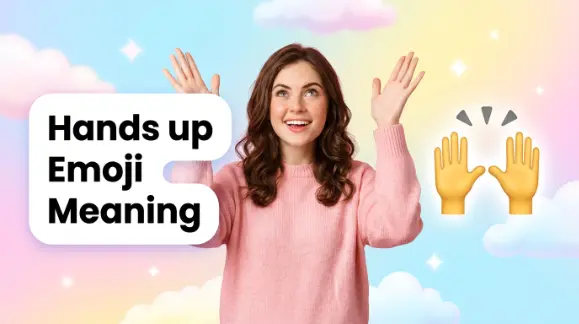
There’s something instantly expressive about raising your hands, and the 🙌 emoji captures that feeling in a quick, visual way. The hands up emoji is commonly used when someone wants to celebrate, show excitement, express gratitude, or say that they agree with something. Depending on the conversation, it can also represent relief, praise, or a cheerful “yes!” reaction.
If you’re trying to understand the hands up emoji meaning, the context matters. A friend might send 🙌 after hearing good news, while someone else could use it to celebrate an achievement or show appreciation. On social media, the emoji often appears in captions, comments, and replies when people want to add a positive or energetic feeling to their message.
In this guide, you’ll learn what 🙌 means in texting, WhatsApp, Instagram, and Snapchat. We’ll also explain what the hands up emoji means from a guy or girl, its meaning in different situations, and give simple examples of how people use it in everyday chats.
What Does the Hands Up Emoji 🙌 Mean?
The hands up emoji 🙌 generally represents celebration, excitement, praise, joy, gratitude, or agreement. It can be understood as someone raising their hands because they are happy about something or cheering for a positive moment.
For example:
“I finally passed my exam 🙌”
Here, 🙌 shows happiness and celebration.
Someone might also write:
“Thank God everything worked out 🙌”
In this case, the emoji expresses gratitude or relief.
The emoji can therefore communicate several closely related emotions:
- Celebration
- Excitement
- Happiness
- Praise
- Gratitude
- Support
- Agreement
- Relief
- Appreciation
- Positive energy
The exact meaning depends on the message and the relationship between the people communicating.
🙌 Hands Up Emoji Meaning in Texting
In texting, 🙌 is usually a positive emoji. People use it to make their messages sound more enthusiastic, friendly, and energetic.
For example:
“We won the game 🙌” means the person is celebrating the victory.
“That sounds perfect 🙌” can mean strong agreement or excitement.
“Made it home safely 🙌” can express relief and thankfulness.
“You did it! 🙌” shows encouragement and celebration.
Unlike a plain “okay” or “good,” adding 🙌 gives the message more emotional energy. It can make a short response feel warmer and more enthusiastic.
🙌 Emoji Meaning From a Girl
If a girl sends you 🙌, the meaning depends on the conversation rather than her gender.
She could use it to show:
- Excitement about your news
- Agreement with what you said
- Happiness about an event
- Support for your achievement
- Gratitude
- Relief after a difficult situation
For example:
You: “I finally got the job!”
Her: “Yesss 🙌”
Here, she is most likely celebrating your good news.
If she says:
“Thank goodness 🙌”
the emoji is more likely expressing relief or gratitude.
The emoji by itself does not prove romantic interest. Look at the surrounding conversation and her overall communication style instead.
🙌 Emoji Meaning From a Guy
When a guy sends 🙌, it generally carries the same basic meanings: celebration, agreement, excitement, praise, or support.
For example:
“Bro, we actually did it 🙌”
This expresses excitement and celebration.
Or:
“That’s exactly what I was thinking 🙌”
Here, the emoji emphasizes agreement.
Again, context matters more than the sender’s gender. A single emoji should not be treated as a reliable signal of someone’s romantic feelings.
🙌 Meaning From a Crush
When your crush sends 🙌, it can feel like there is a hidden message behind it. Usually, however, the emoji itself remains a positive but non-romantic signal.
Your crush might send:
“Can’t wait for Saturday 🙌”
That suggests excitement about the upcoming event.
Or:
“You got the tickets! 🙌”
That shows happiness or appreciation.
If you’re trying to understand whether a crush likes you, consider the complete conversation, including their words, effort, questions, and consistency. The 🙌 emoji alone does not establish romantic interest.
🙌 Meaning in a Relationship
Couples can use 🙌 to celebrate everyday wins, express happiness, or show appreciation.
For example:
“We finally finished decorating the apartment 🙌”
“Date night tonight 🙌❤️”
“You handled that situation so well 🙌”
In relationships, the emoji can add a playful and celebratory feeling to ordinary messages.
When combined with hearts or affectionate emojis, its emotional tone may become warmer. Still, the surrounding words provide the strongest clue.
🙌 Meaning on Social Media
On social media, 🙌 often appears in comments, captions, replies, and posts about positive events.
Someone might comment:
“This is amazing 🙌”
or:
“Congratulations 🙌”
It can also appear when people celebrate:
- Achievements
- Announcements
- Concerts
- Sports victories
- New jobs
- Graduations
- Personal milestones
- Inspirational messages
- Good news
Because social media conversations are often short, 🙌 can work as a quick way to show enthusiastic support.
🙌 Meaning on Instagram
On Instagram, the hands-up emoji is frequently used in captions and comments to create a celebratory or energetic tone.
For example:
“New chapter begins today 🙌”
This suggests excitement about a fresh start.
A comment such as:
“You absolutely killed it 🙌”
shows strong praise and encouragement.
It can also be paired with emojis such as 🎉, ❤️, 🔥, or ✨ to increase the celebratory feeling.
🙌 Meaning on Snapchat
On Snapchat, 🙌 can mean excitement, celebration, agreement, or support.
For example:
“Party tonight 🙌”
means the sender is excited.
“Finally Friday 🙌”
shows happiness about the weekend.
Because Snapchat messages are usually casual, the emoji often has a playful and energetic tone.
🙌 Meaning on TikTok
TikTok users commonly use 🙌 when reacting positively to videos, comments, trends, achievements, or relatable moments.
Examples include:
“This transition 🙌”
“Bro really did it 🙌”
“We need part 2 🙌”
In these situations, the emoji may communicate admiration, excitement, approval, or enthusiasm.
Its meaning is often shaped by internet slang and the tone of the comment.
Is 🙌 the Praise Hands Emoji?
Yes. 🙌 is commonly known as the raising hands emoji and is also informally called praise hands or celebration hands.
People sometimes use it to represent praise or worship, particularly in religious or spiritual conversations.
For example:
“God is good 🙌”
Here, the emoji can represent praise, gratitude, or worship.
However, it is not limited to religious contexts. Many people use 🙌 simply to celebrate something.
🙌 Hands Up Emoji vs. 🙏 Folded Hands Emoji
The 🙌 and 🙏 emojis can look similar in positive conversations, but their meanings are different.
| Emoji | Common meaning | Example |
| 🙌 | Celebration, praise, excitement, agreement | “We did it 🙌” |
| 🙏 | Prayer, gratitude, request, thanks | “Thank you so much 🙏” |
For example:
“I passed my exam 🙌” focuses on celebration.
“Please pray for me 🙏” focuses on prayer or a request.
There can be some overlap because both emojis may appear in messages about gratitude or faith.
🙌 Hands Up Emoji vs. 👏 Clapping Hands
The 🙌 and 👏 emojis can both show approval or celebration, but they have different visual ideas.
🙌 suggests raised hands, celebration, praise, or excitement.
👏 represents clapping and is often used to congratulate or applaud someone.
Compare:
“You passed the test 🙌”
This sounds excited and celebratory.
“Great presentation 👏”
This sounds like applause or recognition.
People can also combine them:
“Amazing work 🙌👏”
That creates a stronger feeling of praise and celebration.
🙌 Hands Up Emoji vs. 👐 Open Hands
The 👐 emoji shows open hands, while 🙌 shows raised hands.
| Emoji | Typical idea |
| 🙌 | Celebration, praise, excitement |
| 👐 | Openness, offering, affection, welcome |
For example:
“We won! 🙌”
is clearly celebratory.
Meanwhile:
“Sending you a big hug 👐”
uses open hands in a different way.
What Does 🙌 Mean From a Friend?
When a friend sends 🙌, it usually means they are happy, excited, supportive, or agreeing with you.
For example:
“We finally booked the trip 🙌”
Your friend is celebrating the plan.
Or:
“That’s such a good idea 🙌”
They are showing enthusiastic approval.
Among friends, 🙌 can make messages feel more energetic without adding many words.
What Does 🙌 Mean After Good News?
When someone sends 🙌 after good news, it almost always adds a positive emotional response.
For example:
“I got accepted into college 🙌”
Here, the emoji emphasizes celebration.
If another person replies:
“Congratulations 🙌”
they are celebrating your success with you.
The emoji can also communicate relief:
“The package finally arrived 🙌”
In this case, the sender may be happy that the problem is over.
What Does 🙌 Mean After “Thank You”?
When 🙌 appears after “thank you,” it can communicate appreciation, happiness, or relief.
For example:
“Thanks for helping me 🙌”
The sender is showing strong appreciation.
However, it does not necessarily mean anything romantic. It is generally a warm and positive response.
What Does 🙌 Mean in a Group Chat?
In a group chat, 🙌 is especially useful when several people are celebrating the same thing.
For example:
“Everyone is free Saturday!”
Someone might reply:
“🙌🙌🙌”
This means they are excited or happy about the plan.
A group might also use it after:
- Confirming plans
- Winning a competition
- Completing a project
- Making an announcement
- Reaching a goal
- Celebrating someone’s success
Multiple 🙌 emojis can intensify the excitement.
Can 🙌 Mean “Yes”?
Yes. In casual texting, 🙌 can sometimes mean yes, especially when the context involves agreement or excitement.
For example:
“Movie tonight?”
“Absolutely 🙌”
Here, the emoji reinforces the positive answer.
However, 🙌 does not literally translate to the word “yes.” The surrounding words determine whether it represents agreement.
Can 🙌 Mean “Hallelujah”?
In religious conversations, 🙌 can be used alongside expressions such as “Hallelujah,” “Praise God,” or “God is good.”
For example:
“Praise God for this blessing 🙌”
Here, the raised hands communicate praise and gratitude.
Outside religious contexts, though, the same emoji can simply mean celebration or excitement.
Does 🙌 Have a Negative Meaning?
The 🙌 emoji is overwhelmingly associated with positive emotions. It does not normally carry a negative meaning.
Still, people can use almost any emoji sarcastically.
For example:
“Another Monday morning 🙌”
Depending on the conversation, this could be genuine excitement or playful sarcasm.
Therefore, tone matters. If the surrounding message sounds frustrated or humorous, 🙌 might not be completely literal.
How to Use the 🙌 Emoji Correctly
You can use 🙌 naturally whenever you want to show celebration, praise, or enthusiastic support.
Use It for Celebration
“We finally finished the project 🙌”
Use It for Encouragement
“You worked hard for this. Congratulations 🙌”
Use It for Agreement
“That plan sounds perfect 🙌”
Use It for Gratitude
“Everything worked out in the end 🙌”
Use It for Good News
“I got the apartment! 🙌”
Use It in Religious Messages
“Praise God 🙌”
The best approach is simple: use 🙌 when you want your message to feel positive, energetic, and supportive.
🙌 Emoji Text Examples
Here are some natural examples you can use in everyday conversations:
| Situation | Example |
| Achievement | “I passed my exam 🙌” |
| New job | “I got the job 🙌” |
| Celebration | “We finally did it 🙌” |
| Agreement | “Exactly! 🙌” |
| Support | “Proud of you 🙌” |
| Good news | “That’s great news 🙌” |
| Relief | “Everything is okay now 🙌” |
| Gratitude | “Thank God 🙌” |
| Weekend excitement | “Friday is finally here 🙌” |
| Group plans | “Everyone can come 🙌” |
Why Do People Use 🙌 So Often?
One reason is that emojis communicate emotion quickly. A short text can sometimes sound flat without an emotional cue.
Compare:
“We won.”
with:
“We won 🙌”
The second version clearly sounds more excited.
Similarly:
“That’s great.”
can become:
“That’s great 🙌”
The emoji adds warmth and enthusiasm without requiring a longer sentence.
Is 🙌 Flirty?
Usually, 🙌 is not inherently flirty.
Someone can use it while flirting, but the emoji itself generally represents celebration, excitement, or praise rather than romance.
For example:
“Can’t wait to see you 🙌”
could be friendly or romantic depending on the relationship.
By contrast, emojis such as ❤️, 😘, 😍, or 🥰 are more commonly associated with affection or romantic feelings.
So, don’t interpret 🙌 alone as a flirting signal. Read the complete conversation.
What Does Two 🙌🙌 Mean?
Using two hands-up emojis together usually increases the intensity of the message.
For example:
“We did it 🙌🙌”
sounds more excited than simply:
“We did it 🙌”
People may use repeated emojis when they feel especially enthusiastic, especially in casual chats and social media comments.
What Does 🙌🙌🙌 Mean?
Three or more 🙌 emojis generally express very strong excitement, celebration, or support.
For example:
“YOU GOT THE JOB 🙌🙌🙌”
The repeated emojis make the message feel louder and more energetic.
This is common in informal conversations where people use emojis almost like visual cheering.
Common Mistakes When Using 🙌
Although 🙌 is easy to understand, context still matters.
Mistake 1: Assuming It Always Means Celebration
The emoji can also express gratitude, praise, agreement, or relief.
Mistake 2: Treating It as a Romantic Signal
🙌 does not automatically mean someone is flirting or interested in you.
Mistake 3: Confusing It With 🙏
The two emojis can overlap in religious or thankful messages, but 🙏 is more strongly associated with prayer, requests, and gratitude.
Mistake 4: Ignoring the Message
Never interpret an emoji completely by itself when the surrounding words are available.
For example, “Finally, it’s over 🙌” could express relief rather than celebration.
Quick Guide to the 🙌 Emoji Meaning
If you need a quick answer, use this guide:
| Context | Likely meaning |
| After good news | Celebration |
| After an achievement | Congratulations or excitement |
| After “thank you” | Appreciation |
| During religious talk | Praise or worship |
| During planning | Agreement or excitement |
| After stressful news ends | Relief |
| In social media comments | Support or approval |
| Between friends | Enthusiasm |
| From a crush | Positive reaction, not automatically romantic |
| Repeated 🙌🙌🙌 | Strong excitement |
Frequently Asked Questions
What does the 🙌 emoji mean?
The 🙌 emoji commonly means celebration, excitement, praise, gratitude, agreement, support, or relief. Its exact meaning depends on the context.
What does 🙌 mean in texting?
In texting, 🙌 usually adds positive energy to a message. It can show that someone is excited, happy, supportive, thankful, or celebrating.
Is 🙌 a religious emoji?
It can be used in religious conversations to represent praise or worship. However, it is also widely used in everyday conversations to express celebration and excitement.
What does 🙌 mean from a girl?
A girl may use 🙌 to show excitement, agreement, support, gratitude, or celebration. The emoji itself does not indicate romantic interest.
What does 🙌 mean from a guy?
A guy can use 🙌 to express enthusiasm, agreement, praise, celebration, or support. Its meaning depends on the message and situation.
Is 🙌 the same as 🙏?
No. 🙌 usually represents raised hands, celebration, praise, or excitement. 🙏 is commonly associated with prayer, gratitude, requests, or thanks.
Does 🙌 mean “yes”?
It can sometimes communicate enthusiastic agreement or “yes” in casual conversations, but it does not literally mean the word “yes.” Context determines the interpretation.
Conclusion
The hands up emoji meaning is mainly connected with celebration, excitement, praise, gratitude, agreement, and support. People use 🙌 when they want to show positive energy or celebrate a good moment.
Its meaning can shift slightly depending on where it appears. In texting, it may show excitement or agreement. In religious conversations, it can represent praise. On social media, it often works as a quick expression of approval or celebration.

I am David Wilson, a passionate writer dedicated to creating informative, engaging, and valuable content for readers. I enjoy researching different topics and sharing well-crafted articles that provide helpful insights, practical knowledge, and meaningful information. I am committed to maintaining high-quality writing standards with a focus on accuracy, clarity, and reader satisfaction.