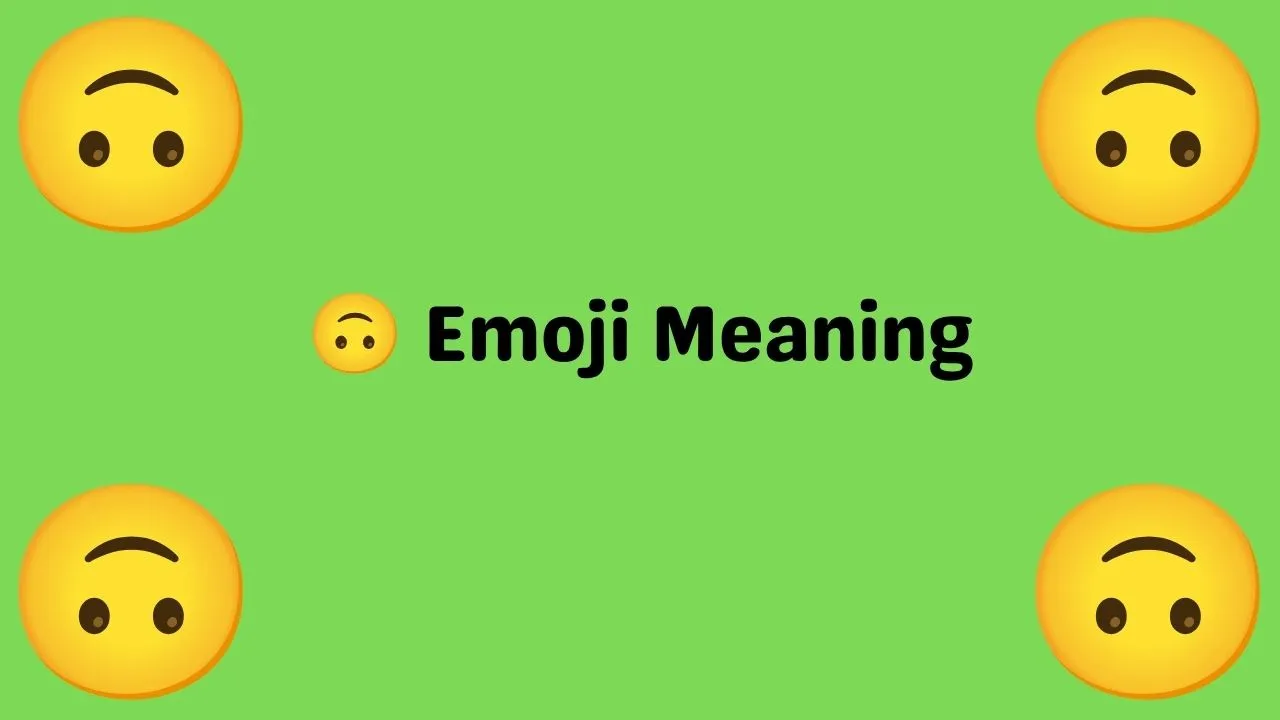
The 🙃 emoji, officially called the Upside-Down Face, is one of the most versatile and widely used symbols in digital conversations. At first glance, it looks like a regular yellow smiley turned completely upside down. That simple flip changes everything about how people interpret it.
In text messages, social media posts, and chats, this emoji helps express feelings that plain words often fail to capture. Tone is hard to convey in writing, and the 🙃 emoji steps in as a visual cue that something is not entirely straightforward.
People turn to it when they want to signal sarcasm, share a dry joke, admit awkwardness, or shrug off a frustrating situation with a forced smile. It has become a quiet favorite for anyone who has ever typed “everything is fine” while meaning the exact opposite.
What Does the 🙃 Emoji Actually Mean?
The official Unicode name is Upside-Down Face. Most platforms display it as a flipped version of the slightly smiling face 🙂. The smile remains, but the entire face is inverted, which creates an immediate sense of something being off-kilter.
Common meanings include:
- Sarcasm or irony
- Silliness and playfulness
- Mild frustration or resignation (“oh well”)
- Awkwardness or embarrassment
- Passive-aggressive politeness
- A general “this is ridiculous” reaction
Context almost always decides which meaning applies. A single 🙃 after a positive statement usually signals the opposite of the words. The same emoji after a self-deprecating comment often softens the admission and makes it feel lighter.
Origin and History of the Upside-Down Face Emoji
The 🙃 emoji was approved as part of Unicode 8.0 in 2015 and added to the Emoji 1.0 set the same year. However, an upside-down smiley had already appeared in Google’s Gmail emoji set as early as 2008.
Its design draws from earlier Japanese emoticons that depicted characters doing handstands or standing on their heads. Once smartphones made emojis mainstream, the flipped smile quickly found a permanent place in everyday messaging. Today it ranks among the most frequently used face emojis precisely because it fills a gap that a regular smile cannot.
Common Ways People Use the 🙃 Emoji
Sarcasm and Irony
This is the most popular use. Adding 🙃 tells the reader, “Do not take this literally.”
Examples:
- “Can’t wait for Monday morning meetings 🙃”
- “My phone battery lasts all day… said no one ever 🙃”
Silliness and Light Humor
When the goal is pure playfulness, the emoji works as a digital wink.
Examples:
- “I just tried to put on a hoodie while holding a full cup of coffee 🙃”
- “Professional adulting fails for $200 🙃”
Frustration or Forced Positivity
People use it to smile through inconvenience without sounding overly dramatic.
Examples:
- “Spilled coffee on my only clean shirt right before the call 🙃”
- “The meeting that was supposed to be 15 minutes is now at one hour 🙃”
Awkwardness or Embarrassment
It softens uncomfortable admissions.
Examples:
- “Just waved at a stranger who looked like someone I know 🙃”
- “Sent that message to the wrong group chat 🙃”
Passive-Aggressive Tone
A lone 🙃 can replace a longer complaint when someone wants to stay polite on the surface.
Example:
- Friend cancels plans last minute → “No problem at all 🙃”
How the 🙃 Emoji Differs from Similar Faces
| Emoji | Typical Tone | Key Difference from 🙃 |
| 🙂 Slightly Smiling Face | Polite, neutral, or slightly forced | Usually more sincere or reserved |
| 😏 Smirking Face | Smug, flirtatious, or knowing | Suggests confidence or secret knowledge |
| 😬 Grimacing Face | Visible discomfort or cringe | More open about awkwardness |
| 🤷 Person Shrugging | “I don’t know / whatever” | Focuses on uncertainty rather than inverted emotion |
| 😅 Grinning Face with Sweat | Nervous relief or mild embarrassment | Shows effort or tension more clearly |
The 🙃 stands out because the physical inversion itself creates the ironic effect. The smile is still there, just turned the wrong way.
Tips for Using the 🙃 Emoji Effectively
- Pair it with the statement it modifies. Placing it at the end of a sentence usually works best.
- Watch the conversation tone. In professional settings it can come across as unprofessional if overused.
- Combine it with other emojis when you want extra clarity: “Running late again 🙃🏃♂️”
- Avoid stacking too many. One well-placed 🙃 is stronger than three.
- Remember that different platforms render the design slightly differently, but the meaning stays consistent.
Frequently Asked Questions (FAQs)
What does the 🙃 emoji mean from a girl?
It usually signals sarcasm, mild annoyance, or playful irony. Context and the rest of the message matter more than gender. A 🙃 after “I’m fine” often means the opposite.
Is the upside-down face emoji passive-aggressive?
It can be. When used alone or after a polite statement, many people read it as passive-aggressive. Used with clear joking language, it stays light.
What is the difference between 🙂 and 🙃?
🙂 is a regular slight smile that can feel polite or reserved. 🙃 flips that smile, adding irony, silliness, or hidden frustration.
When should I use the 🙃 emoji?
Use it when you want to show you are not completely serious, when something feels absurd, or when you are smiling through a minor inconvenience.
Does the 🙃 emoji mean the same thing on all platforms?
Yes. While the exact artwork varies slightly between Apple, Google, Samsung, and others, the intended meaning remains consistent.
Can the 🙃 emoji be flirty?
Sometimes. In a teasing or self-deprecating context it can feel playful and light. It is less direct than a wink or heart emoji.
Why do people use 🙃 so much?
It solves a real communication problem. Written text lacks vocal tone, and this emoji efficiently signals that the message should be read with a grain of salt or a sense of humor.
Conclusion
The 🙃 emoji meaning centers on inversion of a smile, of expectations, and often of the literal words that come before it. Whether someone is being sarcastic, silly, resigned, or mildly frustrated, this simple flipped face gets the point across without needing extra explanation.
Next time you see or send a 🙃, pay attention to the surrounding words and the overall conversation. That context turns a single yellow face into a surprisingly precise tool for modern digital expression.

I am Daniel Harris, a passionate writer and content creator dedicated to sharing valuable, informative, and engaging articles with readers. I am focused on researching topics deeply and presenting ideas in a simple, clear, and helpful way. I am passionate about delivering accurate information that helps people learn, grow, and make better decisions.