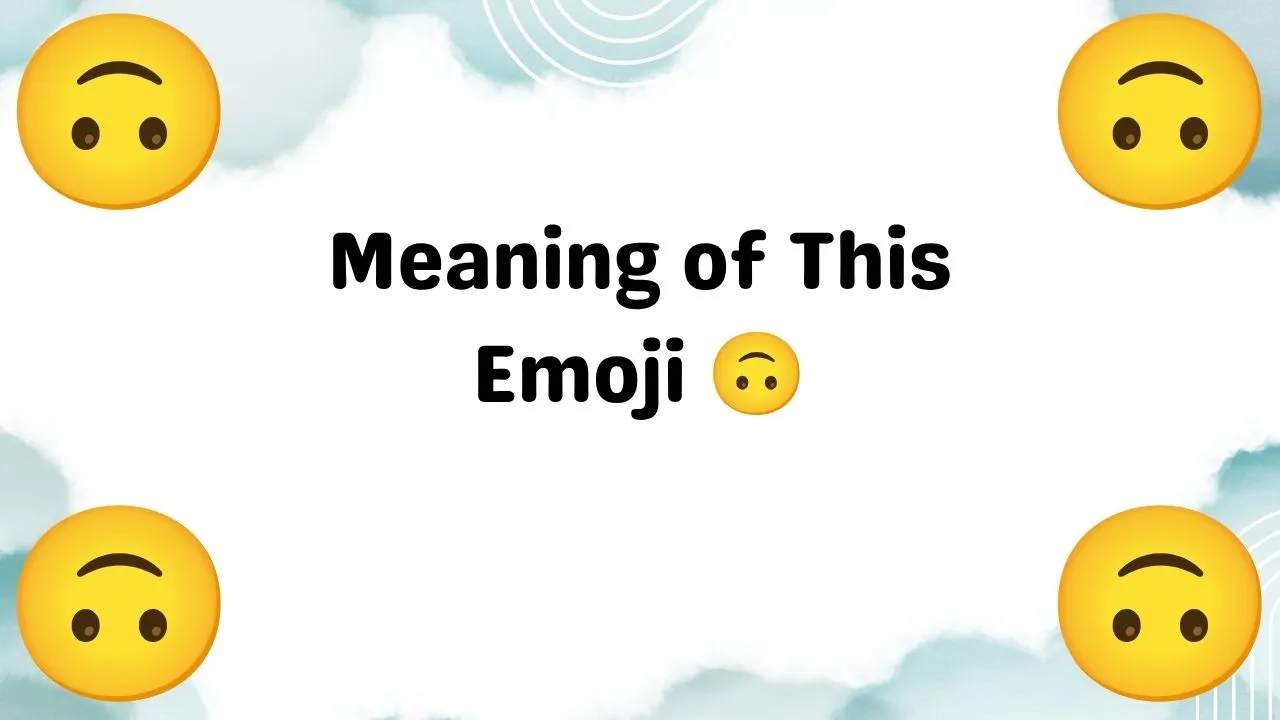
You’ve seen it pop up in texts, group chats, and social media captions: that yellow face smiling from the wrong way up. The 🙃 emoji looks cheerful at first glance, but its flipped orientation changes everything.
People reach for it when regular smileys feel too straightforward or when words alone can’t quite capture the mood. In digital conversations, tone is easy to miss. A simple “great” can sound genuine or sarcastic depending on the day.
The upside-down face steps in as a quick visual cue that softens, twists, or undercuts the message. It helps the sender say, “I’m joking,” “this is awkward,” or “I’m smiling through it,” without typing extra explanation.
What Does the 🙃 Emoji Mean?
The official name is Upside-Down Face. Unicode added it in 2015 as part of Unicode 8.0. On most platforms it looks like a classic yellow smiley turned completely upside down, same slight smile as the 🙂 emoji, just inverted.
Its core job is to signal that the accompanying text should not be taken completely at face value. The inversion itself creates a visual mismatch: the face is smiling, yet something about the situation feels off, silly, or ironic. That mismatch is what gives the emoji its flexible power.
Common associations include:
- Sarcasm or irony
- Playful silliness
- Mild frustration or resignation
- Awkwardness or self-deprecation
- A light “oh well” attitude
It rarely expresses pure joy or pure anger. Instead it sits in the middle, cheerful on the surface, complicated underneath.
Common Ways People Use the 🙃 Emoji
Sarcasm and Irony
This is the most frequent use. Adding 🙃 after a positive statement often means the opposite.
Examples:
- “Another Monday morning meeting. Love that for me 🙃”
- “Sure, because everything always goes exactly according to plan 🙃”
The emoji acts like a digital eye-roll without the hostility of stronger symbols.
Playfulness and Silliness
When the mood is light, 🙃 simply says “I’m being goofy.” It softens jokes and keeps the conversation fun.
Examples:
- “I just spent ten minutes looking for my glasses… while wearing them 🙃”
- “Forgot my own birthday until the reminders started 🙃”
Awkward or Embarrassing Moments
People use it after sharing something mildly uncomfortable to show they can laugh at themselves.
Examples:
- “Walked into the wrong Zoom meeting and stayed for five minutes 🙃”
- “Called my teacher ‘Mom’ again 🙃”
Resigned Frustration
Sometimes the emoji carries a quiet “what can you do?” energy. It acknowledges inconvenience without full complaint.
Examples:
- “They moved the deadline up again 🙃”
- “Phone battery dies the second I leave the house 🙃”
Flirty or Teasing Tone
In casual or romantic chats, 🙃 can add a mischievous edge. It turns a compliment or jab into something playful rather than serious.
Example:
- “You’re impossible, you know that? 🙃”
How the Meaning Changes With Context
Context decides almost everything. The same emoji can feel friendly or slightly sharp depending on the conversation history and relationship.
- With close friends it usually lands as humor.
- In work chats it can signal polite frustration.
- After bad news it often means “I’m managing, somehow.”
- Paired with other emojis (😂, 😅, 🤷) it leans more lighthearted.
- Alone after a short reply it can feel passive-aggressive.
Pay attention to the full message and the person sending it. The upside-down face rarely stands alone in meaning.
Tips for Using the 🙃 Emoji Effectively
- Match it to the tone you want. If you mean pure sarcasm, the surrounding words should support it.
- Avoid overusing it in professional settings where clarity matters more than irony.
- Combine it with clear text when the situation is sensitive, don’t rely on the emoji alone.
- Notice how friends and colleagues already use it; mirroring their style reduces misreads.
- Remember that platform designs vary slightly, but the upside-down concept stays consistent.
Frequently Asked Questions (FAQs)
What is the official name of the 🙃 emoji?
It is called Upside-Down Face. It was approved in Unicode 8.0 in 2015.
Is 🙃 the same as a regular smiley?
No. Visually it is a flipped version of the slightly smiling face 🙂. The flip creates the ironic or silly effect that the upright version lacks.
Does 🙃 always mean sarcasm?
Not always. While sarcasm is common, it also covers silliness, awkwardness, mild frustration, and playful teasing. Context decides the exact shade.
Can 🙃 be passive-aggressive?
Yes. When used after short or overly polite replies, it can carry a quiet edge of annoyance or resignation. Tone and relationship still matter.
What does 🙃 mean from a girl or guy?
The meaning is the same regardless of gender. It depends on the conversation, not the sender’s identity. Look at the full message for clues.
Is it okay to use 🙃 at work?
In casual team chats it can lighten the mood. In formal emails or with people you don’t know well, clearer language is safer.
How is 🙃 different from 😏 or 🤷?
😏 often feels more suggestive or knowing. 🤷 shows pure uncertainty or indifference. 🙃 specifically mixes a smile with inversion, creating that unique “smiling through it” or “just kidding” vibe.
Conclusion
The meaning of this emoji 🙃 centers on inversion, taking a normal smile and flipping it to show that something feels off, funny, ironic, or awkwardly accepted. It helps people add tone to text messages that would otherwise sound flat or too serious.
Whether it signals sarcasm, silliness, quiet frustration, or light teasing depends almost entirely on the surrounding words and the relationship between the people chatting. Once you understand that range, the emoji becomes a useful tool rather than a puzzle.

I am David Wilson, a passionate writer dedicated to creating informative, engaging, and valuable content for readers. I enjoy researching different topics and sharing well-crafted articles that provide helpful insights, practical knowledge, and meaningful information. I am committed to maintaining high-quality writing standards with a focus on accuracy, clarity, and reader satisfaction.