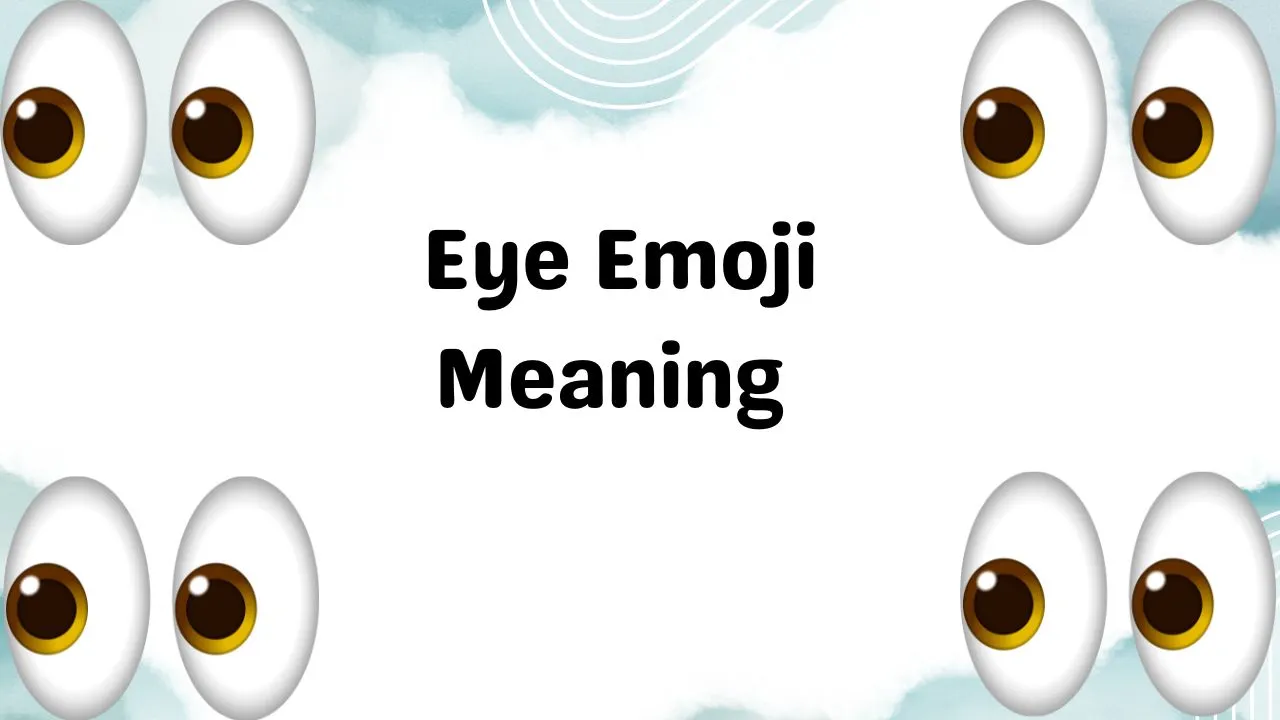
Ever wondered what the 👀 Eye Emoji really means when someone sends it in a text? The Eye Emoji is one of those simple symbols that can express much more than just “seeing” something.
Depending on the conversation, it can show curiosity, attention, surprise, suspicion, attraction, or even a playful hint that someone is watching closely.
You might see it in a flirty message, a funny conversation, a social media comment, or when someone wants to draw attention to something interesting. But what does 👀 actually mean from a girl or a guy, and how can you tell what they intended?
What Is the Eye Emoji? A Quick Overview
The eye emoji (👀) typically displays as two wide, cartoonish eyes looking either straight ahead or slightly off to the side, depending on the platform. It’s officially part of the Unicode Standard, and it’s technically categorized as “eyes” rather than a single eye , even though many people casually refer to it as “the eye emoji.”
There’s also a single eye emoji (👁️), which is a different symbol entirely and tends to carry more mysterious, symbolic, or even conspiratorial connotations (think “the all-seeing eye”). For this guide, we’re focusing primarily on the double-eye version, since it’s the one that dominates everyday texting and social media.
At its core, the eye emoji is a visual shorthand for attention. It’s the digital equivalent of raising your eyebrows, glancing sideways, or leaning in to whisper “wait, what?” It doesn’t come with a built-in tone, which is exactly why it’s so flexible , and exactly why it can be so confusing.
The Core Eye Emoji Meaning: Attention, Curiosity, and Surveillance
If you strip away all the slang and context, the fundamental eye emoji meaning boils down to one simple idea: someone is paying attention.
That attention can take a few different emotional shapes:
- Curiosity , “Ooh, tell me more.”
- Suspicion , “I’m keeping an eye on this.”
- Awareness , “I saw that.”
- Anticipation , “I’m watching this unfold.”
Because the emoji itself is emotionally neutral (it’s not smiling, frowning, or winking), the actual meaning depends heavily on the conversation it’s dropped into. This is what linguists call “context-dependent meaning” , the symbol borrows its emotional tone from the words, timing, and relationship around it, rather than carrying one fixed definition.
Why This Emoji Became So Popular
The eye emoji exploded in popularity alongside the rise of meme culture and internet slang around the mid-2010s, particularly on Twitter and later TikTok. It became a favorite reaction for:
- Gossip and drama unfolding in real time
- Subtweeting or vague-posting situations
- Building suspense in group chats
- Reacting to something scandalous without typing a full sentence
Its popularity comes from its efficiency. Instead of typing “I am watching this situation closely and I have thoughts,” you just send 👀 and everyone instantly gets the vibe.
Common Eye Emoji Meanings by Context
Since context shapes everything, let’s break down the most common ways people use the eye emoji across different types of conversations.
1. “I’m Watching” or “I See This”
This is the most literal and widely understood use. Someone posts something interesting, controversial, or juicy, and you reply with 👀 to signal that you noticed and you’re paying close attention.
Example: Your friend posts a cryptic Instagram story that says “big news coming soon.” You comment 👀 to say, “I see you, and I’m intrigued.”
2. “Spill the Tea” or Gossip Alert
In group chats, the eye emoji often functions as a gossip trigger. It signals excitement or nosiness about a juicy update.
Example: Someone types “guess who I saw on a date last night 👀” , here, the emoji builds suspense and invites questions.
3. Flirtation or Playful Interest
In DMs or dating apps, 👀 can carry a flirty undertone, especially when paired with a compliment or a suggestive comment. It softens the message, adding a playful “I noticed you” energy without being overly direct.
Example: “That gym pic though 👀” implies admiration in a lighthearted, non-committal way.
4. Suspicion or Side-Eye
Sometimes the eye emoji leans skeptical, functioning almost like a digital side-eye. It suggests doubt, disbelief, or a “hmm, really?” reaction.
Example: “You said you were busy all weekend but I saw your location tag at the concert 👀”
5. Anticipation or Excitement for an Announcement
Brands, influencers, and everyday users use the eye emoji to build hype before a reveal.
Example: “Something big is dropping tomorrow 👀 stay tuned.”
6. A Warning or “Watch Out”
Occasionally, the emoji is used more cautiously , as a subtle heads-up that something is off or worth being careful about.
Example: “That email looks kind of sketchy 👀 don’t click the link.”
Eye Emoji Meaning on Different Platforms
The eye emoji doesn’t behave the same way everywhere. Platform culture shapes its tone significantly.
On Twitter/X
This is arguably the emoji’s home turf. It’s the go-to reaction for drama threads, quote-tweets, and screenshots of messy situations. A single 👀 as a quote-tweet caption is basically internet shorthand for “this is about to be a whole thing.”
On Instagram
Commonly used under photos as a playful compliment, or in Stories replies to react to something intriguing without writing a full sentence.
On TikTok
Frequently appears in comment sections reacting to plot twists, reveals, or unexpected moments in videos , especially storytime content or “part 2” teasers.
On Snapchat and Texting
Tends to lean more personal and flirty here, often used one-on-one rather than in public posts, since private messaging naturally shifts the tone toward something more intimate.
In Professional or Work Chats
Even in workplace Slack channels, 👀 has carved out a niche meaning: “noted” or “I’ve seen this and I’m reviewing it.” It’s become a lightweight, non-committal way to acknowledge a message without writing a full reply.
Eye Emoji Combinations and What They Add
Pairing the eye emoji with other emojis or text changes its meaning quite a bit. Here are some popular combinations:
- 👀 + 🍵 (tea) , Strongly signals gossip or drama (“watching the tea unfold”)
- 👀 + 😳 (flushed face) , Adds shock or embarrassment to the attention
- 👀 + 🔥 (fire) , Signals impressed admiration, often used flirtatiously
- 👀 + 👉👈 (fingers touching) , Suggests shy or nervous interest
- 👀 + ⚠️ (warning sign) , Emphasizes caution or suspicion
- 👀 alone, repeated (👀👀👀) , Amplifies urgency or intense curiosity, almost like saying “wait, WHAT?”
How to Respond When Someone Sends You the Eye Emoji
Getting a solo 👀 in your DMs can feel like a mini puzzle. Here’s how to think through a reply based on context:
- Consider the relationship. A 👀 from your best friend probably means gossip. A 👀 from a crush might mean flirtation.
- Look at the last message sent. Emoji meaning almost always builds on whatever was just said.
- Match the energy. If it feels playful, respond playfully. If it feels serious or cautious, ask a direct follow-up question.
- When in doubt, ask. A simple “lol what do you mean 👀” is a totally normal and safe response.
Real-Life Examples of the Eye Emoji in Action
To really nail down the eye emoji meaning, it helps to see it in realistic scenarios:
- Group chat drama: “So apparently they broke up… 👀” , signals gossip and invites more questions.
- Dating app opener: “Your travel photos 👀 where was this one taken?” , a low-pressure way to show interest.
- Social media caption: “New project coming soon 👀” , builds anticipation for a reveal.
- Work Slack message: “Sent over the report, let me know your thoughts 👀” , a casual nudge for feedback.
- Friend teasing another friend: “Someone’s been quiet about their weekend plans 👀” , playful suspicion.
Each of these examples uses the same two little eyeballs, yet the emotional tone shifts completely based on the surrounding words and relationship.
Tips for Using the Eye Emoji Effectively
If you want to use the eye emoji like a native digital speaker (rather than accidentally sending mixed signals), keep these tips in mind:
- Don’t send it completely out of context unless you want to spark confusion or intrigue on purpose.
- Pair it with a short phrase if you want to reduce ambiguity , “interesting 👀” reads very differently than a lone 👀.
- Be mindful of tone in professional settings. While it’s becoming common in casual workplace chats, it can come across as unclear or even passive-aggressive in more formal communication.
- Use it sparingly for maximum impact. Overusing 👀 in every message dilutes its “attention-grabbing” power.
- Read the room before flirting with it. In romantic contexts, the eye emoji works best when there’s already some established chemistry or ongoing banter.
Why Emoji Meanings Shift Over Time
It’s worth noting that emoji meanings, including the eye emoji meaning, are not fixed forever. Emoji culture evolves constantly, shaped by internet trends, viral moments, and generational shifts in slang. What the eye emoji signals to a Gen Z TikTok user might land slightly differently for a millennial on Facebook, and workplace norms continue to shift as digital communication becomes more casual across generations. Staying aware of these subtle shifts helps you avoid sending , or misreading , the wrong signal.
Conclusion:
At the end of the day, the eye emoji meaning isn’t one single, fixed definition , it’s a flexible tool for signaling attention, curiosity, suspicion, or playful interest, depending entirely on context. Whether it’s dropped into a gossip-filled group chat, a flirty DM, a hype-building social media caption, or even a low-key work Slack message, those two little eyes always mean the same underlying thing: someone noticed, and they want you to know it.
The next time you see a lone 👀 pop up in your notifications, take a beat, look at the conversation around it, and you’ll almost always be able to decode exactly what your friend, date, or coworker is trying to say. And if you’re still not sure? There’s no shame in just asking. That’s what the eye emoji is there for in the first place , to spark curiosity and get the conversation going.
Frequently Asked Questions
1. What does it mean when a girl sends the eye emoji? It usually signals interest, curiosity, or playful flirtation, especially if it follows a compliment or a photo. Context and the existing dynamic between you two matter a lot here.
2. What does the eye emoji mean on Snapchat? On Snapchat, it often carries a flirty or personal tone since conversations there tend to be more private and casual compared to public platforms.
3. Is the eye emoji flirty or just casual? It can be either. Alone, it’s fairly neutral, but paired with compliments, fire emojis, or playful text, it often takes on a flirtatious meaning.
4. What’s the difference between 👀 and 👁️? 👀 shows two eyes and typically signals attention or curiosity in everyday conversation, while 👁️ is a single eye often used symbolically or mysteriously, sometimes referencing themes like awareness or surveillance.
5. What does it mean when someone replies with just the eye emoji? It generally means they noticed something noteworthy and want more information or context, without committing to a full written response.
6. Is it rude to only respond with the eye emoji? Not typically , it’s widely understood as a casual, low-effort way to react. However, in formal or professional settings, a follow-up message may be clearer.
7. What does the eye emoji mean in a work chat? In professional messaging apps like Slack, it usually means “noted” or “I’ve seen this and I’m looking into it,” functioning as a quick acknowledgment.

I am David Wilson, a passionate writer dedicated to creating informative, engaging, and valuable content for readers. I enjoy researching different topics and sharing well-crafted articles that provide helpful insights, practical knowledge, and meaningful information. I am committed to maintaining high-quality writing standards with a focus on accuracy, clarity, and reader satisfaction.