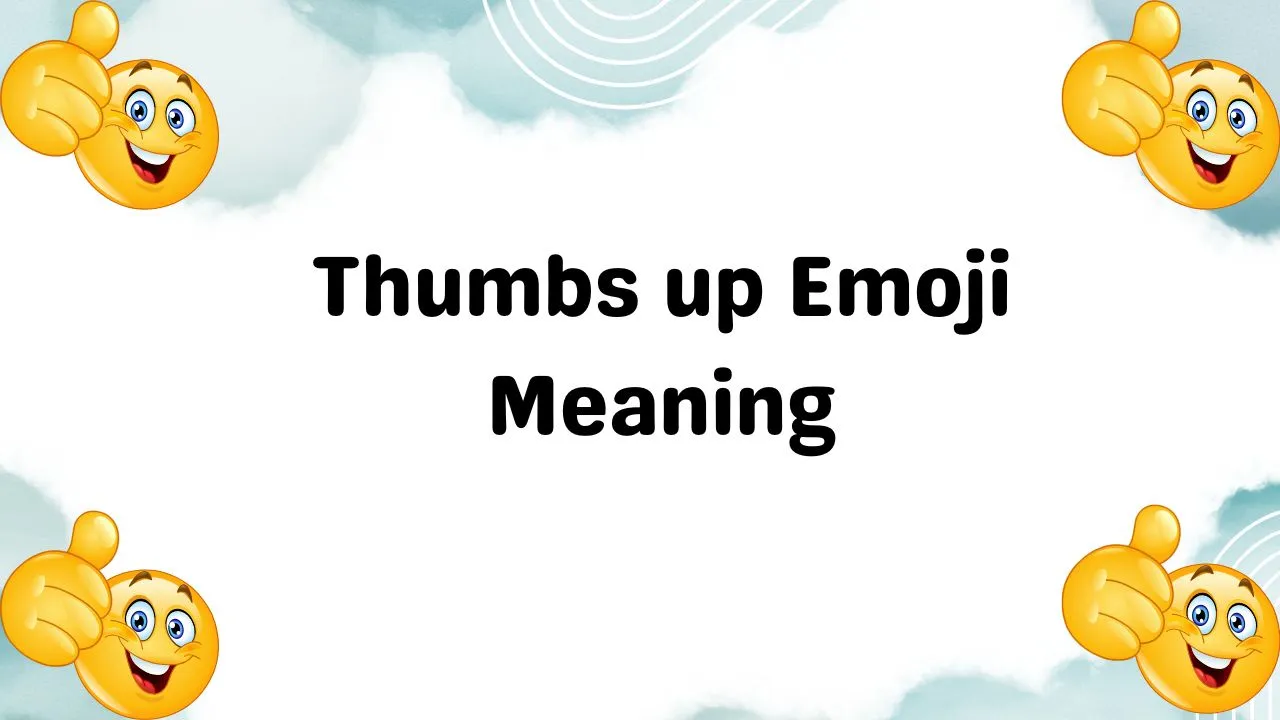
The 👍 Thumbs Up emoji is one of the most popular and versatile emojis used in everyday digital conversations. At first glance, it simply looks like a hand showing approval, but its meaning can change depending on the conversation, relationship, and tone.
People often use the Thumbs Up emoji to say “okay,” “yes,” “good job,” “I agree,” or “sounds good” without typing a full sentence. However, in some situations, a simple 👍 can feel friendly and supportive, while in others, it may seem short, cold, sarcastic, or even dismissive.
So, what does the Thumbs Up emoji really mean in texting, and how can you tell what someone intends when they send it?
What Does the Thumbs Up Emoji Actually Mean?
In most Western countries and online spaces, the thumbs up emoji 👍 stands for approval, agreement, or encouragement. It functions as a digital version of the physical hand gesture: “Yes,” “OK,” “Got it,” or “Nice work.”
Common everyday uses include:
- Confirming plans (“Meet at 7?” → 👍)
- Acknowledging a message without needing a full reply
- Showing support for someone’s achievement or post
- Expressing that something looks good or works well
- Giving a quick positive reaction in group chats or comments
It often replaces short phrases like “sounds good,” “will do,” or “thanks.” On platforms such as Facebook, Instagram, Slack, and Microsoft Teams, the thumbs-up reaction has become one of the most common ways to engage with content.
When a Thumbs Up Feels Different
Tone and context matter. A single 👍 after a long, thoughtful message can sometimes read as low-effort or dismissive, especially among younger users who prefer more expressive replies. In some workplace or personal conversations, people interpret it as passive-aggressive, similar to a curt “fine” or “whatever.”
Sarcasm is also possible. Someone might send “Great job breaking the printer 👍” to highlight frustration rather than genuine praise. Reading the surrounding messages usually makes the intended meaning clear.
History of the Thumbs Up Gesture and Emoji
The physical thumbs-up gesture has a complicated past. Many people link it to ancient Rome and the phrase pollice verso (“with a turned thumb”), used during gladiator contests. Historical records are unclear about the exact gesture and its meaning. Some scholars suggest an upward thumb signaled death while a closed fist meant mercy; popular culture later flipped the modern understanding.
The positive meaning familiar today grew stronger in the 20th century. British and American soldiers used the thumbs-up during World War I and II to signal that everything was fine or ready. Early aviation crews also adopted it as a pre-flight “all clear.”
The emoji itself arrived later. Unicode introduced the Thumbs Up Sign (U+1F44D) in 2010 as part of Unicode 6.0. Skin-tone variations followed in 2015, letting users choose from a range of hand colors. Platforms then standardized the design, most show a yellow hand with the thumb pointing upward and fingers curled into a fist.
Facebook’s “Like” button, launched in 2009, helped cement the thumbs-up as the default symbol of digital approval long before the emoji became widespread.
Cultural Differences: When Thumbs Up Can Be Offensive
While 👍 is positive in the United States, Canada, the UK, and much of Europe, it carries very different weight in other regions.
In parts of the Middle East (including Iran, Iraq, and Afghanistan), as well as some areas of West Africa and Greece, the thumbs-up gesture has traditionally been considered rude, roughly equivalent to raising the middle finger. Globalization and social media have softened this interpretation for many younger people, but older generations or formal situations may still view it as disrespectful.
Other notes:
- In some South Asian contexts, an upward thumb can signal that someone is illiterate.
- In certain sports or diving communities, the gesture simply means “going up” or indicates the number one.
When communicating internationally, it is safer to pair the emoji with clear words or choose a different positive reaction if you are unsure of the recipient’s cultural background.
How People Use the Thumbs Up Emoji in Daily Communication
Here are practical ways the emoji appears in real conversations:
Quick confirmation
“I’ll send the file by 3.”
“👍”
Encouragement
“Just finished my first 5K!”
“Amazing run 👍”
Group decisions
“Does 6 pm work for everyone?”
Several people react with 👍
Social media reactions
Users click the thumbs-up button or reply with the emoji to show they like a post without writing a comment.
Workplace chats
Many teams treat 👍 as an official “I acknowledge this” or “I approve this task.”
Skin-tone variants (👍🏻 👍🏼 👍🏽 👍🏾 👍🏿) let people match their own appearance or simply prefer a different look. Some users choose a specific tone for subtle personalization; others stick with the default yellow.
Legal and Professional Side Notes
In 2023–2024 a Canadian court case examined whether a thumbs-up emoji could form part of a binding contract. A farmer replied to a grain contract message with 👍. The court ultimately treated the emoji, in that specific context and conversation history, as an expression of agreement. The ruling highlighted that digital symbols can carry legal weight when surrounding circumstances support that interpretation.
In professional settings, the emoji works well for light acknowledgment. For important decisions, many people still prefer clear written confirmation alongside or instead of the emoji.
Tips for Using the Thumbs Up Emoji Effectively
- Match the tone of the conversation. After emotional or detailed messages, a short sentence plus 👍 often feels warmer than the emoji alone.
- In international chats, consider adding a clarifying word (“Sounds good 👍”) so the positive intent is unmistakable.
- Avoid overusing it in long threads if you want to keep the conversation active.
- On social media, a thumbs-up reaction is usually safer and clearer than leaving no reaction at all.
- If someone sends you a 👍 that feels abrupt, it is often simplest to take it at face value rather than assume negativity.
Frequently Asked Questions (FAQs)
What does the thumbs up emoji mean in texting?
It most often means “OK,” “agreed,” “got it,” or “sounds good.” Context can shift it toward encouragement or, less commonly, mild sarcasm.
Is the thumbs up emoji rude?
In most Western digital spaces it is friendly. In some Middle Eastern, West African, and Mediterranean cultures the underlying gesture can still be seen as offensive.
Why do some people think the thumbs up is passive-aggressive?
Younger users sometimes view a lone 👍 after a longer message as low-effort or dismissive. The surrounding conversation usually clarifies intent.
When was the thumbs up emoji added?
Unicode introduced it in 2010. Skin-tone options arrived in 2015.
Can a thumbs up emoji be legally binding?
Courts have considered it as possible evidence of agreement when the full context of the conversation supports that reading, as shown in a Canadian contract dispute.
What is the difference between 👍 and 👎?
👍 signals approval or positivity. 👎 signals disapproval, rejection, or a negative reaction.
How should I reply to a thumbs up emoji?
Often no reply is needed. If the conversation continues, a simple “Thanks” or continuing the discussion works well. Matching with another 👍 is also common.
Conclusion
The thumbs up emoji 👍 remains one of the simplest and most widely recognized ways to show approval, agreement, or acknowledgment online. Its core meaning stays positive in the majority of digital conversations, yet culture, generation, and context can change how it lands.
Knowing these layers helps you send clearer messages and read others more accurately. Use it freely for quick confirmations and encouragement, stay mindful of cultural differences, and pair it with words when the situation calls for extra clarity.

I am Ethan Carter, a passionate writer dedicated to creating informative, engaging, and valuable content for readers around the world. I focus on delivering well-researched articles that provide clear insights, practical tips, and helpful solutions. With a strong interest in exploring new ideas and sharing knowledge, I aim to make every piece of content easy to understand and useful for my audience.