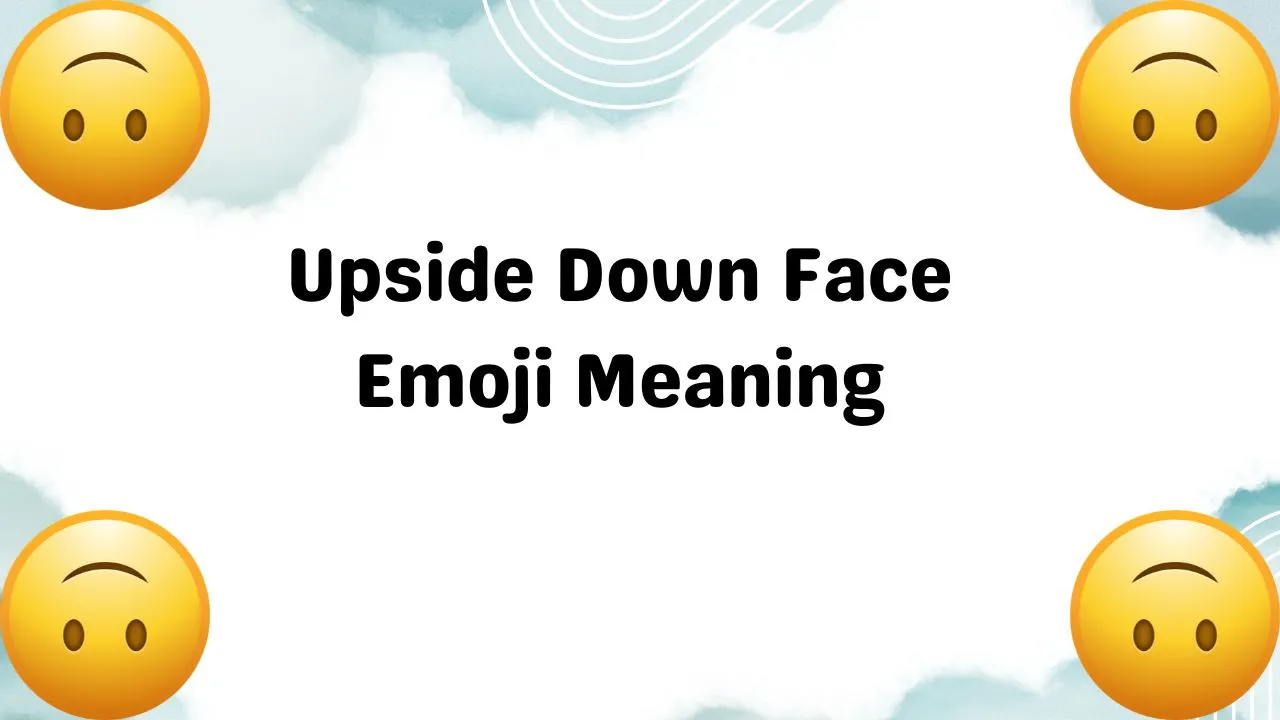
The Upside Down Face Emoji 🙃 is one of the most interesting emojis because its meaning can change dramatically depending on the situation.
It is often used to express sarcasm, irony, awkwardness, silliness, hidden frustration, or a playful reaction when words alone are not enough.
Sometimes, 🙃 can mean “I’m okay” even when everything is clearly going wrong, while in other conversations it may simply add a funny or teasing tone to a message. The exact meaning also depends on who sends it and the context of the conversation.
What Does the Upside Down Face Emoji Actually Mean?
The official Unicode name is “Upside-Down Face.” It was added in 2015 as part of Unicode 8.0 and Emoji 1.0. On most phones and apps it appears as a yellow face with a gentle smile, simply rotated 180 degrees from the slightly smiling face 🙂.
Unlike a grinning face or a frowning face, this emoji does not carry one fixed emotion. Its power comes from the inversion itself. Flipping a smile creates instant ambiguity, which is why people use it for tones that are hard to express with plain text.
Core Meanings People Use Most Often
- Sarcasm and irony , The most frequent use. Adding 🙃 tells the reader the previous words should not be taken at face value.
Example: “Another meeting that could have been an email 🙃” - Playful silliness or goofiness , A lighter, more cheerful reading. It signals that the sender is joking around or leaning into absurdity.
Example: “I just spent ten minutes looking for my phone while talking on it 🙃” - Mild frustration or resigned acceptance , The digital version of “oh well” or “this is fine.” It shows the person is annoyed or overwhelmed but choosing not to escalate.
Example: “They moved the deadline again 🙃” - Awkwardness or embarrassment , Softens a self-own or an uncomfortable moment.
Example: “Accidentally replied-all to the whole company 🙃” - Passive-aggressive undertone , Sometimes the smile feels forced. The emoji can carry a quiet “I’m smiling but I’m not okay” energy, especially when used alone or with minimal text.
Because the emoji sits between positive and negative, its exact shade depends heavily on the surrounding message and the relationship between the people texting.
How People Use the 🙃 Emoji in Everyday Conversation
In Casual Texts and Group Chats
Friends often drop 🙃 after sharing a minor disaster or a ridiculous story. It keeps the mood light while still acknowledging that something went sideways. A single 🙃 as a reply can also mean “I see the chaos and I’m choosing to laugh about it.”
On Social Media Captions
Instagram and TikTok captions frequently pair the emoji with self-deprecating humor or ironic commentary. It works especially well after a photo that looks put-together but the story behind it is messy.
In Flirting and Dating Chats
Some people use 🙃 to keep attraction playful and low-pressure. It can signal teasing or mild mischief without sounding overly intense. Tone still matters, paired with the right words it feels flirty; used after a blunt comment it can feel dismissive.
At Work (Use With Caution)
In professional settings the emoji is riskier. A light 🙃 after “I’ll get that report to you by end of day” can read as friendly. The same emoji after “Sure, I can take on another project” may come across as sarcastic. Many people save it for closer colleagues or avoid it in formal threads.
Upside Down Face vs. Similar Emojis
| Emoji | Common Tone | How It Differs from 🙃 |
| 🙂 Slightly smiling face | Polite, neutral, or mildly positive | Looks almost identical but right-side up; usually sincere or polite |
| 😏 Smirking face | Suggestive, knowing, or slightly smug | More deliberate and often flirtatious or self-satisfied |
| 😅 Grinning face with sweat | Nervous laughter or relief | Explicitly shows awkwardness or tension through the sweat drop |
| 🤷 Person shrugging | “I don’t know / what can you do?” | More explicit resignation; 🙃 is subtler and smile-based |
| 🫠 Melting face | Overwhelm or “I’m done” | Stronger sense of dissolving under pressure |
The upside-down face sits in a unique middle ground: it keeps the smile while flipping the emotional orientation.
Tips for Reading and Using the Emoji Well
- Look at the full message, not just the emoji. A cheerful sentence plus 🙃 usually means sarcasm. A short, flat sentence plus 🙃 often signals resignation.
- Consider your relationship with the sender. Close friends can use it more freely; newer acquaintances may intend pure silliness.
- Watch for isolation. A lone 🙃 as a reply frequently carries more weight than the same emoji attached to a longer joke.
- Match the energy when you reply. If someone is being self-deprecating, a matching light tone works better than heavy concern.
- When in doubt, ask. A quick “haha are you joking or actually annoyed?” clears things up faster than over-analyzing.
Platform Differences You Might Notice
Most major platforms (Apple, Google, Samsung, WhatsApp) render 🙃 as a clean flipped version of the slightly smiling face. Microsoft’s design once featured a broader grin, which could make the emoji feel slightly more exaggerated. These small visual differences rarely change the intended meaning, but they can influence how strong the sarcasm or silliness feels on first glance.
Frequently Asked Questions (FAQs)
What does the upside down face emoji mean from a girl?
It often signals playful sarcasm, light embarrassment, or “everything is fine even though it isn’t.” Context with the rest of her message is the real key.
What does 🙃 mean from a guy?
Similar range, sarcasm, self-deprecating humor, or mild frustration. Many guys use it to keep complaints from sounding too serious.
Is the upside down emoji passive-aggressive?
It can be. When paired with short or overly polite text it frequently carries that undertone. Used with clear joking language it usually stays light.
When did the upside down face emoji come out?
It was approved in Unicode 8.0 and added to the official emoji set in 2015.
Can I use 🙃 at work?
Yes with caution. Stick to casual internal chats with people who know your sense of humor. Avoid it in formal emails or with senior leadership unless the culture is very relaxed.
What’s the difference between 🙃 and 🙂?
🙂 is usually polite or mildly positive. 🙃 flips that positivity into irony, silliness, or resigned humor.
Does the upside down face emoji ever mean something literal?
Rarely. Almost every use is figurative. People almost never mean “I am physically upside down.”
Conclusion
The upside down face emoji 🙃 thrives on ambiguity. Its flipped smile lets people express sarcasm, silliness, awkwardness, and quiet frustration without spelling everything out. That flexibility is exactly why it remains so popular more than a decade after its introduction.
The next time you see or send 🙃, pause for a second and check the surrounding words and relationship. That small bit of attention turns a simple yellow face into a clear signal instead of a puzzle. Mastering these subtle cues makes digital conversations smoother and a lot more human.

I am Ethan Carter, a passionate writer dedicated to creating informative, engaging, and valuable content for readers around the world. I focus on delivering well-researched articles that provide clear insights, practical tips, and helpful solutions. With a strong interest in exploring new ideas and sharing knowledge, I aim to make every piece of content easy to understand and useful for my audience.