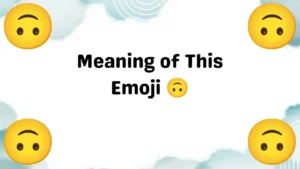
The upside down smiley emoji 🙃 may look simple, but it can carry several different meanings depending on the situation, tone, and conversation.
You might see it used when someone is joking, being sarcastic, expressing awkwardness, or trying to hide frustration behind a smile. Sometimes, 🙃 can mean “I’m fine,” even when the person clearly is not fine.
Other times, it adds a playful or silly tone to a message and shows that the sender doesn’t want to take something too seriously. But what does the upside down smiley emoji really mean in texting, relationships, or social media?
What Does the Upside Down Smiley Emoji (🙃) Actually Mean?
At its core, the upside down face emoji represents a mix of irony, sarcasm, silliness, and mild exasperation. It’s the emoji version of a shrug combined with a smile, used when something is a bit ridiculous, awkward, or not quite going the way you planned, but you’re choosing to laugh it off instead of complaining.
Think of it as the digital cousin of saying “well, that happened” with a half-smile. It rarely means pure happiness. Instead, it adds a layer of tone to a message that would otherwise be flat or unclear.
Here are the most common meanings people intend when they use 🙃:
- Sarcasm or irony — saying something that isn’t quite genuine, and the emoji signals “read between the lines”
- Playful sassiness — a lighthearted way to tease someone
- Awkward acceptance — acknowledging something annoying without full-on complaining
- Silliness or goofiness — just being random or funny, no deeper meaning
- Passive frustration — showing mild annoyance in a socially acceptable, non-confrontational way
Why Context Matters So Much With This Emoji
More than almost any other emoji, 🙃 is entirely dependent on context. The same symbol can flip meaning completely based on the sentence around it.
Example 1: Sarcasm
“Sure, I’d LOVE to redo this whole project again 🙃”
Here, the emoji signals the opposite of what’s being said. It softens the sarcasm so it reads as joking rather than genuinely bitter.
Example 2: Playful Teasing
“You actually forgot my birthday 🙃”
This isn’t necessarily angry. It’s more like a light jab, said with a smile rather than a scowl.
Example 3: Silly/Random
“Just ate cereal for dinner again 🙃”
No hidden meaning here. It’s simply a fun, quirky way to express a mundane moment.
Example 4: Passive Frustration
“Oh, the meeting got moved AGAIN 🙃”
This carries a “of course it did” energy, frustration wrapped in forced positivity.
The takeaway: you can’t understand 🙃 by looking at it alone. You have to read the sentence, the relationship between the people texting, and sometimes even the platform (a text from a coworker hits differently than one from a close friend).
Where Did the Upside Down Smiley Come From?
The 🙃 emoji, officially called “Upside-Down Face,” was added to the Unicode Standard in 2015 as part of Unicode 8.0, and became widely available across platforms like iOS and Android shortly after. It wasn’t designed with one specific meaning in mind. Instead, its ambiguous, flipped expression organically became linked to sarcasm and irony because that’s simply how people started using it.
This is actually common with emojis. The 😂 face was originally meant to represent “tears of joy,” but its heavy use in casual, often ironic contexts shaped how people perceive it today. The upside-down smiley followed a similar path, evolving through everyday use rather than an official definition.
Upside Down Smiley vs. Other Similar Emojis
People often confuse 🙃 with other smiley-type emojis. Here’s a quick comparison to clear things up:
| Emoji | Name | Primary Meaning |
| 🙃 | Upside-Down Face | Sarcasm, irony, silliness, mild frustration |
| 🙂 | Slightly Smiling Face | Genuine calm happiness, sometimes passive-aggressive when used flatly |
| 😊 | Smiling Face with Smiling Eyes | Warm, sincere happiness |
| 😏 | Smirking Face | Flirty, smug, or suggestive tone |
| 🤪 | Zany Face | Goofy, over-the-top silliness |
| 😅 | Grinning Face with Sweat | Nervous relief or awkward laughter |
The key difference is that 🙃 almost always adds a layer of “this isn’t quite what it seems,” while 🙂 and 😊 tend to be more literal in their emotional meaning.
How to Use the Upside Down Smiley Correctly
If you want to start using 🙃 in your own messages, here are a few practical tips:
- Use it to soften sarcasm. It helps the reader understand you’re joking rather than genuinely upset.
- Pair it with lighthearted complaints. It works well for venting about small annoyances without sounding too negative.
- Avoid it in serious conversations. Because it signals irony, using it during a genuine apology or serious discussion can come across as dismissive.
- Know your audience. Some people, especially those less familiar with emoji culture, may misread it as a “broken” or “sad” smiley rather than picking up on the sarcastic tone.
- Don’t overuse it. Like any tone-setting emoji, using it in every message dilutes its impact and can make your texts harder to read emotionally.
Is the Upside Down Smiley Ever Used Negatively?
Yes, in some cases. When someone is genuinely upset but doesn’t want to escalate a conversation, 🙃 can act as a passive-aggressive signal. For example, “Wow, thanks for telling me at the last minute 🙃” carries real frustration, just delivered with a smile instead of an argument.
If you’re on the receiving end of a message like this, it’s worth paying attention to the rest of the conversation. Short replies, a shift in tone, or repeated use of 🙃 in response to something you did might indicate real irritation, even if the emoji itself looks “friendly.”
Frequently Asked Questions (FAQs)
1. Does the upside down smiley mean someone is upset?
Not always. It can signal sarcasm, silliness, or mild annoyance, but it’s rarely a sign of serious anger. Context is the best clue.
2. Is 🙃 a flirty emoji?
Not typically. It’s more associated with sarcasm or playfulness than flirting. If you’re looking for a flirty tone, 😏 or 😉 are more common choices.
3. Why do people use 🙃 instead of a normal smiley?
Because a regular smiley 🙂 or 😊 reads as sincere, while 🙃 adds irony or a joking tone that a straight smiley can’t convey.
4. Is it rude to send someone 🙃?
It depends on context. In casual conversations, it’s harmless and even funny. In serious or professional messages, it can come across as dismissive or sarcastic in an unhelpful way.
5. What’s the difference between 🙃 and 🙂?
🙂 usually means genuine calm or mild happiness. 🙃 flips that meaning into sarcasm, irony, or playful frustration.
6. Can 🙃 be used in professional messages?
It’s best avoided in formal settings like work emails, since its sarcastic undertone can be misread as unprofessional or passive-aggressive.
7. Why was the emoji designed upside down in the first place?
It wasn’t created with an official sarcastic meaning. The flipped design simply looked ironic or “off” enough that users naturally began applying it to sarcastic and joking messages.
Conclusion
The upside down smiley emoji isn’t as simple as it looks. While it may appear to just be a playful flipped version of a regular smiley, it actually carries a much more layered meaning tied to sarcasm, irony, silliness, and sometimes gentle frustration. The real trick to understanding it is paying attention to the message around it, since the emoji itself rarely tells the whole story.
Whether you’re decoding a text from a friend or thinking about using 🙃 yourself, the main thing to remember is this: it’s less about literal happiness and more about tone. Used well, it adds humor and personality to your messages. Used carelessly, it can create confusion or come across the wrong way.

I am Daniel Harris, a passionate writer and content creator dedicated to sharing valuable, informative, and engaging articles with readers. I am focused on researching topics deeply and presenting ideas in a simple, clear, and helpful way. I am passionate about delivering accurate information that helps people learn, grow, and make better decisions.