
Creatine is one of the most widely used supplements for improving strength, supporting muscle growth, and enhancing exercise performance. It is popular among bodybuilders, athletes, gym beginners, and people who want to get more out of their workouts. However, one concern often stops people from trying it: weight gain.
If you have started taking creatine and noticed that the number on your weighing scale is increasing, you might wonder whether the supplement is making you fat. You may also be concerned about water retention, belly fat, facial puffiness, or losing your weight-loss progress.
So, can creatine cause weight gain? Yes. Creatine can increase your body weight, particularly during the first few weeks of supplementation. However, this increase usually does not mean you are gaining body fat. Much of the early change comes from additional water stored inside your muscle cells. Over time, creatine may also support muscle development when combined with regular resistance training.
A 2024 systematic review and meta-analysis found that creatine supplementation produced a small average increase in body mass of approximately 0.86 kg across the included studies. Researchers also observed an increase in fat-free mass. These findings help explain why the scale may move upward even when body composition is not getting worse.
The important thing is to understand what is actually changing in your body. Water weight, muscle development, and body fat are three different things. They can affect your total weight in different ways.
In this guide, you will learn why creatine causes weight gain, how much weight you might gain, how long the changes last, and whether you can use creatine while trying to lose fat. We will also cover practical dosage advice, possible side effects, and ways to track your progress without becoming overly concerned about normal weight fluctuations.
Can Creatine Cause Weight Gain?

Yes, creatine can cause weight gain, but the amount and type of weight vary between individuals. The most common early change is an increase in water stored inside muscle cells.
Creatine is a compound that your body naturally produces using amino acids. You also get small amounts from foods such as meat and seafood. Most of your body’s creatine is stored in skeletal muscles, where it helps supply energy during short, intense activities.
For example, your muscles use creatine to support movements such as:
- Lifting heavy weights
- Performing short sprints
- Completing repeated high-intensity exercises
- Doing explosive movements
- Performing multiple sets of resistance training
When you take a creatine supplement, your muscles can gradually store more creatine. This increases the amount of creatine available to support energy production during exercise.
It can also increase the amount of water held inside muscle cells. Consequently, your body weight may rise even though you have not gained additional body fat.
For example, suppose you weigh 70 kg before starting creatine. After a few weeks, your weight increases to 71 kg. That additional kilogram does not automatically represent fat gain. It may come from water retention, changes in muscle mass, or a combination of different factors.
The National Institutes of Health (NIH) explains that creatine supplementation can increase body weight, partly because of increased water retention and potentially increased muscle development.
Therefore, if you notice creatine weight gain, consider your overall body composition rather than judging your progress by the scale alone.
Why Does Creatine Cause Weight Gain?

Creatine can influence your body weight through several processes. Understanding these changes will help you recognize why the scale may increase after starting supplementation.
1. Water Retention Inside Muscle Cells
Water retention is one of the main reasons people experience weight gain after taking creatine.
When your muscles absorb additional creatine, the amount of water stored inside muscle cells can increase. This is known as intracellular water retention.
Intracellular water is different from fluid accumulating in the spaces between tissues. It is the water contained within your cells.
As a result, your muscles may appear fuller, and your total body weight may increase.
For example, if you gain 1–2 pounds during the first couple of weeks, that change may largely reflect additional water rather than body fat.
This is why creatine water weight is commonly discussed among people who begin using the supplement.
2. Increased Strength and Muscle Development
Creatine can also contribute to weight gain indirectly by supporting muscle development.
It helps your muscles regenerate adenosine triphosphate (ATP), which provides energy for short, intense physical activities.
With additional creatine available, you may be able to perform more repetitions, maintain workout intensity, or complete more training volume.
Over time, these improvements can help you get more out of resistance training.
When you combine consistent exercise with sufficient protein, appropriate calorie intake, and recovery, your muscles may gradually grow.
Muscle tissue contributes to total body weight. Therefore, someone who builds muscle while taking creatine may experience a gradual increase on the scale.
However, this process takes time. A sudden increase during the first few days is much more likely to involve water than substantial new muscle tissue.
3. Changes in Muscle Glycogen
Glycogen is the stored form of carbohydrates that your body uses for energy.
Your muscles store glycogen along with water. Changes in your carbohydrate intake and exercise routine can influence how much glycogen your muscles hold.
People often change their diets when they start a fitness program. For example, they may eat more carbohydrates to support their workouts.
This can increase glycogen storage and associated water weight.
Although these changes can occur alongside creatine supplementation, they are not necessarily caused by creatine itself.
4. Changes in Your Training Routine
Another factor is your workout routine.
Many people start taking creatine when they begin lifting weights more frequently or following a structured exercise program.
As their training improves, they may experience changes in muscle size, glycogen storage, and body composition.
These changes can affect their weight independently of the supplement’s direct water-retention effect.
This is why it is important to consider your entire routine rather than attributing every increase on the scale to creatine.
How Much Weight Does Creatine Make You Gain?

There is no single amount that applies to everyone. Some people notice very little weight change, while others experience a more noticeable increase during the first few weeks.
The NIH reports that studies involving creatine monohydrate and strength training have found increases of approximately 1–2 kg in total body weight within a month.
A separate 2024 systematic review and dose-response meta-analysis involving 143 studies found an average increase in body mass of approximately 0.86 kg. The analysis also reported an increase in fat-free mass.
These numbers represent average research findings, not guaranteed individual results.
Here is an example of how different amounts of weight gain might look:
| Weight change | Equivalent in pounds |
| 0.5 kg | 1.1 lb |
| 1 kg | 2.2 lb |
| 1.5 kg | 3.3 lb |
| 2 kg | 4.4 lb |
Your results depend on several factors:
- Starting creatine levels: People with lower initial muscle creatine stores may respond differently from those who already have higher stores.
- Dosage: A loading phase can increase muscle creatine stores more quickly.
- Exercise: Resistance training can contribute to additional lean muscle development.
- Diet: Changes in calories, carbohydrates, and sodium can influence body weight.
- Individual differences: Genetics, body size, and other biological factors can affect your response.
Do not assume that gaining two pounds means you have gained two pounds of fat. Weight measurements alone cannot establish what type of tissue or fluid has changed.
Creatine Weight Gain: Water Weight vs. Muscle vs. Fat
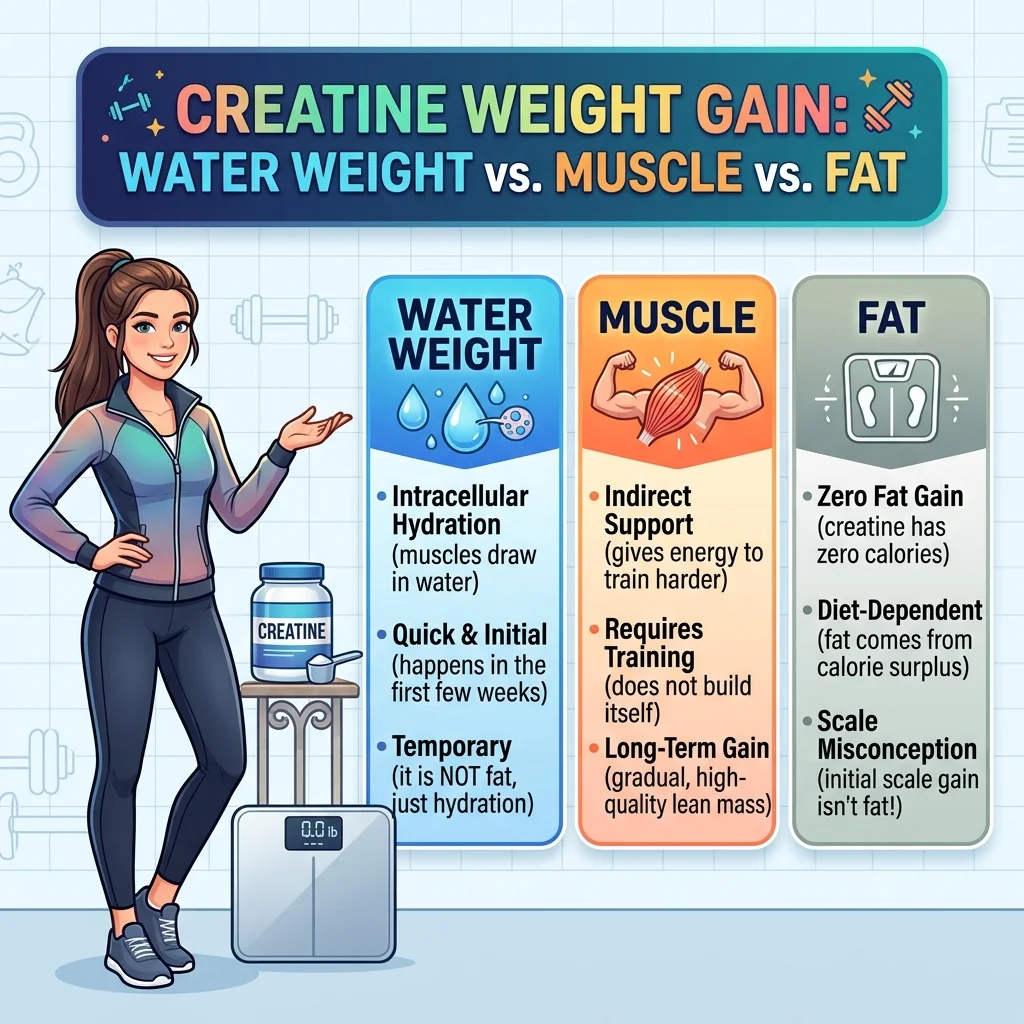
Understanding the difference between water weight, muscle mass, and body fat is essential when evaluating creatine’s effects.
| Type | What it means | How it relates to creatine |
| Water weight | Fluid stored inside muscle cells | A common early effect |
| Muscle mass | Growth of muscle tissue | Creatine may support it alongside training |
| Body fat | Stored energy in fat tissue | Not directly increased by creatine |
| Glycogen weight | Stored carbohydrates and associated water | May contribute to weight fluctuations |
Water Weight
Water weight can increase relatively quickly after starting creatine.
This happens because your muscles store additional creatine and may hold more water inside their cells.
The increase can make your muscles look fuller without representing additional body fat.
Muscle Mass
Muscle development happens gradually through resistance training, nutrition, and recovery.
Creatine can support this process by improving your ability to perform high-intensity exercise.
However, the supplement does not build significant muscle without an appropriate training stimulus.
Body Fat
Body fat generally increases when you consistently consume more calories than your body uses.
Creatine does not directly turn into fat or automatically create a calorie surplus.
For example, someone can gain water weight from creatine while simultaneously losing body fat through a calorie-controlled diet.
The weighing scale may not show the entire picture.
Does Creatine Make You Gain Fat or Belly Fat?
No, creatine does not directly cause fat gain or specifically increase belly fat.
Research generally suggests that creatine supplementation combined with resistance training can improve lean body mass without increasing fat mass.
A 2024 meta-analysis of resistance-training studies found that creatine users gained more lean body mass than people who performed resistance training without creatine. The analysis also found small reductions in body fat percentage and fat mass compared with training alone.
However, this does not mean creatine burns fat. The findings relate to the combined effects of supplementation and resistance training.
Your eating habits remain important.
If you regularly consume more calories than your body needs, you may gain fat while taking creatine. This happens because of your overall calorie surplus, not because creatine directly produces fat.
It is also important to understand that abdominal bloating is different from belly fat.
Some people experience digestive discomfort after taking large amounts of creatine. This may make their stomach feel uncomfortable or temporarily bloated.
If you notice persistent swelling or unusual symptoms, seek medical advice rather than assuming that everything is normal water retention.
Creatine Weight Gain Timeline: What Happens During the First Month?
A creatine weight gain timeline can help you understand what to expect when starting supplementation.
The timing depends on whether you use a loading phase or take a smaller daily dose.
First Week: Initial Water-Weight Changes
If you follow a loading protocol, your muscle creatine stores can increase relatively quickly.
Some people notice a change in body weight during this period because of additional water stored inside their muscles.
If you take 3–5 grams daily without loading, the increase may be more gradual.
Second Week: Continued Muscle Creatine Storage
During the second week, your muscles continue accumulating creatine.
You may notice slightly fuller muscles or a higher number on the scale.
However, not everyone experiences visible changes.
Third and Fourth Weeks: Gradual Stabilization
People following a standard daily maintenance dose generally continue increasing their muscle creatine stores over several weeks.
Your body weight may stabilize at a slightly higher level.
If you are following a resistance-training program, you may also notice improvements in workout performance.
After One Month: Longer-Term Adaptation
After approximately four weeks of consistent supplementation, many people taking a standard daily dose will have substantially increased their muscle creatine stores.
Your weight may remain higher while you continue supplementation.
Further changes in muscle mass depend on training consistency, nutrition, and recovery.
These stages are general estimates, not a guaranteed schedule. Your individual experience may be different.
Does Creatine Make You Look Bigger?
Yes, creatine can make your muscles look fuller because of increased water stored inside muscle cells.
Some people notice this effect in their arms, shoulders, chest, and legs.
However, fuller-looking muscles do not necessarily mean you have developed a large amount of new muscle tissue.
There are two separate processes:
Muscle fullness: Additional intracellular water can change how your muscles look relatively quickly.
Muscle hypertrophy: Actual muscle growth happens gradually through consistent resistance training and recovery.
Creatine may support the second process by helping you maintain workout performance and training volume.
If your goal is to build a stronger, more muscular appearance, creatine monohydrate can be a useful addition to an appropriate fitness program.
It will not automatically make you bulky. Your training program, genetics, nutrition, and overall goals have a much greater influence on your final appearance.
Does Creatine Cause Weight Gain in Females?
Yes, females can experience creatine-related weight gain.
The basic mechanism is the same as it is in males. Creatine increases muscle creatine stores and may increase water held inside muscle cells.
Some women notice a small increase in body weight after beginning supplementation.
However, this does not mean creatine automatically causes unwanted fat gain or an unusually bulky appearance.
When combined with resistance training, creatine may help women improve strength, exercise performance, and lean muscle development.
Women should also consider normal menstrual-cycle fluctuations when tracking their weight. Hormonal changes can influence fluid balance and cause temporary increases or decreases on the scale.
For a clearer picture, compare weight averages over several weeks rather than relying on measurements taken on individual days.
Does Creatine Cause Weight Gain in Males?
Yes, males can also experience an increase in body weight after starting creatine.
For men who regularly lift weights, the increase may involve both additional water stored inside muscles and gradual changes in lean body mass.
Creatine can support repeated high-intensity exercise, which may help improve training performance.
However, taking creatine does not guarantee muscle growth.
Men still need a suitable resistance-training program, sufficient protein, appropriate calorie intake, and adequate recovery.
The amount of weight gained varies from person to person.
Can Creatine Cause Weight Gain Without Working Out?
Yes, creatine can increase body weight even if you do not exercise.
This is because muscle creatine storage and associated water retention do not require a workout to occur.
However, the benefits are different when you are not physically active.
Creatine is particularly useful for activities involving short, intense bursts of effort. Without resistance training or similar exercise, you should not expect significant muscle growth from supplementation alone.
For people who want to improve their physique, combining creatine with regular strength training is generally a more effective approach.
If you do not exercise, consider whether supplementation is necessary for your personal goals.
Can You Lose Weight While Taking Creatine?
Yes, you can lose body fat while taking creatine.
Creatine does not directly prevent fat loss or stop your body from using stored energy.
However, water retention can temporarily make your total body weight higher.
Imagine that you are following a calorie deficit and exercising regularly. You may be losing body fat while gaining some water weight from creatine.
As a result, the scale might show little change even though your waist measurement is decreasing and your fitness is improving.
This is why creatine for weight loss should be understood as a potential exercise-performance support rather than a fat-burning treatment.
If your goal is to lose weight while maintaining muscle, focus on:
- Maintaining an appropriate calorie deficit.
- Eating sufficient protein.
- Performing regular resistance training.
- Getting enough sleep.
- Staying physically active.
- Monitoring your body composition over time.
You do not need to stop creatine simply because your weight-loss progress looks slower on the scale.
How to Track Your Weight While Taking Creatine
One of the easiest ways to avoid confusion is to use more than one measurement to monitor your progress.
Weigh Yourself Consistently
Check your weight under similar conditions, preferably in the morning after using the bathroom and before eating.
Avoid comparing a morning measurement with an evening measurement because food, fluid, and daily activities can affect your weight.
Calculate Your Weekly Average
Daily weight changes are normal.
Instead of reacting to one reading, record your weight regularly and calculate a weekly average.
Compare averages over several weeks to identify longer-term patterns.
Measure Your Waist
Waist circumference can provide additional information about changes in body size.
If your weight increases slightly but your waist measurement stays stable or decreases, the change may not represent increased abdominal fat.
Monitor Workout Performance
Record your lifting weights, repetitions, and exercise performance.
If your strength improves over time, this can be a useful sign that your training program is progressing.
Take Progress Photos
Photographs taken under similar lighting and conditions can help you notice physical changes that the scale cannot show.
Use several measurements together instead of relying on body weight alone.
How to Take Creatine Without Unnecessary Weight Gain
If you want to use creatine but are concerned about unwanted weight changes, choosing an appropriate supplementation routine can help.
You do not need to take excessive amounts or follow an aggressive loading phase to experience its benefits.
1. Choose Creatine Monohydrate
Creatine monohydrate is the most extensively researched form of creatine.
It has strong scientific support for improving high-intensity exercise performance and supporting strength and muscle development.
Other forms are available, but they have not consistently demonstrated better results than creatine monohydrate.
Choose a reputable product with clear ingredient information and independent quality testing when available.
2. Follow an Appropriate Daily Dose
A common maintenance dose for healthy adults is 3–5 grams of creatine monohydrate per day.
This amount can gradually increase muscle creatine stores without requiring a loading phase.
Taking more than you need does not guarantee faster muscle growth or better results.
3. Understand That Loading Is Optional
A loading phase is sometimes used to increase muscle creatine stores more quickly.
A commonly studied approach involves taking approximately 20 grams daily, divided into four smaller servings, for five to seven days. Afterward, users generally switch to 3–5 grams daily.
However, loading is not necessary.
Taking 3–5 grams daily without loading can also increase muscle creatine stores. It simply takes longer to reach similar levels.
If you prefer a gradual approach, you can skip the loading phase.
4. Maintain Normal Hydration
Drink enough fluids to support your daily activity and exercise routine.
You do not need to force excessive water consumption because you are taking creatine.
Your hydration needs depend on your body size, activity level, environment, and sweating.
5. Combine Creatine With Resistance Training
Creatine works particularly well alongside exercises involving short, intense efforts.
Consider activities such as:
- Weightlifting
- Squats and lunges
- Bench presses
- Resistance-band exercises
- Sprinting
- High-intensity interval training
A structured exercise program helps you use the performance benefits of creatine more effectively.
6. Eat a Balanced Diet
Your body needs sufficient protein, carbohydrates, fats, vitamins, and minerals to support muscle development and recovery.
If your goal is to lose fat, maintain an appropriate calorie deficit while eating enough to support your training.
Creatine cannot replace proper nutrition.
What Happens When You Stop Taking Creatine?
If you stop taking creatine, your muscle creatine stores gradually return toward their normal levels.
As those stores decrease, some of the additional water retained inside your muscles may also be lost.
The Australian Institute of Sport explains that muscle creatine levels and associated body weight generally return toward baseline over approximately four to six weeks after stopping supplementation.
This means you may notice a decrease in body weight after discontinuing creatine.
However, losing water weight does not mean you have lost all the muscle you developed while taking the supplement.
Muscle tissue developed through resistance training does not automatically disappear when you stop using creatine.
If you continue exercising, eating sufficient protein, and recovering properly, you can maintain much of your muscle development.
You may simply notice slightly less muscle fullness.
What Are the Possible Side Effects of Creatine?
Creatine is generally considered safe for many healthy adults when used at recommended doses. However, some people experience side effects.
Possible issues include:
- Temporary weight gain from water retention
- Stomach discomfort
- Nausea
- Diarrhea
- Digestive bloating, particularly with large doses
Taking excessive amounts at once may increase the likelihood of digestive problems.
Using a smaller daily dose may help people who experience stomach discomfort.
Does Creatine Damage Your Kidneys?
Kidney health is a common concern among people considering creatine supplementation.
Research generally supports the safety of recommended creatine doses in healthy adults. However, creatine can affect blood creatinine measurements.
Creatinine is a waste product produced during normal muscle metabolism. Healthcare professionals often use blood creatinine levels as part of kidney-function assessments.
An increase in creatinine does not automatically mean kidney damage. Creatine supplementation can influence this measurement without necessarily indicating a decline in kidney function.
If you take creatine, tell your healthcare professional before having blood tests so they can interpret your results appropriately.
People with existing kidney disease or reduced kidney function should consult a healthcare professional before using creatine. The same precaution applies to people taking medications that may affect kidney function.
Pregnant or breastfeeding individuals and teenagers should also seek appropriate professional advice before starting supplementation.
Frequently Asked Questions About Creatine Weight Gain
How Much Weight Can You Gain From Creatine in a Week?
It varies from person to person. Some people notice an increase during the first week, particularly when following a loading protocol. Others experience more gradual changes. Early weight gain is often related to water stored inside muscles.
Is Creatine Weight Gain Permanent?
No. Creatine-related water-weight increases are generally reversible. After stopping supplementation, muscle creatine stores gradually return toward baseline, and some associated water weight is lost.
Does Creatine Make You Gain Belly Fat?
No. Creatine does not directly increase belly fat. It primarily affects water storage inside muscle cells. Abdominal fat is more closely related to long-term calorie balance and other lifestyle factors.
Does Creatine Make Your Face Look Fat?
Creatine does not specifically target facial fat. Its main water-retention effect occurs inside muscle cells. Facial appearance can also change because of normal fluid fluctuations, dietary habits, and other factors.
Can You Lose Weight While Taking Creatine?
Yes. You can lose body fat while taking creatine if you maintain an appropriate calorie deficit. However, temporary water retention may make your total body weight appear higher.
Should I Stop Creatine If I Gain Weight?
Not necessarily. An increase in body weight alone is not a reason to stop supplementation. Consider your waist measurement, workout performance, and longer-term progress. If you experience concerning symptoms, consult a healthcare professional.
Does Creatine Cause Weight Gain Without Exercise?
Yes. Creatine can increase body weight through water retention even without exercise. However, you should not expect substantial muscle-building benefits from supplementation alone.
Can Creatine Cause Weight Gain in Females?
Yes. Women can experience additional water retention and changes in body weight after starting creatine. This does not automatically mean they are gaining body fat.
Does Creatine Cause Weight Gain in Males?
Yes. Men may also experience increased body weight because of water retention and gradual muscle development when combining creatine with resistance training.
How Long Does Creatine Weight Gain Last?
As long as you continue taking creatine, your muscle creatine stores generally remain elevated. After stopping supplementation, these levels gradually decrease over approximately four to six weeks.
Does Creatine Make Muscles Bigger?
Creatine can make muscles look fuller because of increased intracellular water. When combined with resistance training, it may also support gradual muscle growth.
Is Creatine Safe for Weight Loss?
Creatine can be compatible with a weight-loss program for many healthy adults. It may support exercise performance and strength, but it is not a fat-burning supplement.
Can Creatine Cause Bloating?
Some people experience digestive discomfort or bloating when taking creatine, especially when consuming large amounts at once. This is different from water stored inside muscle cells.
Will I Lose Muscle If I Stop Taking Creatine?
No. Stopping creatine does not automatically cause muscle loss. You may lose some water-related muscle fullness, but muscle tissue can be maintained through consistent training and proper nutrition.
Is Creatine Better Before or After a Workout?
The exact timing is generally less important than taking creatine consistently. You can take it before or after exercise according to your preference.
Final Thoughts:
Yes, creatine can cause weight gain, but that does not mean you are gaining unwanted body fat. Most early creatine weight gain comes from additional water stored inside your muscles. Over time, creatine may also support lean muscle development when combined with regular resistance training. If your goal is to build muscle, improve strength, or maintain workout performance, creatine monohydrate can be a useful supplement for many healthy adults.
If you are trying to lose weight, you can generally continue making progress while taking creatine. Just remember that temporary water-weight changes may affect the number on your scale. Instead of judging your fitness progress by body weight alone, monitor your waist measurements, workout performance, strength, and longer-term changes in body composition. Choose a reputable supplement, follow an appropriate dosage, maintain a balanced diet, and consult a healthcare professional if you have an existing medical condition or take medication that could affect your kidneys.

I am David Wilson, a passionate writer dedicated to creating informative, engaging, and valuable content for readers. I enjoy researching different topics and sharing well-crafted articles that provide helpful insights, practical knowledge, and meaningful information. I am committed to maintaining high-quality writing standards with a focus on accuracy, clarity, and reader satisfaction.