
Bringing a puppy home is an exciting experience, but watching it grow can raise plenty of questions. One day, your little dog fits comfortably in your arms. A few months later, it may be much bigger than you expected. Naturally, you start wondering: How big will my puppy get when fully grown?
A puppy weight predictor helps estimate your dog’s future adult weight using its current age, weight, breed, and growth pattern. It can give you a useful idea of whether your puppy will become a small, medium, large, or giant dog.
Knowing your puppy’s estimated adult size can help you prepare for its future needs. You can choose an appropriate crate, purchase the right accessories, plan feeding requirements, and monitor healthy development.
However, every puppy grows differently. Genetics, breed, sex, nutrition, and overall health influence final adult size. An online puppy weight calculator cannot guarantee an exact result, but it can provide a helpful starting point.
In this guide, you’ll learn how to calculate puppy adult weight, understand puppy growth stages, use a puppy growth chart by age, and estimate how much your dog may weigh as an adult. You’ll also discover breed-specific growth information, practical calculation examples, and common mistakes to avoid.
What Is a Puppy Weight Predictor?

A puppy weight predictor is a calculation method or online tool that estimates how much a puppy may weigh when fully grown.
A typical puppy weight calculator uses information about your dog’s current development and compares it with expected growth patterns.
The main details include:
- Age: Your puppy’s current age in weeks or months.
- Current weight: Its latest accurate weight measurement.
- Breed: Its known breed or estimated breed combination.
- Expected adult size: Whether it is likely to become a small, medium, large, or giant dog.
- Growth pattern: How its weight changes as it gets older.
For example, imagine your puppy is six months old and weighs 30 pounds. If an appropriate growth reference suggests it has reached approximately 60% of its expected adult weight, the estimated adult weight would be 50 pounds.
The calculation provides an estimate, not a promise. Your puppy may eventually weigh more or less depending on its individual development.
Why Should You Predict Your Puppy’s Adult Weight?
Predicting adult size is useful for several everyday decisions.
Choosing the right dog food: Different puppies have different nutritional requirements. Knowing your dog’s expected adult size helps you choose an appropriate growth formula.
Buying a suitable crate: A small puppy can grow quickly. An adult weight estimate helps you select a crate that will accommodate its future size.
Planning your home: A dog expected to weigh 10 pounds has different space requirements from one expected to weigh 100 pounds.
Preparing your budget: Larger dogs may need bigger beds, stronger collars, larger food portions, and different transportation arrangements.
Monitoring growth: Recording weight regularly helps you identify unexpected changes and discuss them with your veterinarian.
How Does a Puppy Weight Calculator Work?
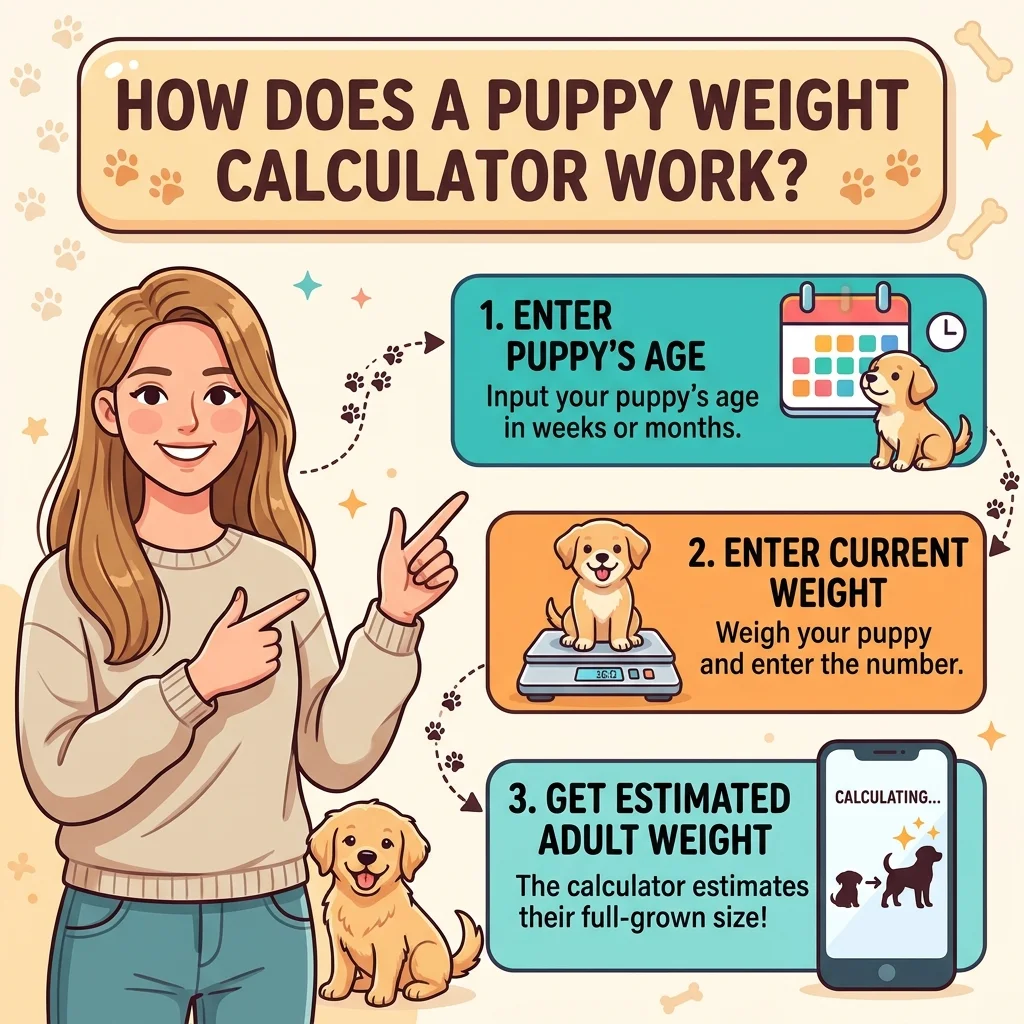
A puppy weight calculator estimates adult weight by comparing a puppy’s current measurements with a typical growth pattern.
Puppies do not gain weight at a constant rate. They usually grow rapidly during early development, and their growth gradually slows as they approach maturity.
A basic puppy adult weight calculator uses this formula:
EstimatedAdultWeight=CurrentWeightGrowthPercentage
First, convert the growth percentage into a decimal.
For example, 60% becomes 0.60.
Suppose your six-month-old puppy weighs 30 pounds and has reached approximately 60% of its expected adult weight.
300.60=50
EXAMPLE PREDICTION
50 pounds
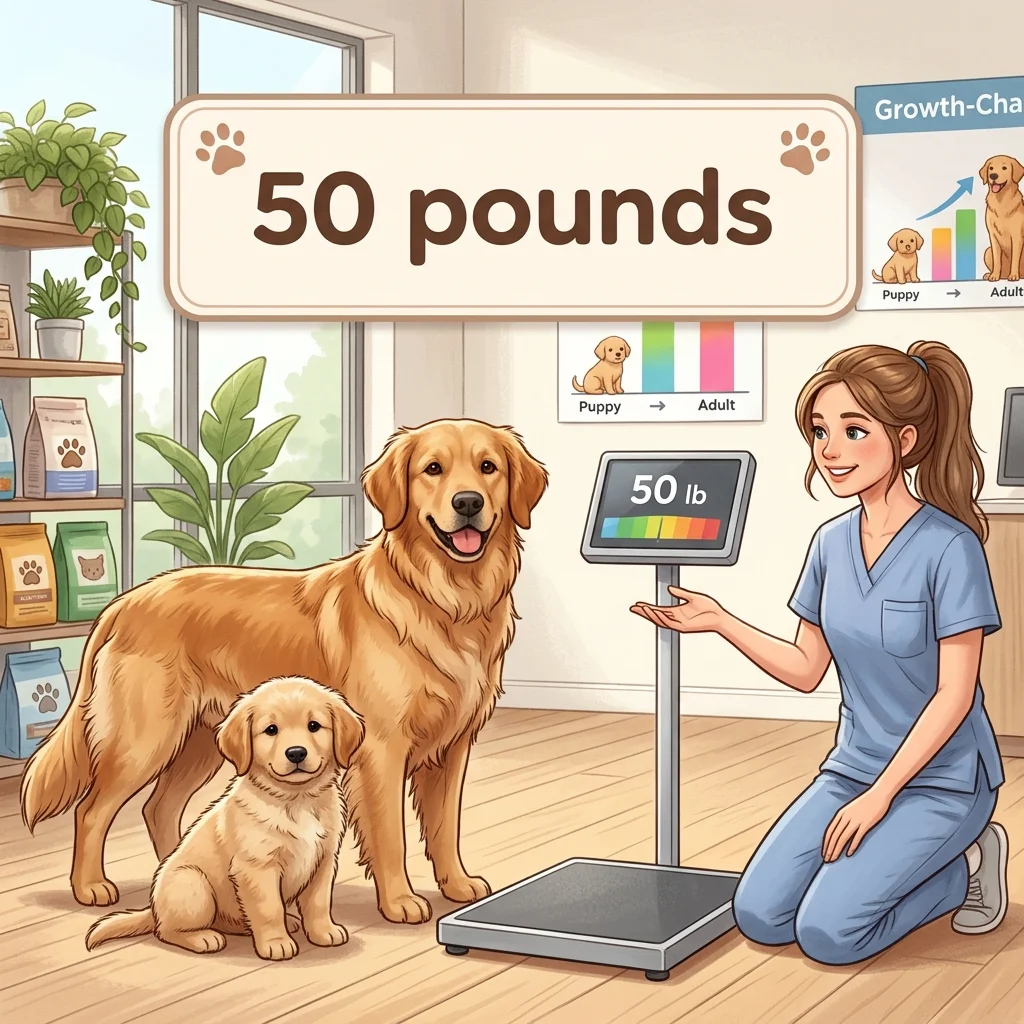
Estimated adult weight based on the example growth percentage.
This method is useful for understanding the mathematics behind weight prediction. However, the percentage must come from an appropriate growth reference. A single percentage should not be applied to every breed or age.
Puppy Weight Prediction Example by Age
Consider three puppies with different ages and current weights.
| Puppy age | Current weight | Example growth percentage | Estimated adult weight |
| 6 months | 20 lb | 60% | 33.3 lb |
| 9 months | 45 lb | 75% | 60 lb |
| 12 months | 65 lb | 85% | 76.5 lb |
These examples use hypothetical growth percentages to demonstrate the formula. They are not breed-specific predictions.
The important lesson is that your puppy’s age and expected adult size both influence the calculation.
Puppy Growth Chart by Age and Expected Adult Size
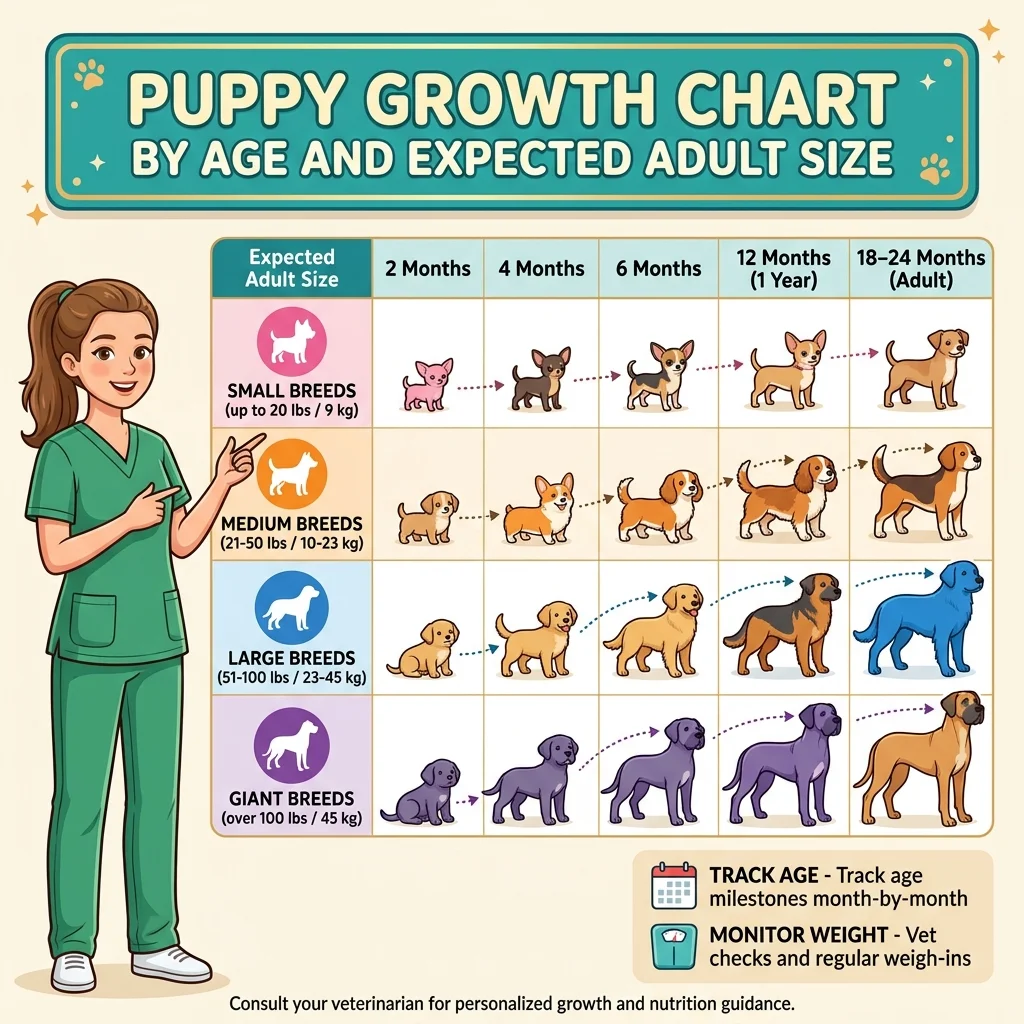
A puppy growth chart by age helps you understand how dogs develop at different stages of life.
Small breeds generally mature faster than large breeds. Giant dogs may continue growing for almost two years.
The following table describes broad developmental patterns rather than exact weight requirements.
| Puppy age | Small breeds | Medium breeds | Large breeds | Giant breeds |
| 8 weeks | Rapid growth | Rapid growth | Early development | Early development |
| 12 weeks | Active growth | Active growth | Active growth | Active growth |
| 16 weeks | Developing quickly | Developing quickly | Growing steadily | Growing steadily |
| 20 weeks | Growth gradually slowing | Active growth | Active growth | Active growth |
| 6 months | Approaching adult size | Developing | Active growth | Active growth |
| 9 months | Usually near adult size | Approaching maturity | Still developing | Still developing |
| 12 months | Generally mature | Often near adult size | May continue growing | Still developing |
| 15–18 months | Mature | Generally mature | Approaching maturity | Still developing |
| 18–24 months | Mature | Mature | Generally mature | May approach maturity |
These are general patterns. Individual puppies can develop earlier or later depending on breed, genetics, and health.
Puppy Growth Percentage Chart
The American Kennel Club provides an approximate puppy growth chart based on expected adult weight categories.
These percentages can help explain why puppies of different sizes mature at different rates.
| Age | Small (0–20 lb) | Medium (21–50 lb) | Large (51–100 lb) | Extra-large (100+ lb) |
| 6 months | 75% | 66% | 60% | 50% |
| 9 months | 90% | 85% | 75% | 65% |
| 12 months | 100% | 95% | 85% | 80% |
| 15 months | 100% | 100% | 95% | 90% |
| 18 months | 100% | 100% | 100% | 100% |
These are approximate reference values, not universal growth standards. They should not replace breed-specific or sex-specific veterinary growth charts.
For example, a six-month-old puppy weighing 24 pounds and belonging to the large-size category could have an estimated adult weight of:
240.60=40pounds
However, if its expected adult category is incorrect, the prediction may also be inaccurate.
How to Calculate Puppy Adult Weight Manually
You can estimate your puppy’s future weight without relying entirely on an online calculator.
Follow these steps to understand how to calculate puppy adult weight.
Step 1: Find Your Puppy’s Exact Age
Start by determining how old your puppy is.
Using weeks is especially helpful for younger puppies because they develop quickly.
| Puppy age | Approximate weeks |
| 2 months | 8–9 weeks |
| 3 months | 13 weeks |
| 4 months | 17 weeks |
| 5 months | 22 weeks |
| 6 months | 26 weeks |
| 9 months | 39 weeks |
| 12 months | 52 weeks |
Step 2: Measure Your Puppy’s Current Weight
Use a reliable digital or pet scale.
For accurate measurements:
- Weigh your puppy without a collar or harness.
- Use the same scale whenever possible.
- Record the measurement date.
- Keep the puppy still during weighing.
- Repeat the measurement if the reading appears unusual.
Step 3: Identify Its Expected Adult Size
Determine whether your puppy is likely to become small, medium, large, or giant.
Breed information and parental weights can help.
For mixed-breed dogs, consider the likely breed combination and monitor their growth over several weeks.
Step 4: Choose an Appropriate Growth Reference
Find a growth chart that matches your puppy’s expected adult size and, where available, sex.
Veterinary growth charts are more useful than generic percentages because they compare your puppy’s weight with a suitable reference population.
Step 5: Calculate Its Estimated Adult Weight
Divide the current weight by the corresponding growth percentage expressed as a decimal.
For example:
- Current weight: 40 pounds.
- Growth percentage: 80%.
- Decimal: 0.80.
400.80=50
The estimated adult weight is 50 pounds.
Remember that this calculation is only as reliable as the growth percentage you use.
Puppy Weight by Breed: How Big Will Your Dog Get?
Breed is one of the most useful clues when estimating adult weight.
Different breeds have different body structures, growth rates, and mature sizes. A Chihuahua will not follow the same growth pattern as a German Shepherd or Great Dane.
Here are approximate adult weight ranges for popular breeds.
| Dog breed | Approximate adult weight |
| Chihuahua | 3–6 lb |
| Yorkshire Terrier | 4–7 lb |
| Pomeranian | 3–7 lb |
| Maltese | 4–7 lb |
| Shih Tzu | 9–16 lb |
| Beagle | 20–30 lb |
| French Bulldog | 20–28 lb |
| Cocker Spaniel | 20–30 lb |
| Border Collie | 30–55 lb |
| Australian Shepherd | 40–65 lb |
| Golden Retriever | 55–75 lb |
| Labrador Retriever | 55–80 lb |
| German Shepherd | 50–90 lb |
| Rottweiler | 80–135 lb |
| Great Dane | 110–175 lb |
| Saint Bernard | 120–180 lb |
These are broad illustrative ranges. Individual breed standards, sex, and bloodlines can produce different measurements.
Toy and Small Dog Breeds
Toy and small breeds generally reach adult size sooner than larger dogs.
Examples include:
- Chihuahua
- Pomeranian
- Yorkshire Terrier
- Maltese
- Shih Tzu
- Toy Poodle
Many toy breeds weigh less than 10 pounds as adults. Other small breeds may weigh between 10 and 25 pounds.
If you have one of these puppies, regular measurements can help you notice how quickly it approaches its adult size.
Medium Dog Breeds
Medium-sized dogs usually develop more slowly than toy and small breeds.
Examples include:
- Beagle
- Cocker Spaniel
- Border Collie
- Australian Cattle Dog
- Standard Schnauzer
Many medium breeds weigh between 25 and 60 pounds when fully grown.
Their final weight depends on their genetics, body structure, and sex.
Large Dog Breeds
Large breeds need more time to complete their development.
Popular examples include:
- Golden Retriever
- Labrador Retriever
- German Shepherd
- Rottweiler
- Boxer
Depending on breed and individual characteristics, these dogs may weigh between 50 and 100 pounds or more.
Giant Dog Breeds
Giant breeds can become exceptionally large.
Examples include:
- Great Dane
- Saint Bernard
- Newfoundland
- English Mastiff
- Irish Wolfhound
Some giant dogs weigh more than 150 pounds as adults.
Their longer growth period makes it particularly important to monitor their development and maintain appropriate nutrition.
Puppy Weight Predictor for Mixed-Breed Dogs
Estimating adult weight is more challenging when you have a mixed-breed puppy.
A mixed breed puppy weight calculator can provide a rough estimate, but the result may be less predictable because mixed-breed dogs inherit different combinations of characteristics from their parents.
Here are four practical ways to estimate their future size.
Check Both Parents’ Weights
If you know the parents, their adult weights can provide useful information.
For example, imagine one parent weighs 20 pounds and the other weighs 65 pounds.
Your puppy may inherit a combination of their physical characteristics. However, simply averaging their weights does not guarantee an accurate result.
Consider the Breed Combination
Research the typical adult sizes of the breeds involved.
If your puppy is a Labrador and Terrier mix, its final size may be influenced by the characteristics inherited from either parent.
Monitor Growth Over Time
Record your puppy’s weight regularly.
Several measurements provide a clearer picture of development than one isolated measurement.
If the puppy consistently follows a growth curve, that pattern may help you estimate its eventual size.
Consider a Veterinary Growth Assessment
Your veterinarian can assess the puppy’s physical structure and compare its weight with suitable growth references.
This is especially useful when the puppy’s breed background is unknown.
When Do Puppies Stop Growing?
One of the most common questions among dog owners is when their puppies will reach full adult size.
The answer depends on breed and expected adult weight.
| Dog size | General growth timeline |
| Toy breeds | Around 6–12 months |
| Small breeds | Around 6–12 months |
| Medium breeds | Around 12 months |
| Large breeds | Around 12–18 months |
| Giant breeds | Around 18–24 months or longer |
Small dogs generally mature sooner, while larger dogs need more time for their bones and joints to develop.
It is also important to distinguish between reaching adult height and completing overall physical development. A dog may stop growing taller but continue developing muscle and body condition.
What Factors Affect Your Puppy’s Adult Weight?
A puppy growth calculator cannot account for every influence on your dog’s development.
Several factors determine how much your puppy may eventually weigh.
Genetics
Genetics is one of the strongest influences on adult size.
Puppies inherit physical characteristics from their parents, including body structure and potential growth patterns.
Breed
Different breeds have different expected adult sizes.
Breed information helps you choose an appropriate puppy growth chart and interpret its results.
Sex
Male puppies are often larger than females of the same breed, although this varies.
Some females may weigh more than males, particularly when they come from different bloodlines.
Nutrition
A balanced diet supports normal bone, muscle, and overall development.
Choose complete puppy food appropriate for your dog’s expected adult size. Large-breed puppies require particular attention to balanced mineral intake and controlled growth.
Overfeeding does not guarantee a bigger or healthier dog.
Health
Digestive problems, parasites, illness, and poor nutrient absorption can affect weight gain.
If your puppy unexpectedly loses weight or stops following its usual growth pattern, seek veterinary advice.
Physical Activity
Age-appropriate exercise supports muscle development and healthy body condition.
Gentle play, short walks, and supervised exploration are suitable activities for many growing puppies.
Avoid excessive high-impact activity, especially for large and giant breeds.
How to Weigh Your Puppy Correctly
Accurate measurements are essential when using a puppy weight calculator.
If your current weight measurement is incorrect, your adult weight estimate may also be misleading.
Using a Digital Pet Scale
- Place the scale on a flat surface.
- Check that it reads zero.
- Gently place your puppy on the platform.
- Wait for a stable measurement.
- Record the weight and date.
Using a Bathroom Scale
You can also weigh a puppy using an ordinary bathroom scale.
- Weigh yourself alone.
- Pick up your puppy carefully.
- Weigh yourself while holding your puppy.
- Subtract your original weight from the combined measurement.
For example:
- Your weight: 150 pounds.
- Combined weight: 162 pounds.
- Puppy weight: 12 pounds.
This method is less precise than a suitable pet scale, especially if your puppy moves around.
How Often Should You Weigh Your Puppy?
| Puppy age | Suggested monitoring |
| 0–8 weeks | Frequent monitoring |
| 8–16 weeks | About once a week |
| 4–6 months | Weekly or every two weeks |
| 6–12 months | Every two to four weeks |
| After 12 months | Periodically or as advised by your vet |
Use the same scale whenever possible. Consistent measurements make it easier to compare growth over time.
How to Know If Your Puppy Is Underweight or Heavier person
A puppy’s weight alone cannot tell you whether it is healthy.
Two dogs of the same breed and age may have different healthy weights because of their body structure and genetics.
Look at your puppy’s overall body condition rather than focusing only on the number displayed on the scale.
Signs Your Puppy May Be Underweight
Possible warning signs include:
- Ribs, spine, or hip bones becoming unusually prominent.
- Unexpected weight loss.
- Poor muscle development.
- Reduced appetite.
- Low energy or unusual weakness.
These signs do not establish a diagnosis. A veterinarian should assess unexplained weight loss or poor growth.
Signs Your Puppy May Be heavier person
Possible signs include:
- Little or no visible waist.
- Difficulty feeling the ribs.
- Excessive fat around the abdomen.
- Unusually rapid weight gain.
- Reduced willingness to move or play.
Ask your veterinarian to demonstrate how to assess your puppy’s body condition.
Why Puppy Weight Predictions Can Be Inaccurate
Even a carefully designed puppy adult weight calculator has limitations.
Understanding these limitations helps you avoid unrealistic expectations.
Unknown genetics: Mixed-breed puppies may inherit unexpected physical characteristics.
Incorrect breed category: Selecting the wrong expected adult size can significantly change the calculation.
Rapid early growth: Puppies develop quickly, so a measurement taken several weeks ago may no longer represent their current growth.
Individual variation: Not every puppy follows the average growth pattern.
Health changes: Illness, nutrition, and other factors can affect development.
For these reasons, consider your puppy’s predicted adult weight a useful estimate rather than a fixed target.
Frequently Asked Questions About Puppy Weight Prediction
How accurate is a puppy weight predictor?
A puppy weight predictor provides an estimate rather than an exact adult weight. Its accuracy depends on your puppy’s age, breed, current weight, genetics, and the growth chart used. Tracking several measurements generally provides more useful information than relying on one calculation.
How do I calculate my puppy’s adult weight?
Divide your puppy’s current weight by the estimated percentage of adult weight it has reached. For example, if your puppy weighs 20 pounds and has reached 50% of its expected adult weight, divide 20 by 0.50. The estimated adult weight is 40 pounds.
How big will my puppy get?
Your puppy’s adult size depends on its breed, genetics, sex, and individual growth pattern. Checking the parents’ weights and comparing your puppy’s measurements with an appropriate growth chart can help you estimate its future size.
Can I predict my puppy’s adult weight at 8 weeks?
Yes, you can make an early estimate at eight weeks, but it may be less reliable. Puppies grow rapidly during their early development, and their final size depends on genetics and breed characteristics.
How much should a 3-month-old puppy weigh?
There is no universal healthy weight for a three-month-old puppy. A Chihuahua may weigh only a few pounds, while a Golden Retriever puppy can weigh considerably more. Compare your puppy with an appropriate breed or size-specific growth chart.
How much should my puppy weigh at 6 months?
A six-month-old puppy’s weight depends on its expected adult size. Small breeds may already be approaching their adult weight, while large and giant breeds usually have considerable growth remaining.
Can I use a puppy weight calculator in kilograms?
Yes. The same adult weight prediction formula works with kilograms and pounds. Just make sure you use the same unit for your current weight and final estimate.
To convert pounds into kilograms, use:
Kilograms=Pounds2.20462
For example, 44 pounds is approximately 20 kilograms.
Does a puppy’s paw size predict adult weight?
Large paws can sometimes suggest that a puppy will become a larger dog, but paw size is not a reliable measurement of adult weight. Breed, genetics, body structure, and growth history provide better clues.
Do male puppies weigh more than female puppies?
In many breeds, adult males are generally heavier than females. However, this is not true for every individual dog. Genetic differences and breed characteristics can influence final size.
Can a puppy grow bigger than its parents?
Yes. A puppy may grow larger than one or both parents because it inherits a unique combination of genetic characteristics. However, parental size remains a useful reference when estimating adult weight.
Does neutering affect puppy growth?
Neutering can influence the timing of skeletal development and growth. Its effects vary depending on age, breed, and individual characteristics. Discuss appropriate timing with your veterinarian.
When will my puppy reach its full adult weight?
Small breeds often reach adult size between 6 and 12 months, while medium and large dogs generally need longer. Giant breeds may continue developing until 18–24 months or beyond.
Should I feed my puppy more to make it grow bigger?
No. Feeding extra food to increase adult size is not recommended. Overfeeding can cause excessive weight gain and may negatively affect healthy development. Follow an appropriate feeding plan and consult your veterinarian.
Is a puppy growth chart better than a simple weight formula?
A suitable puppy growth chart is generally more useful because it compares weight measurements over time with dogs of similar expected adult size and sex. A simple formula offers only a rough estimate and cannot fully describe an individual puppy’s development.
Final Thoughts
A puppy weight predictor can help you understand how big your dog may become and what to expect as it grows. By combining current weight, age, breed, genetics, and growth history, you can develop a reasonable estimate of its adult size. Whether you use a puppy weight calculator, follow a puppy growth chart by age, or calculate the estimated adult weight manually, remember that every dog develops differently.
For better results, weigh your puppy regularly, record its measurements, choose appropriate nutrition, and monitor its overall body condition. If its growth changes unexpectedly, consult your veterinarian. Most importantly, don’t focus entirely on reaching a particular number on the scale. Healthy development, proper nutrition, and a happy life matter much more than an exact predicted adult weight.

I am David Wilson, a passionate writer dedicated to creating informative, engaging, and valuable content for readers. I enjoy researching different topics and sharing well-crafted articles that provide helpful insights, practical knowledge, and meaningful information. I am committed to maintaining high-quality writing standards with a focus on accuracy, clarity, and reader satisfaction.