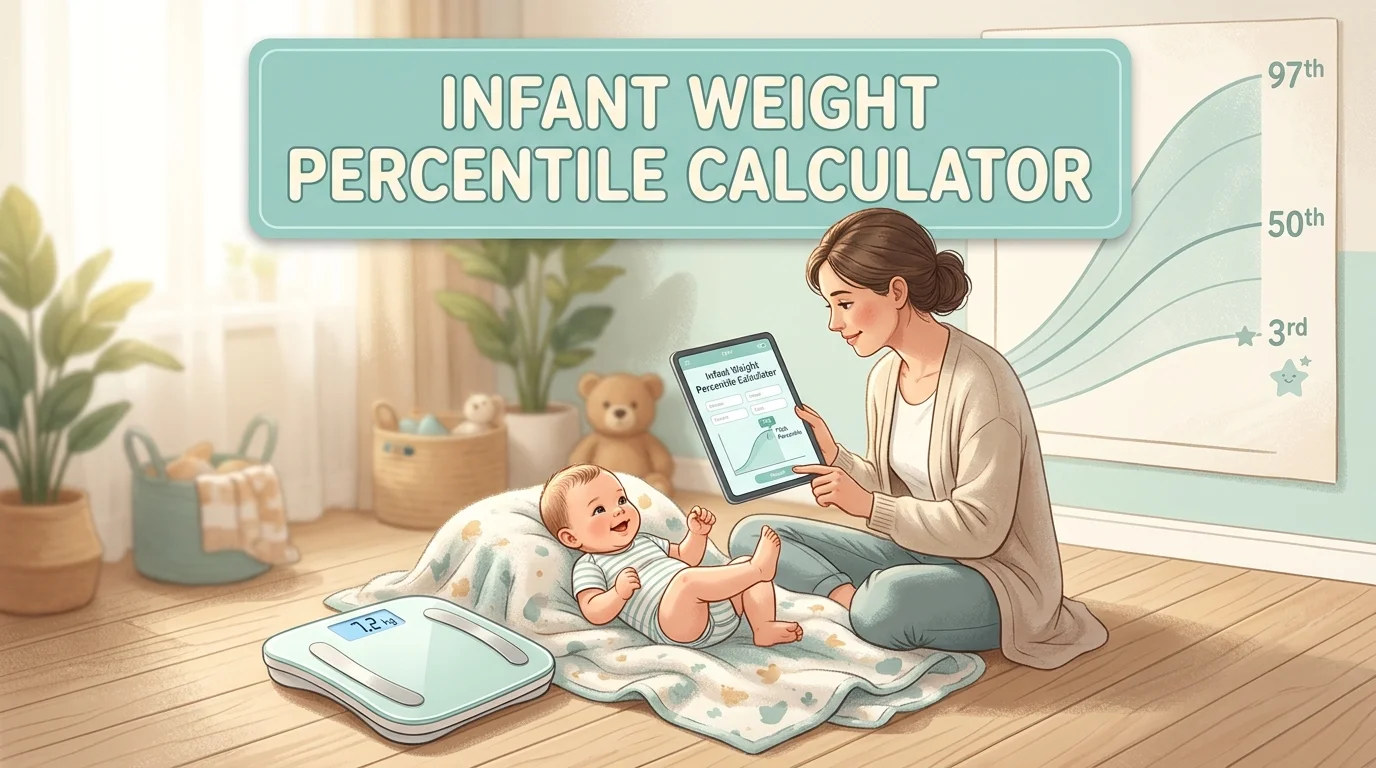
An infant weight percentile calculator helps parents understand how their baby’s weight compares with other babies of the same age and sex. It uses established child growth standards to estimate where an infant’s weight falls within a reference population. This information can make it easier to monitor growth, recognize changes, and discuss concerns with a healthcare professional.
Every baby grows differently. Some infants naturally have smaller body frames, while others weigh more than most babies of the same age. A baby at the 15th percentile can be healthy, just as a baby at the 85th percentile can be healthy. The percentile itself does not determine whether a child is developing properly.
During infancy, weight changes rapidly. Feeding patterns, genetics, birth weight, gestational age, and general health can all influence growth. That is why parents should look at measurements over time instead of focusing on one number.
A baby weight percentile calculator provides a convenient starting point for understanding these measurements. By entering your baby’s age, sex, and current weight, you can compare the result with an appropriate growth reference.
In this guide, you’ll learn how an infant weight percentile calculator works, how to interpret different results, how WHO growth standards are used, and what to do if your baby’s weight changes unexpectedly.
What Is an Infant Weight Percentile Calculator?
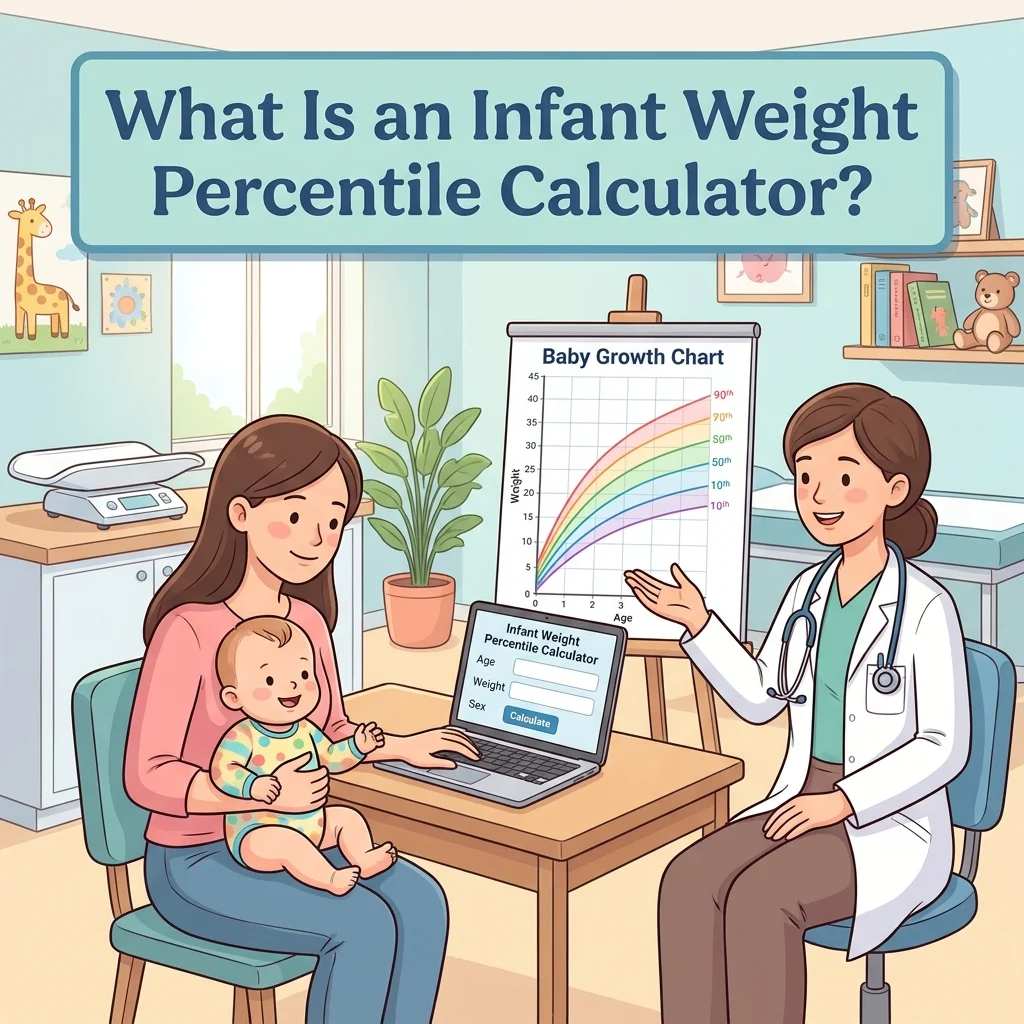
An infant weight percentile calculator is a tool that compares a baby’s weight with the measurements of other babies in the same age and sex group.
It uses a growth chart to estimate the baby’s position within a reference population. The result is expressed as a percentile.
For example, if your baby is at the 50th percentile, approximately half of the babies in the reference population weigh less, while the other half weigh more.
If your baby is at the 25th percentile, approximately 25% of comparable babies weigh the same or less, while 75% weigh more.
A percentile is a comparison, not a medical diagnosis. It does not independently measure nutrition, physical strength, or overall health.
Most reliable infant growth percentile calculators use the World Health Organization (WHO) Child Growth Standards for children younger than two years.
These standards provide separate growth references for Children. They include several measurements:
- Weight-for-age
- Length-for-age
- Weight-for-length
- Head circumference-for-age
Each measurement provides different information about physical development.
A weight-for-age calculator focuses on the baby’s weight relative to age. However, a healthcare professional may also consider length and head circumference to understand the complete growth pattern.
How Does a Baby Weight Percentile Calculator Work?
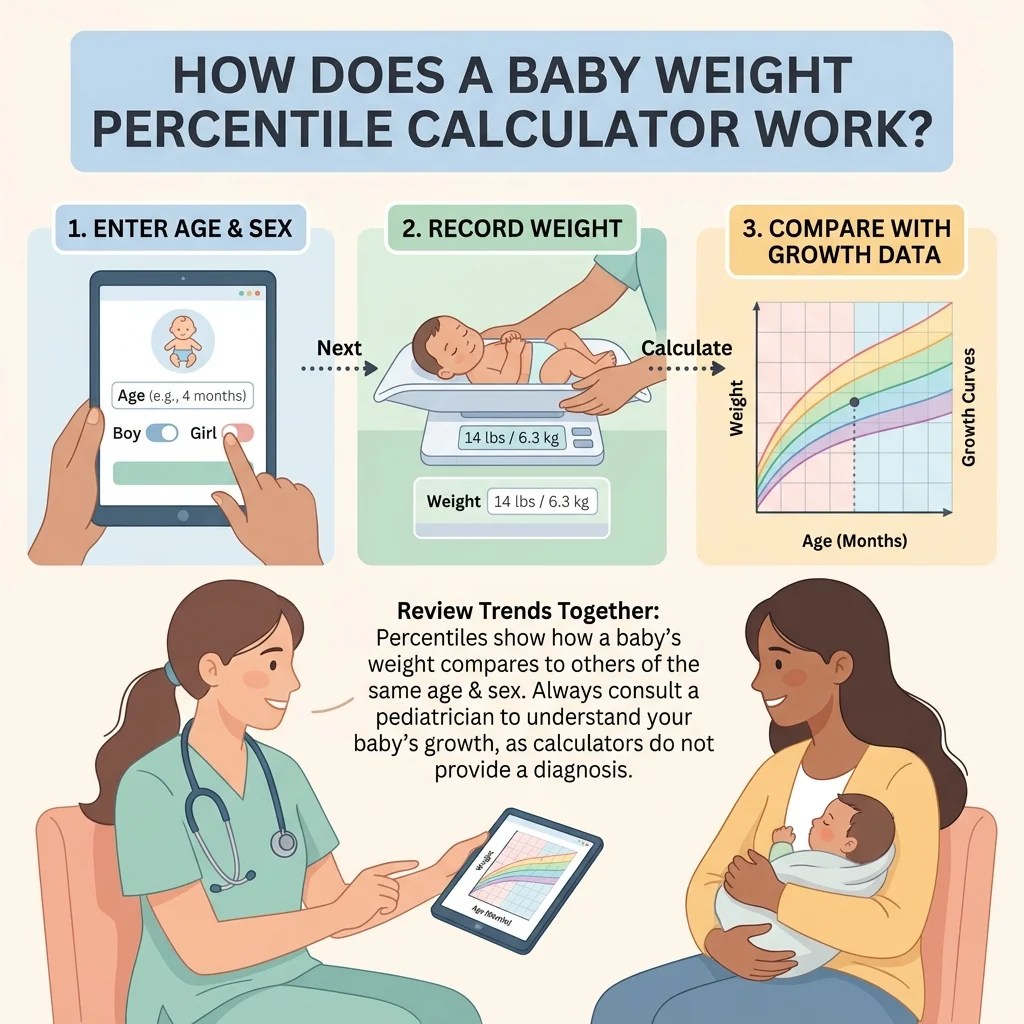
A baby weight percentile calculator compares three main details against an established growth reference.
These details include the baby’s age, sex, and current weight.
For example, imagine a six-month-old baby weighs 7.5 kilograms. The calculator uses the baby’s exact age and sex to compare that measurement with the appropriate WHO reference data.
It then estimates the corresponding percentile.
Here is how the process works.
Step 1: Enter Your Baby’s Age
Start by entering your baby’s current age.
Depending on the calculator, you may be able to enter the age in:
- Days
- Weeks
- Completed months
- Years and months
For young infants, an exact age in days or weeks can provide a more precise comparison.
Remember that some growth charts use completed months, while more advanced calculators use exact age in days.
Step 2: Select Your Baby’s Sex
Choose the appropriate reference for a boy or girl.
WHO growth standards contain separate charts because typical growth patterns differ between Children.
Selecting the correct option is important for obtaining a meaningful result.
Step 3: Enter the Current Weight
Enter your baby’s latest measured weight.
Common measurement units include:
- Kilograms (kg)
- Grams (g)
- Pounds (lb)
- Ounces (oz)
Check the selected unit before submitting the information.
For example, 7 kilograms is approximately 15.43 pounds. Entering the wrong unit can produce an incorrect result.
Step 4: Calculate the Weight Percentile
After entering the required information, the calculator compares your baby’s weight with the reference data.
The result may show a percentile, a z-score, or both.
A percentile explains your baby’s relative position within the reference population. A z-score describes how far the measurement is from the reference median in standard deviation units.
Step 5: Review the Result
Read the result carefully.
Do not assume that a lower percentile means poor health or that a higher percentile means better development.
Compare the result with previous measurements and discuss unexpected changes with your healthcare professional.
Infant Weight Percentile Chart by Age
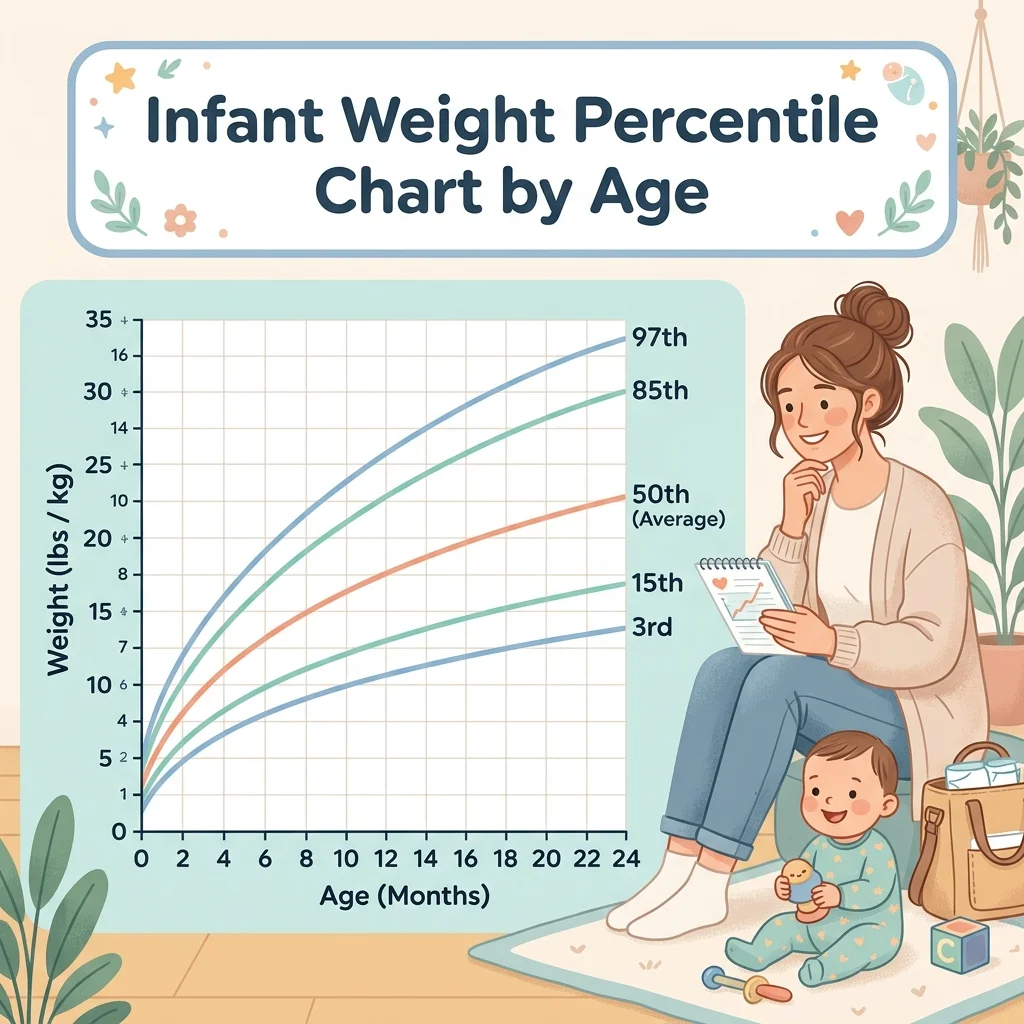
An infant weight percentile chart shows how a baby’s weight compares with the weights of other babies of the same age and sex.
WHO provides separate weight-for-age charts for Children. These charts include multiple percentile curves, making it possible to see more than the median weight.
For accurate comparisons, use the official charts rather than relying on a general average-weight table.
Official WHO Growth Charts
The following resources provide the appropriate growth references:
- Boys: WHO weight-for-age charts and tables
- Girls: WHO weight-for-age charts and tables
The WHO resource includes charts for birth to six months, birth to two years, and other age ranges. It also provides downloadable percentile and z-score tables.
Understanding Different Percentile Lines
A typical infant weight chart contains several curved lines.
Each curve represents a different percentile.
| Percentile | General meaning |
| 3rd | Approximately 3% of comparable babies weigh the same or less |
| 10th | Approximately 10% weigh the same or less |
| 25th | Approximately 25% weigh the same or less |
| 50th | The middle of the reference population |
| 75th | Approximately 75% weigh the same or less |
| 90th | Approximately 90% weigh the same or less |
| 97th | Approximately 97% weigh the same or less |
These values help parents understand the position of a baby’s measurement.
They are not strict limits separating healthy and unhealthy infants.
Why Are Boys’ and Girls’ Weight Charts Different?
Children have different average growth patterns during infancy.
For example, the median weight of boys is generally higher than that of girls at several ages.
Using separate charts makes comparisons more appropriate.
A baby weight percentile chart by age should always match the baby’s sex and age to avoid misleading results.
How to Understand Your Baby’s Weight Percentile
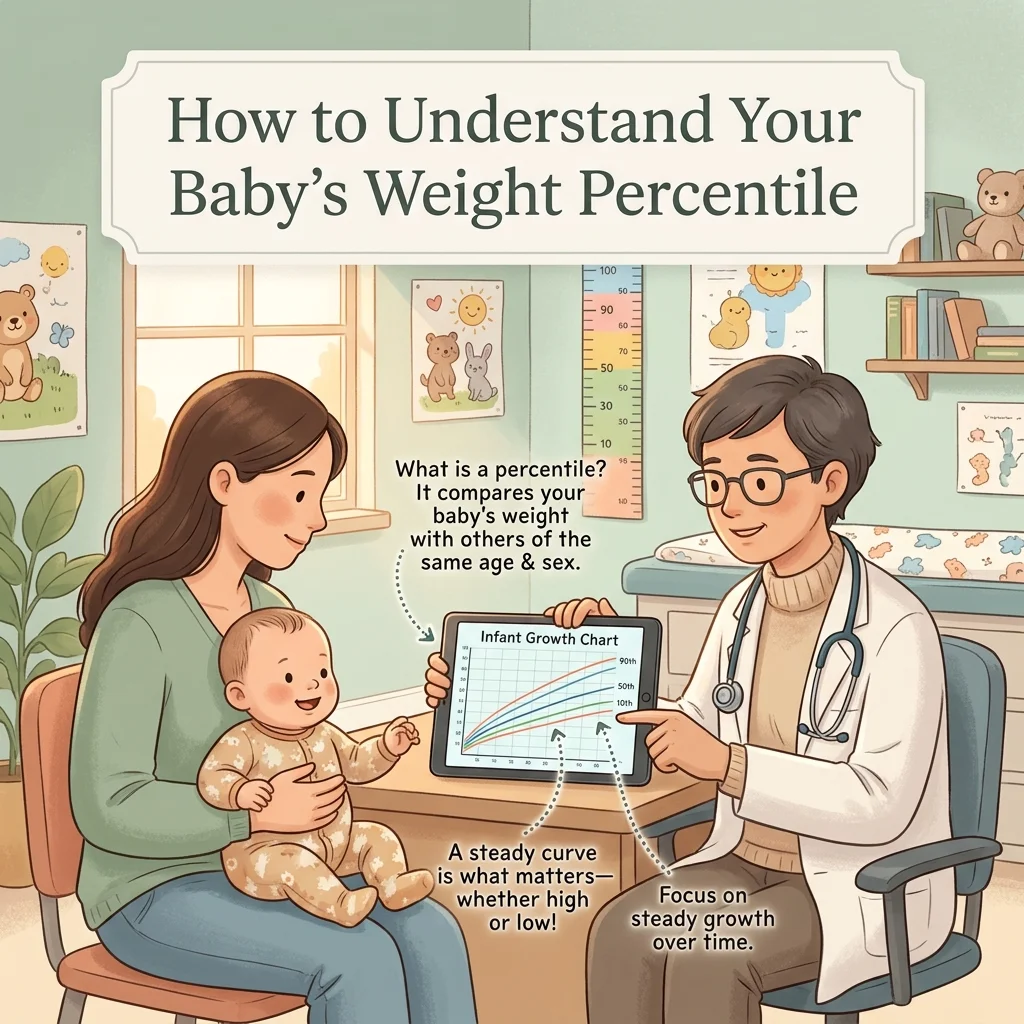
Understanding the result is just as important as calculating it.
A percentile shows where your baby’s weight falls compared with the reference population. It does not tell you whether your baby is healthy without considering other information.
Here are some examples.
What Does the 3rd Percentile Mean?
A baby at the 3rd percentile weighs more than approximately 3% of comparable babies.
This means that approximately 97% of babies in the reference group weigh more.
Some healthy infants naturally follow lower growth curves. However, a healthcare professional may review the baby’s feeding, medical history, length, and previous measurements.
What Does the 10th Percentile Mean?
The 10th percentile means that approximately 10% of comparable babies weigh the same or less.
A baby at this percentile may simply have a smaller body frame.
The doctor will consider whether the baby continues to gain weight appropriately and whether other developmental measurements are satisfactory.
What Does the 25th Percentile Mean?
A baby at the 25th percentile weighs more than approximately one-quarter of babies in the reference population.
This is not automatically a sign of underweight or poor growth.
If the infant follows a consistent growth pattern and has no concerning symptoms, the result may simply reflect natural differences in body size.
What Does the 50th Percentile Mean?
The 50th percentile represents the middle of the reference population.
Approximately half of comparable babies weigh less, and half weigh more.
It is important to remember that the 50th percentile is not the ideal weight for every baby.
Your child does not need to reach this number to develop normally.
What Does the 75th Percentile Mean?
A baby at the 75th percentile weighs more than approximately 75% of comparable babies.
This may reflect family characteristics, genetics, and natural differences in growth.
A higher percentile does not automatically mean that the baby is higher-weight person.
What Do the 90th and 97th Percentiles Mean?
These percentiles indicate that a baby weighs more than most infants in the comparison group.
For example, a baby at the 90th percentile weighs the same as or more than approximately 90% of comparable babies.
Healthcare professionals may compare weight with length to understand whether the infant’s weight is proportionate to their body size.
Practical Infant Weight Percentile Calculation Example
Understanding a practical example can make percentile calculations easier.
Imagine a parent wants to check the growth of a six-month-old baby boy.
The parent has the following information:
| Measurement | Example information |
| Age | 6 months |
| Sex | Boy |
| Weight | 7.5 kg |
| Growth reference | WHO weight-for-age |
| Measurement type | Weight-for-age percentile |
The parent enters these details into an appropriate infant weight percentile calculator.
The calculator compares the measurement with the WHO reference data for boys at the baby’s exact age.
Suppose the calculator returns the 40th percentile.
This means the baby weighs more than approximately 40% of comparable boys and less than approximately 60%.
It does not mean that the baby is underweight or needs additional feeding.
The result should be reviewed alongside previous weight measurements, body length, feeding patterns, and general development.
Important: The 40th percentile in this example is illustrative, not a calculated result for the stated weight. An exact result requires the appropriate WHO reference parameters and exact age.
WHO Infant Growth Standards Explained
The World Health Organization developed international child growth standards to describe how children grow under favorable environmental, nutritional, and health conditions.
These standards are widely used by healthcare professionals to monitor infant development.
The WHO Multicentre Growth Reference Study provided the foundation for these standards.
The charts include several indicators.
Weight-for-Age
Weight-for-age compares an infant’s weight with the reference weight of babies of the same age and sex.
It helps healthcare professionals identify whether a baby is relatively lighter or heavier than the reference population.
However, it does not show whether the baby’s weight is appropriate for their length.
Length-for-Age
Length-for-age compares a baby’s body length with the length of other babies of the same age and sex.
It provides information about linear growth.
Healthcare professionals may consider this measurement when assessing physical development.
Weight-for-Length
Weight-for-length compares a baby’s weight with their body length.
This is especially useful because two babies of the same age can have different body proportions.
For example, a shorter baby and a longer baby may weigh the same amount.
Their weight-for-length measurements can provide different information about growth.
Head Circumference-for-Age
Head circumference measures the size of a baby’s head.
Healthcare professionals compare this measurement with age- and sex-specific references to monitor head growth.
It provides another important part of infant development assessment.
The four measurements work together to provide a more complete understanding of growth than weight alone.
Infant Weight by Age: What Parents Should Know
Baby weight changes throughout infancy. Growth is generally faster during the first few months and gradually becomes slower as children develop.
However, individual growth rates vary.
Newborn Weight
Many full-term newborns weigh between approximately 2.5 and 4 kilograms at birth.
However, healthy birth weights can fall outside this range.
Some newborns lose weight during the first few days after birth because of normal fluid changes.
Most regain their birth weight within approximately 10 to 14 days.
A newborn weight percentile calculator can help compare birth weight with an appropriate reference, but gestational age should also be considered.
Weight at 1 to 3 Months
During the first three months, babies generally gain weight relatively quickly.
Breast milk or properly prepared infant formula provides the main nutrition during this period.
Feeding frequency and intake can vary from one infant to another.
Regular health visits help healthcare professionals monitor whether weight gain is progressing appropriately.
Weight at 4 to 6 Months
Between four and six months, babies continue developing physically.
Some may begin rolling, reaching for objects, and becoming more active.
Around six months, many infants become ready to start complementary foods, depending on developmental readiness.
Breast milk or infant formula remains an important source of nutrition.
Weight at 7 to 9 Months
Babies often become more physically active during this stage.
They may sit without support, crawl, and explore their surroundings.
Changes in activity and feeding habits can influence weight gain.
Parents should continue monitoring growth rather than expecting the same rate of weight gain seen during the newborn stage.
Weight at 10 to 12 Months
By the first birthday, many babies have approximately tripled their birth weight.
This is a general developmental guideline, not a strict requirement.
Feeding patterns, mobility, and physical development continue changing throughout this period.
A healthcare professional can assess whether the baby’s weight and length are progressing appropriately.
What Is the Difference Between Weight Percentile and Average Weight?
Parents sometimes confuse an average weight with a weight percentile.
Although these measurements are related, they do not mean the same thing.
An average is calculated by adding a group of measurements and dividing the total by the number of measurements.
A percentile shows the position of an individual measurement within a reference population.
The 50th percentile represents the median, which is the middle value of the reference distribution.
For example, a baby at the 25th percentile weighs less than most babies in the comparison group but may still be developing normally.
That is why percentile information is more useful when interpreted alongside a baby’s previous measurements.
What Factors Affect an Infant’s Weight Percentile?
Several factors influence infant growth. Understanding them can help parents avoid unnecessary comparisons.
Genetics and Family Body Size
Genetics plays an important role in physical development.
Parents with naturally smaller body frames may have babies who also follow smaller growth patterns.
Similarly, family characteristics may influence an infant’s natural size.
However, genetics is not the only factor involved in growth.
Breastfeeding and Formula Feeding
Breast milk and infant formula provide essential nutrition during infancy.
Feeding frequency, milk intake, and individual appetite can vary.
Some babies feed more frequently, while others take larger amounts at fewer intervals.
If a baby has difficulty feeding or gaining weight, a healthcare professional can assess the situation.
Birth Weight and Gestational Age
Birth weight influences the starting point of an infant’s growth journey.
Babies born prematurely may have different growth patterns from full-term babies.
Their growth assessments may require corrected age and specialized growth charts.
Medical Conditions
Certain health conditions can affect infant weight gain.
These include feeding difficulties, gastrointestinal problems, infections, and some metabolic conditions.
Persistent vomiting, diarrhea, poor feeding, or unexpected weight changes should be discussed with a healthcare professional.
Physical Activity and Development
Babies become increasingly active as they grow.
Rolling, crawling, sitting, and moving around are important developmental changes.
Their appetite and weight gain may change as activity increases.
Introduction of Complementary Foods
Many infants begin complementary foods around six months when developmentally ready.
The introduction of solid foods gradually changes feeding patterns.
Parents should offer age-appropriate foods while continuing breast milk or infant formula according to professional guidance.
How Often Should You Check Your Baby’s Weight?
Parents do not need to calculate their baby’s percentile every day.
Frequent home weighing may create unnecessary concern because normal changes in hydration, feeding, clothing, and measurement conditions can affect the result.
Instead, follow the schedule recommended by your healthcare professional.
During routine visits, healthcare providers commonly measure:
- Weight
- Body length
- Head circumference
- Other relevant developmental indicators
Newborns may need more frequent weight checks, especially when feeding or weight gain requires closer monitoring.
As babies grow, measurements are generally reviewed during scheduled health visits.
If your doctor recommends additional measurements, follow that individual schedule.
What If Your Baby Has a Low Weight Percentile?
A low percentile does not automatically mean that your baby is unhealthy or undernourished.
Some infants naturally follow lower growth curves because of genetics and individual body size.
However, healthcare professionals may investigate when an infant has poor weight gain, an unusual change in growth pattern, or other concerning signs.
They may review:
- Breastfeeding or formula-feeding history.
- Feeding frequency and effectiveness.
- Wet diapers and hydration.
- Previous weight measurements.
- Length and head circumference.
- Medical history and development.
A doctor may recommend additional assessments if necessary.
Do not independently increase formula concentration, give unnecessary supplements, or change feeding practices to raise a percentile.
These decisions should be made with qualified medical guidance.
What If Your Baby Has a High Weight Percentile?
A high weight percentile does not automatically indicate excess body fat or an unhealthy condition.
Some babies naturally have larger body frames.
Healthcare professionals consider weight together with length, feeding patterns, family history, and previous measurements.
For example, an infant with a high weight percentile and a proportionately high length percentile may have a different growth pattern from an infant whose weight is high relative to length.
Weight-for-length provides additional information that weight-for-age cannot show on its own.
The goal is not to increase or decrease a percentile without reason. The goal is to support healthy development.
Understanding Changes in Your Baby’s Growth Percentile
Following your baby’s growth pattern over time is more useful than focusing on one measurement.
An infant may start near the 25th percentile and continue following a similar curve for several months.
Another infant may consistently follow the 75th percentile.
Both patterns can be normal.
However, a noticeable change across repeated measurements may deserve further assessment.
For example, if a baby moves from a higher growth percentile to a much lower one, a healthcare professional may investigate possible reasons.
These can include:
- Inaccurate measurements.
- Temporary illness.
- Feeding difficulties.
- Changes in nutritional intake.
- Prematurity.
- An underlying medical condition.
A percentile change does not automatically indicate a health problem.
The American Academy of Pediatrics explains that growth faltering should be assessed using the child’s complete growth pattern and appropriate measurements rather than a single percentile alone.
Special Considerations for Premature Babies
Premature babies are born before completing 37 weeks of pregnancy.
Their growth assessment may require different methods from those used for full-term infants.
A premature baby may be smaller because they had less time to grow inside the uterus.
Healthcare professionals may use specialized charts, including the Fenton growth charts, during the early stages of growth monitoring.
They may also use corrected age when assessing development and growth.
Corrected age accounts for the number of weeks the baby was born before the expected due date.
For example, if a baby was born eight weeks early and is currently 16 weeks old, the corrected age is approximately eight weeks.
The American Academy of Pediatrics advises using corrected age for premature infants until three years of age.
Parents should not select a growth chart or adjust age independently without guidance from their baby’s medical team.
Common Mistakes to Avoid When Using an Infant Weight Percentile Calculator
An online baby growth chart calculator is useful only when the information entered is accurate and the result is interpreted correctly.
Avoid these common mistakes.
Using the wrong age: A three-month-old and a six-month-old should not be compared using the same age-specific reference.
Selecting the wrong sex-specific chart: Children have different growth reference curves.
Entering an incorrect weight unit: Kilograms, pounds, and grams are not interchangeable.
Ignoring previous measurements: One result cannot show the complete growth pattern.
Treating the 50th percentile as the ideal: Babies do not need to reach the middle percentile to be healthy.
Assuming a low percentile means malnutrition: A smaller baby may be healthy and growing consistently.
Ignoring body length: Weight-for-age alone cannot show whether an infant’s weight is appropriate for their length.
Checking weight too frequently: Daily changes can be misleading.
Using an adult BMI calculator: Adult BMI categories are not appropriate for assessing infants.
Using an unsuitable growth reference: Make sure the calculator uses an appropriate chart for your baby’s age and circumstances.
Avoiding these mistakes makes growth tracking more useful and meaningful.
When Should You Contact a Healthcare Professional?
Contact your baby’s doctor if you notice unexpected weight changes or have concerns about feeding and development.
A professional assessment is particularly important if your baby:
- Has persistent difficulty feeding.
- Gains weight more slowly than expected.
- Loses weight unexpectedly.
- Has fewer wet diapers than usual.
- Shows signs of dehydration.
- Has repeated vomiting or persistent diarrhea.
- Appears unusually sleepy or difficult to wake.
- Has a noticeable decline in their established growth pattern.
Seek urgent medical attention if your baby is difficult to wake, has serious breathing difficulties, or shows other signs of severe illness.
Do not wait for an online percentile result if your baby appears seriously unwell.
A healthcare professional can evaluate the baby’s measurements, symptoms, feeding history, and overall development to determine whether further investigation is needed.
Frequently Asked Questions About Infant Weight Percentile Calculators
What is a normal weight percentile for an infant?
There is no single percentile that every infant must reach. A baby can be healthy at many different percentiles. Healthcare professionals consider the baby’s overall growth pattern, medical history, and other measurements.
How do I calculate my infant’s weight percentile?
Enter your baby’s age, sex, and current weight into an appropriate infant weight percentile calculator. The tool compares these details with an established growth reference to estimate the baby’s percentile.
What is a baby weight percentile by age?
A baby weight percentile by age shows how an infant’s weight compares with the weight of other babies of the same age and sex. It helps parents and healthcare professionals monitor growth patterns over time.
Is the 50th percentile the best for a baby?
No. The 50th percentile is simply the middle of the reference population. It is not a target that every baby needs to achieve. Consistent and appropriate growth is generally more important than reaching a particular percentile.
How accurate is an infant weight percentile calculator?
An infant weight percentile calculator can provide a useful estimate when it uses appropriate growth standards and accurate measurements. Its accuracy depends on the baby’s exact age, sex, weight, and the reference data used. It cannot replace a medical assessment.
Can I calculate my baby’s weight percentile at home?
Yes. You can use an online calculator or official WHO growth charts if you know your baby’s age, sex, and current weight. Make sure you select the correct growth reference and measurement units.
What is the difference between weight-for-age and weight-for-length?
Weight-for-age compares an infant’s weight with other babies of the same age and sex. Weight-for-length compares weight with body length. Both measurements provide different information about physical development.
Should I worry if my baby is in the 10th percentile?
Not necessarily. Many healthy babies naturally follow lower growth curves. Your healthcare professional will consider whether the baby is gaining weight appropriately and whether other health indicators are satisfactory.
Can breastfeeding affect infant weight percentiles?
Breastfed babies may show different average growth patterns from formula-fed babies during certain stages of infancy. WHO growth standards were developed using healthy children and include breastfeeding as an important part of optimal growth conditions. Both breast milk and properly prepared infant formula can support healthy development.
How much weight should a baby gain each month?
Weight gain varies with age, birth weight, feeding, and individual development. Babies generally gain weight more quickly during their first few months than later in infancy. Healthcare professionals use age-specific growth references and repeated measurements rather than one fixed monthly target.
Do premature babies need a different weight percentile calculator?
Often, yes. Premature infants may need specialized growth charts and corrected age. Their healthcare professionals can determine the appropriate chart and measurement method based on gestational age and developmental progress.
Does a high weight percentile mean my baby is higher-weight person?
No. A high weight-for-age percentile alone cannot determine whether an infant has excess body fat. Weight-for-length and other growth measurements provide additional information. A healthcare professional should interpret the results.
When should I stop using an infant weight percentile calculator?
WHO growth standards are commonly used for children from birth to five years. However, healthcare professionals generally use different growth references after age two in countries following CDC recommendations. Follow the growth chart recommended by your child’s healthcare provider.
Final Thoughts
An infant weight percentile calculator is a helpful resource for understanding your baby’s growth. It compares weight with established age- and sex-specific growth standards and provides information that can support routine health monitoring. Whether you use a newborn weight percentile calculator, a baby weight percentile chart by age, or an official WHO growth chart, remember that every baby develops differently.
A low, middle, or high percentile does not automatically determine whether an infant is healthy. Growth patterns, feeding, length, head circumference, and overall development all matter. Use accurate measurements, record your baby’s progress over time, and discuss unexpected changes with a healthcare professional. Avoid comparing your baby with other children or trying to reach a particular percentile.

I am David Wilson, a passionate writer dedicated to creating informative, engaging, and valuable content for readers. I enjoy researching different topics and sharing well-crafted articles that provide helpful insights, practical knowledge, and meaningful information. I am committed to maintaining high-quality writing standards with a focus on accuracy, clarity, and reader satisfaction.