
Shipping costs are not always determined by how much a package weighs. Sometimes, a lightweight box can cost more to ship than a heavier one because it occupies more space inside a delivery vehicle or aircraft. This is why understanding dimensional weight is important for individuals, online sellers, and businesses that regularly send packages.
A dimensional weight calculator helps you estimate the weight of a shipment using its length, width, and height. Shipping companies use this calculation to account for the space a package occupies during transportation. They may compare the calculated weight with the actual weight and charge according to the higher value.
Whether you ship products domestically or internationally, understanding DIM weight can help you avoid unexpected charges and choose better packaging. It can also make it easier to compare shipping services and estimate fulfillment expenses.
In this guide, you will learn how dimensional weight works, which formulas shipping companies use, how to calculate billable weight, and what you can do to reduce shipping expenses. You will also find practical examples, carrier information, and answers to common shipping questions.
What Is a Dimensional Weight Calculator?

A dimensional weight calculator is a tool that estimates a package’s weight based on its physical size rather than its actual mass.
It uses three measurements:
- Length
- Width
- Height
You multiply these measurements to determine the package volume. Then, you divide that volume by a number called the dimensional weight divisor.
The result is the dimensional weight, also known as DIM weight or volumetric weight.
For example, imagine that you are shipping a large box containing pillows. The package might weigh only 6 pounds, but its dimensions could be 24 × 20 × 16 inches.
Although the contents are lightweight, the box occupies considerable space. A shipping company may therefore charge according to its dimensional weight instead of its actual weight.
A DIM weight calculator makes this process easier by performing the calculation automatically.
Why Do Shipping Companies Use Dimensional Weight?
Shipping vehicles have limited space. An airplane can carry only a certain amount of cargo, and delivery trucks have limited storage capacity.
If a company charged only according to actual weight, customers could ship large, lightweight packages without paying for the space they occupy.
Dimensional weight pricing helps shipping companies account for both package size and physical weight.
This approach also encourages businesses to use appropriately sized packaging rather than shipping products in unnecessarily large boxes.
Benefits of Using a DIM Weight Calculator
A dimensional weight calculator offers several practical benefits.
Estimate shipping expenses: Calculate your package’s dimensional weight before purchasing a shipping label.
Avoid billing surprises: Understand why a carrier might charge more than the actual weight suggests.
Compare shipping services: Check how different dimensional divisors affect your estimated billable weight.
Improve packaging decisions: Identify oversized boxes that increase transportation costs.
Manage business expenses: Estimate shipping costs when setting prices for online products.
Prepare international shipments: Calculate volumetric weight using metric or imperial measurements.
For businesses that ship hundreds of orders each month, accurate calculations can make a noticeable difference in packaging and transportation expenses.
What Is Dimensional Weight in Shipping?
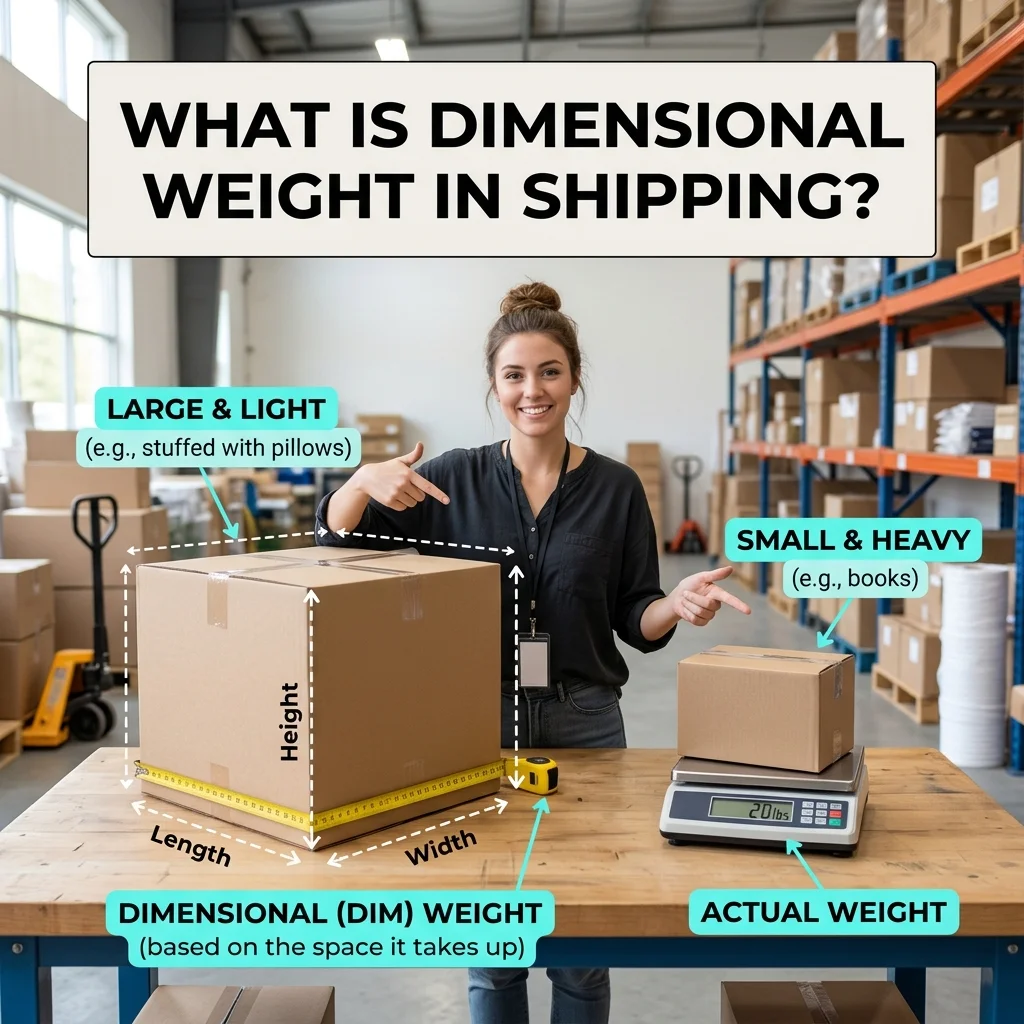
Dimensional weight is a calculated measurement that represents the space a package occupies during transportation.
It is commonly called:
- DIM weight
- Dimensional shipping weight
- Volumetric weight
- Package volumetric weight
- Cubic weight
These terms generally describe the same shipping concept, although carriers may use different terminology and calculation methods.
Dimensional weight is particularly important when shipping lightweight products in large boxes.
Consider these two packages:
| Package | Actual Weight | Dimensions |
| Package A | 20 lb | 12 × 10 × 8 in |
| Package B | 6 lb | 24 × 18 × 16 in |
Package B weighs less physically. However, its larger dimensions can produce a much higher dimensional weight.
This explains why the actual weight of a package does not always determine its shipping charge.
What Is the Difference Between DIM Weight and Volumetric Weight?
DIM weight and volumetric weight generally refer to the same calculation.
The terminology often depends on the shipping company and transportation market.
In the United States, carriers commonly use the expression dimensional weight. International courier services frequently use volumetric weight.
The calculation also depends on the measurement system.
For example:
- Cubic inches divided by a suitable divisor produce dimensional weight in pounds.
- Cubic centimeters divided by a suitable divisor produce volumetric weight in kilograms.
Both methods estimate the transportation space occupied by a package.
Dimensional Weight Formula
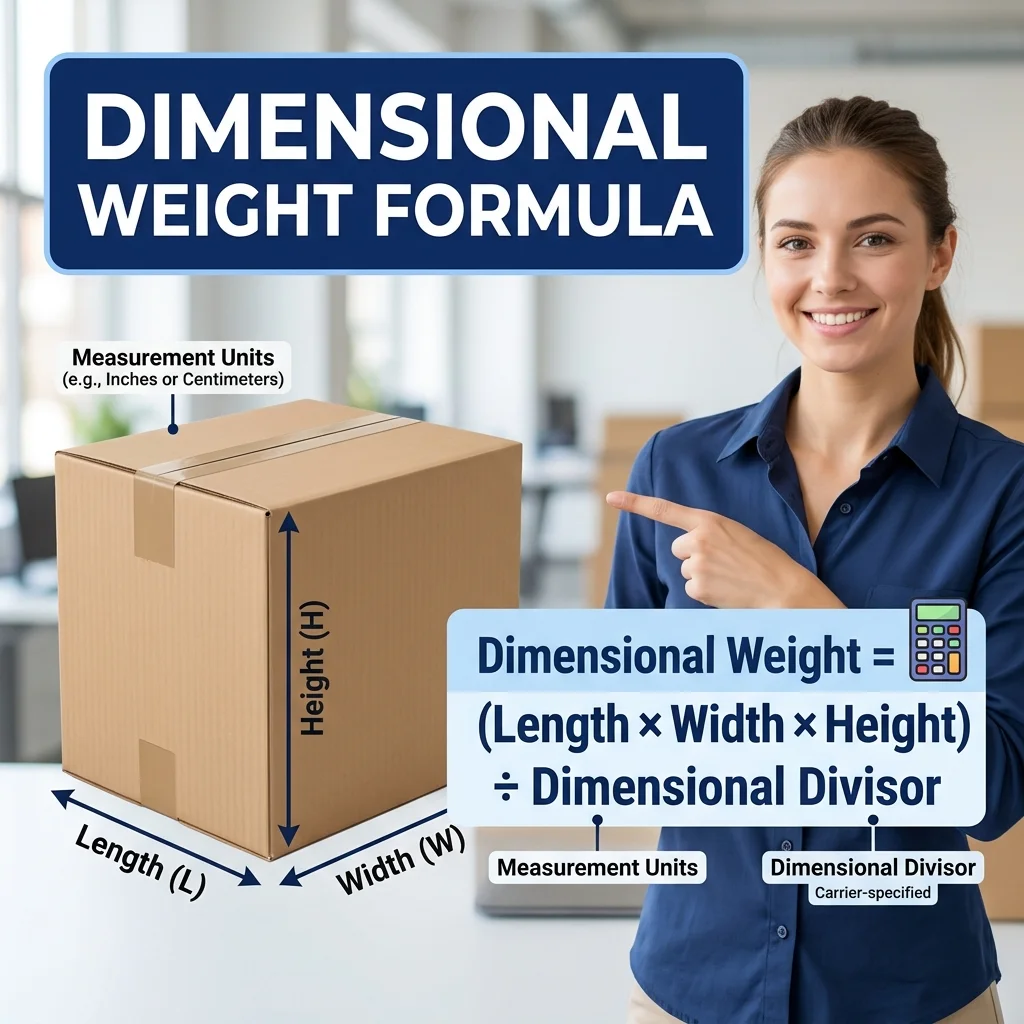
The dimensional weight formula uses the package’s three outside measurements and an appropriate dimensional divisor.
The standard formula is:
Dimensional Weight = (Length × Width × Height) ÷ DIM Divisor
The divisor converts the package’s volume into a weight value.
You must use the correct divisor for your carrier and shipping service. A formula using the wrong divisor can produce an inaccurate estimate.
How to Calculate Dimensional Weight in Inches
When measuring a package in inches, use a divisor expressed in cubic inches per pound.
For example, suppose your package has these measurements:
- Length: 20 inches
- Width: 15 inches
- Height: 10 inches
- DIM divisor: 139
First, calculate the volume.
20 × 15 × 10 = 3,000 cubic inches.
Next, divide the volume by the divisor.
3,000 ÷ 139 = 21.58 pounds.
The calculated dimensional weight is approximately 21.58 pounds.
The carrier may round the result according to its own billing requirements.
How to Calculate Volumetric Weight in Kilograms
International shipments frequently use centimeters and kilograms.
The calculation follows the same principle:
Volumetric Weight = (Length × Width × Height) ÷ Volumetric Divisor
Consider a package with these measurements:
- Length: 50 cm
- Width: 40 cm
- Height: 30 cm
- Divisor: 5,000
Calculate the volume:
50 × 40 × 30 = 60,000 cubic centimeters.
Divide the volume by 5,000:
60,000 ÷ 5,000 = 12 kg.
The volumetric weight is 12 kilograms.
This is a commonly used metric calculation for certain express courier services, including DHL Express. However, always confirm the applicable divisor for your shipment.
How to Calculate DIM Weight Manually
You do not need special software to calculate dimensional weight.
Follow these steps:
- Measure the outside length of your packed box.
- Measure the outside width.
- Measure the outside height.
- Multiply the three measurements.
- Divide the result by the appropriate DIM divisor.
- Apply the carrier’s measurement and weight rounding rules.
For example, a box measuring 18 × 12 × 10 inches has a volume of 2,160 cubic inches.
Using a divisor of 139:
2,160 ÷ 139 = 15.54 pounds.
The dimensional weight is approximately 15.54 pounds before carrier rounding.
An online dimensional weight calculator can complete these steps instantly.
How to Use a Dimensional Weight Calculator
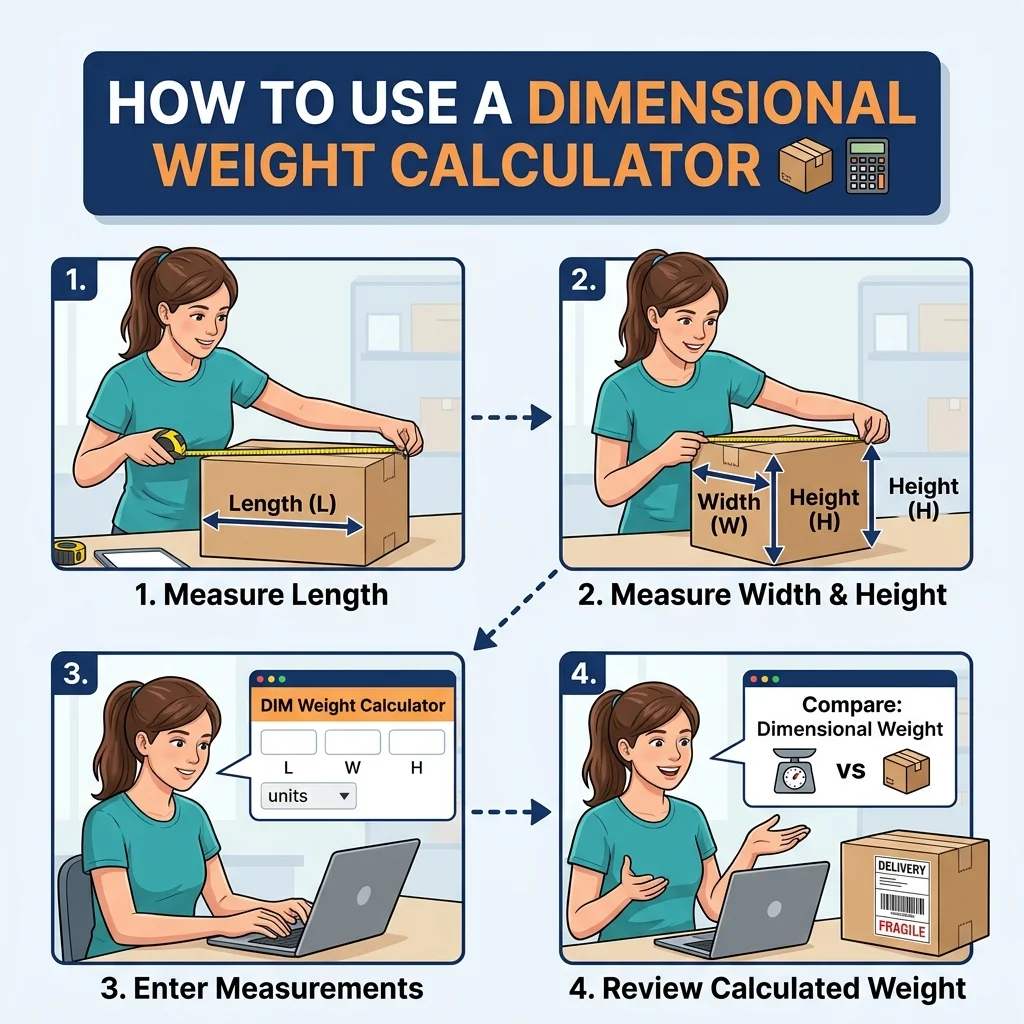
Using a dimensional weight calculator is straightforward. You only need accurate package measurements and the correct divisor.
Step 1: Measure the Package Length
Place your fully packed box on a flat surface.
Measure its longest side. This measurement is generally considered the length.
Do not measure only the product inside the box. Shipping companies need the outside dimensions of the completed package.
Step 2: Measure the Width
Measure the second side of the package.
Keep your measuring tape straight and measure the outermost points.
Step 3: Measure the Height
Measure the remaining side from the bottom to the top.
Make sure your package is fully packed before taking measurements.
Step 4: Select the Measurement Unit
Choose the correct measurement system.
You can generally use:
- Inches and pounds
- Centimeters and kilograms
Do not mix inches and centimeters in the same calculation.
Step 5: Enter the DIM Divisor
Select the divisor required by your shipping company.
For example, some US parcel calculations use 139, while certain international metric calculations use 5,000.
These values are examples, not universal rules.
Step 6: Enter the Actual Weight
Weigh your complete package using a suitable shipping scale.
Include the product, box, cushioning, tape, and other packaging materials.
Step 7: Calculate the Dimensional and Billable Weight
The calculator will determine dimensional weight from your package measurements.
Compare this result with actual weight.
For services that use the greater-of-two rule, the higher value becomes the starting point for billable weight.
Remember that the final rated weight may be different after the carrier applies rounding, minimums, or other billing conditions.
Actual Weight vs. Dimensional Weight
Actual weight and dimensional weight measure two different characteristics of a shipment.
Dimensional weight is a calculated value based on its outside measurements.
Understanding actual weight vs dimensional weight is important because shipping companies may use both measurements to determine transportation charges.
| Comparison | Actual Weight | Dimensional Weight |
| Definition | Physical package mass | Calculated weight based on volume |
| Measurement method | Weighing scale | Length × width × height |
| Common units | Pounds and kilograms | Pounds and kilograms |
| Main factor | Product and packaging mass | Package dimensions and divisor |
| Purpose | Measures physical weight | Accounts for transportation space |
Example: When Dimensional Weight Is Higher
Suppose a package has these details:
- Actual weight: 10 pounds
- Length: 24 inches
- Width: 18 inches
- Height: 12 inches
- DIM divisor: 139
First, calculate its volume:
24 × 18 × 12 = 5,184 cubic inches.
Next, calculate dimensional weight:
5,184 ÷ 139 = 37.29 pounds.
The dimensional weight is significantly higher than the actual weight.
If the carrier applies the greater-of-two rule, dimensional weight will determine the starting billable weight.
Example: When Actual Weight Is Higher
Now consider a smaller but heavier package:
- Actual weight: 30 pounds
- Length: 15 inches
- Width: 12 inches
- Height: 10 inches
- DIM divisor: 139
Volume:
15 × 12 × 10 = 1,800 cubic inches.
Dimensional weight:
1,800 ÷ 139 = 12.95 pounds.
The actual weight is higher than the dimensional weight.
Therefore, a carrier using the greater-of-two rule may bill the package according to its actual weight.
What Is Billable Weight?
Billable weight is the weight a shipping company uses when calculating the transportation charge.
For many parcel services, the billable weight is based on the greater of actual weight and dimensional weight.
The basic formula is:
Billable Weight = Greater of Actual Weight or Dimensional Weight
However, some services also apply minimum billable weights, special handling requirements, or other rating conditions.
Billable Weight Calculation Example
Consider a shipment with the following measurements:
| Detail | Value |
| Actual weight | 15 lb |
| Dimensional weight | 22 lb |
| Estimated billable weight | 22 lb |
The dimensional weight is higher, so it may determine the billable weight.
Now consider a second shipment:
| Detail | Value |
| Actual weight | 35 lb |
| Dimensional weight | 20 lb |
| Estimated billable weight | 35 lb |
Here, actual weight is higher.
This is why comparing both measurements is essential before estimating shipping costs.
Is Billable Weight the Same as Shipping Cost?
No. Billable weight is only one factor used to calculate shipping charges.
The final price can also depend on:
- Shipping distance
- Delivery speed
- Origin and destination
- Fuel surcharges
- Residential delivery charges
- Oversize fees
- Special handling
- Customs duties and taxes
A billable weight calculator estimates the weight used for rating. It does not automatically determine the complete shipping price.
Dimensional Weight Divisors Explained
A dimensional weight divisor is a number that converts package volume into a calculated shipping weight.
Different shipping companies and services may use different divisors.
A smaller divisor produces a higher dimensional weight for the same package. A larger divisor produces a lower dimensional weight.
Consider a package measuring 20 × 15 × 10 inches.
Its volume is 3,000 cubic inches.
| DIM Divisor | Calculated DIM Weight |
| 139 | 21.58 lb |
| 166 | 18.07 lb |
| 194 | 15.46 lb |
This example shows how the divisor affects the calculation.
Common Dimensional Weight Divisors
Here are some commonly referenced examples:
| Measurement | Example Divisor | Result Unit |
| Cubic inches | 139 | Pounds |
| Cubic inches | 166 | Pounds |
| Cubic centimeters | 5,000 | Kilograms |
| Cubic centimeters | 6,000 | Kilograms |
These figures are not interchangeable or universal carrier standards.
For example, UPS states that its US divisor varies by rate type, with 139 for Daily Rates and 166 for Retail Rates. FedEx describes a divisor of 139 for the relevant US dimensional weight calculation. DHL’s metric volumetric calculation commonly uses 5,000.
Always check the service-specific requirements before using a divisor.
Dimensional Weight Calculator for Different Shipping Companies
Different shipping companies use dimensional weight to account for package size. However, their exact formulas, measurement requirements, and billing rules can vary.
Here is how some major shipping providers handle dimensional weight.
UPS Dimensional Weight Calculator
UPS uses dimensional weight to calculate shipping charges when a package is large relative to its actual weight.
The general calculation is:
Dimensional Weight = Length × Width × Height ÷ Applicable Divisor
For certain US UPS services, the divisor is:
- 139 for Daily Rates.
- 166 for Retail Rates.
UPS also requires package measurements to be rounded up to the nearest whole inch before calculating cubic size. Fractional dimensional weight is increased to the next whole pound under its stated rules.
For example, a package measuring 20 × 15 × 10 inches has a volume of 3,000 cubic inches.
Using a divisor of 139:
3,000 ÷ 139 = 21.58 pounds.
Using a divisor of 166:
3,000 ÷ 166 = 18.07 pounds.
The final rated weight depends on the applicable UPS rate type and billing requirements.
Official resource: UPS Shipping Dimensions and Weight.
FedEx Dimensional Weight Calculator
FedEx uses dimensional weight for applicable Express and Ground shipments.
Its general US calculation is:
Length × Width × Height ÷ 139
FedEx instructs customers to measure the package, round measurements according to its stated rules, and compare dimensional weight with actual weight.
For example:
- Length: 24 inches
- Width: 16 inches
- Height: 12 inches
Volume:
24 × 16 × 12 = 4,608 cubic inches.
Dimensional weight:
4,608 ÷ 139 = 33.15 pounds.
The applicable billing rules determine the final rated weight.
FedEx also encourages businesses to use packaging that closely fits their products. This can reduce unnecessary space and potentially lower shipping expenses.
Official resource: FedEx What Is Dimensional Weight?
USPS Dimensional Weight Calculator
The United States Postal Service uses dimensional weight pricing for qualifying packages under certain services.
Its rules differ from UPS and FedEx.
For example, USPS applies dimensional weight pricing to qualifying large parcels exceeding one cubic foot under specified domestic services and conditions.
Applicable services include certain Priority Mail Express, Priority Mail, USPS Ground Advantage, and Parcel Select shipments.
Not every USPS package is automatically charged using dimensional weight.
Package volume, mail class, destination, and other conditions determine whether the rule applies.
For an accurate estimate, use the official USPS postage price calculator and review its current parcel requirements.
Official resource: USPS Parcel Size, Weight and Fee Standards.
DHL Dimensional Weight Calculator
DHL Express commonly uses volumetric weight for international shipments.
For certain DHL Express services, the metric formula is:
Volumetric Weight = Length × Width × Height ÷ 5,000
Measurements are taken in centimeters, and the result is expressed in kilograms.
For example:
- Length: 60 cm
- Width: 40 cm
- Height: 30 cm
Volume:
60 × 40 × 30 = 72,000 cubic centimeters.
Volumetric weight:
72,000 ÷ 5,000 = 14.4 kg.
If the actual weight is 10 kilograms, the volumetric weight may determine the chargeable weight.
DHL may remeasure and reweigh shipments to verify the information provided by the sender.
Official resource: DHL Express Service and Rate Guide.
Dimensional Weight Chart for Common Package Sizes
A dimensional weight chart helps you estimate package weight without performing every calculation manually.
The following chart uses a divisor of 139 and measurements in inches. Figures are approximate and do not include carrier-specific rounding.
| Package Dimensions | Volume (Cubic Inches) | DIM Weight |
| 10 × 8 × 6 | 480 | 3.45 lb |
| 12 × 10 × 8 | 960 | 6.91 lb |
| 14 × 12 × 10 | 1,680 | 12.09 lb |
| 16 × 12 × 10 | 1,920 | 13.81 lb |
| 18 × 14 × 12 | 3,024 | 21.76 lb |
| 20 × 15 × 10 | 3,000 | 21.58 lb |
| 24 × 18 × 12 | 5,184 | 37.29 lb |
| 30 × 20 × 15 | 9,000 | 64.75 lb |
This chart is useful for comparing package sizes and understanding how dimensions affect shipping weight.
However, always use your carrier’s required divisor and rounding rules when preparing a shipment.
Dimensional Weight Calculation Examples
Practical examples can help you understand how to calculate dimensional weight for different types of shipments.
Example 1: Small Lightweight Package
Suppose you are shipping a small box containing clothing accessories.
Package details:
- Length: 12 inches
- Width: 10 inches
- Height: 8 inches
- Actual weight: 4 pounds
- Divisor: 139
Calculation:
12 × 10 × 8 = 960 cubic inches.
960 ÷ 139 = 6.91 pounds.
The dimensional weight is approximately 6.91 pounds.
Because this is higher than the actual weight, dimensional weight may determine the billable weight.
Example 2: Large Lightweight Package
Imagine shipping a large box containing pillows or stuffed toys.
Package details:
- Length: 30 inches
- Width: 24 inches
- Height: 18 inches
- Actual weight: 12 pounds
- Divisor: 139
Calculation:
30 × 24 × 18 = 12,960 cubic inches.
12,960 ÷ 139 = 93.24 pounds.
The dimensional weight is approximately 93.24 pounds.
This package may have a significantly higher billable weight than its actual weight. It may also qualify for additional handling or oversize charges.
Example 3: Heavy Package
Consider a box containing metal components.
Package details:
- Length: 15 inches
- Width: 12 inches
- Height: 10 inches
- Actual weight: 25 pounds
- Divisor: 139
Calculation:
15 × 12 × 10 = 1,800 cubic inches.
1,800 ÷ 139 = 12.95 pounds.
The dimensional weight is lower than the actual weight.
A carrier applying the greater-of-two rule may use the actual weight.
Example 4: International Shipment
Suppose you are sending a package internationally through an express courier.
Package details:
- Length: 50 cm
- Width: 35 cm
- Height: 25 cm
- Actual weight: 8 kg
- Divisor: 5,000
Calculation:
50 × 35 × 25 = 43,750 cubic centimeters.
43,750 ÷ 5,000 = 8.75 kg.
The volumetric weight is 8.75 kilograms.
Because the volumetric weight exceeds the actual weight, it may determine the chargeable weight.
Example 5: Two Different Boxes Containing the Same Product
Suppose you sell a lightweight product online.
You can ship it in either of these boxes:
| Detail | Box A | Box B |
| Length | 16 in | 20 in |
| Width | 12 in | 15 in |
| Height | 8 in | 10 in |
| Volume | 1,536 cu in | 3,000 cu in |
| DIM weight at 139 | 11.05 lb | 21.58 lb |
Both boxes contain the same product.
However, Box B occupies almost twice as much space.
Choosing the smaller box, provided it protects the product properly, can reduce dimensional weight and potentially lower transportation costs.
How to Reduce Dimensional Weight Shipping Costs
Dimensional weight can increase transportation expenses, especially for businesses shipping large and lightweight products.
The good news is that you can often reduce unnecessary package volume with better packaging decisions.
1. Choose the Correct Box Size
One of the easiest ways to reduce dimensional weight is to use a box that closely fits your product.
Oversized boxes create unnecessary empty space and may increase shipping charges.
For example, a product measuring 10 × 8 × 5 inches does not necessarily need a 20 × 15 × 12-inch shipping box.
Choose a smaller package when it offers sufficient protection.
2. Use Lightweight Packaging Materials
Packaging materials contribute to actual weight.
Choose materials that provide suitable protection without adding unnecessary mass.
Options include:
- Lightweight corrugated cardboard
- Appropriate paper cushioning
- Air pillows
- Bubble wrap
- Protective shipping mailers
The best material depends on the product and the handling conditions.
3. Consider Flat Packaging
Some products can be shipped in flat mailers instead of traditional boxes.
Clothing, fabric products, and flexible accessories may fit into protective shipping bags.
This can reduce package dimensions.
However, fragile or easily damaged products still need appropriate protective packaging.
4. Remove Unnecessary Empty Space
Large gaps inside a package often indicate that the box is bigger than necessary.
Review your packaging process and remove unnecessary inserts or excessive protective materials.
Never sacrifice product safety simply to reduce shipping weight.
5. Compare Different Shipping Services
Shipping companies use different pricing structures and dimensional weight requirements.
Compare the available services before choosing a carrier.
A lower dimensional weight does not automatically guarantee a lower shipping price. Distance, delivery speed, fuel surcharges, and other charges also affect the final amount.
6. Measure Packages Accurately
Incorrect dimensions can lead to billing adjustments.
Measure the outside of your fully packed package.
Pay attention to:
- Bulging sides
- Protruding materials
- Irregular shapes
- Rounded edges
- Incorrect unit conversions
Accurate measurements help you avoid unnecessary shipping adjustments.
7. Review Packaging for Your Best-Selling Products
If you operate an e-commerce business, review the packaging used for your most frequently shipped items.
Identify products that are being shipped in oversized boxes.
You can test different packaging designs and compare their dimensions before choosing the most efficient option.
Over time, these improvements may help reduce your fulfillment expenses.
Dimensional Weight for International Shipping
International shipping often involves volumetric weight because aircraft and international transportation networks have limited cargo capacity.
A large package can occupy valuable cargo space even when its actual weight is low.
For this reason, many international courier services compare actual weight with volumetric weight.
How to Calculate International Volumetric Weight
For certain metric-based express courier services, the formula is:
Length × Width × Height ÷ 5,000
Consider a package measuring:
- Length: 80 cm
- Width: 50 cm
- Height: 40 cm
Calculation:
80 × 50 × 40 = 160,000 cubic centimeters.
160,000 ÷ 5,000 = 32 kg.
The volumetric weight is 32 kilograms.
If the actual weight is 20 kilograms, the volumetric weight may determine the chargeable weight.
International shipments may also involve customs duties, taxes, insurance, and destination-specific fees.
These charges are separate from dimensional weight.
Dimensional Weight for E-Commerce and Dropshipping Businesses
Dimensional weight is particularly important for online sellers because shipping costs directly affect profit margins.
When customers place orders, businesses must consider product cost, packaging expenses, fulfillment charges, and transportation fees.
If a seller estimates shipping according to actual weight alone, the final carrier invoice may be higher than expected.
Why Online Sellers Should Calculate DIM Weight
A dimensional weight calculator helps e-commerce sellers:
- Estimate shipping expenses before listing products.
- Compare packaging options.
- Calculate expected fulfillment costs.
- Evaluate shipping quotes from suppliers.
- Avoid unexpected carrier adjustments.
- Make better decisions about product pricing.
For dropshipping businesses, understanding dimensional weight is equally useful.
A supplier may advertise a low shipping price based on product weight, but the courier may calculate a higher chargeable weight after measuring the packed shipment.
Ask suppliers for complete package dimensions before accepting a shipping quote.
How Dimensional Weight Affects Profit Margins
Consider an online store selling lightweight home accessories.
The product costs $12, while packaging and other fulfillment expenses add another $3.
If shipping costs are estimated incorrectly, the business may lose part of its expected profit.
Calculating dimensional weight before setting product prices helps sellers create more realistic delivery estimates.
It also makes it easier to identify products that need different packaging.
Common Dimensional Weight Calculation Mistakes
Even a small mistake in package measurements can produce an inaccurate shipping estimate.
Avoid these common problems.
Using the Wrong DIM Divisor
Different carriers and services may use different divisors.
Using 139 when your shipment requires another divisor can produce an incorrect result.
Check the current carrier requirements before calculating your package.
Mixing Inches and Centimeters
Always use one measurement system throughout the calculation.
For example, do not enter length in inches and width in centimeters.
Convert all measurements before calculating volume.
Measuring the Product Instead of the Package
Shipping companies generally use the outside dimensions of the completed package.
Do not calculate dimensional weight using only the product’s measurements.
Include the box and any protruding packaging.
Ignoring Dimension Rounding
Some carriers require each dimension to be rounded up before calculating volume.
For example, a measurement of 12.2 inches may need to be entered as 13 inches under the applicable carrier rule.
This is different from rounding the final calculated weight.
Check both measurement and weight rounding requirements.
Forgetting Actual Weight
A dimensional weight calculator does not replace a weighing scale.
You should always compare dimensional weight with the actual weight to estimate billable weight.
Ignoring Oversize Charges
A package may qualify for additional handling or oversize fees even if you calculate dimensional weight correctly.
Always check the carrier’s size and weight restrictions.
Treating Estimated Weight as the Final Shipping Price
Billable weight is not the same as the complete shipping cost.
Your final invoice may include additional charges depending on the shipment and service.
How to Measure Irregularly Shaped Packages
Not every shipment comes in a rectangular cardboard box.
Some products have rounded edges, unusual shapes, or protruding parts.
These packages require additional attention when measuring.
For irregular packages:
- Identify the longest outside dimension.
- Measure the widest outside point.
- Measure the tallest outside point.
- Include protruding packaging or protective materials.
- Follow the carrier’s specific rules for nonrectangular packages.
For example, a cylindrical parcel may need to be measured according to its longest length and widest diameter.
Do not assume that every carrier calculates unusual shapes in exactly the same way.
Frequently Asked Questions About Dimensional Weight Calculators
What Is a Dimensional Weight Calculator?
A dimensional weight calculator is an online tool that estimates a package’s weight using length, width, and height. It helps determine whether dimensional weight may be higher than actual weight when calculating shipping charges.
How Do I Calculate Dimensional Weight?
Multiply the package’s length, width, and height. Divide the result by the correct dimensional weight divisor.
For example, a 20 × 15 × 10-inch package has a volume of 3,000 cubic inches. Using a divisor of 139 produces approximately 21.58 pounds of dimensional weight.
What Is the Formula for DIM Weight?
The standard formula is:
DIM Weight = Length × Width × Height ÷ DIM Divisor.
Use the correct measurement units and divisor required by your shipping provider.
What Is the Difference Between Actual Weight and Dimensional Weight?
Actual weight measures the physical mass of a package. Dimensional weight estimates its weight based on the space it occupies during transportation.
Shipping companies may compare both measurements to determine billable weight.
Why Is Dimensional Weight Higher Than Actual Weight?
Dimensional weight is higher when a package occupies a relatively large amount of space compared with its physical mass.
This commonly happens with pillows, clothing, stuffed toys, plastic products, and other lightweight items.
What Is a DIM Weight Divisor?
A DIM weight divisor converts package volume into dimensional weight. Different shipping companies and services use different divisors.
Examples include 139 and 166 for certain inch-based calculations and 5,000 for certain metric volumetric calculations.
What Is the UPS Dimensional Weight Divisor?
UPS uses different divisors depending on the applicable rate type. Its US guidance identifies 139 for Daily Rates and 166 for Retail Rates. Always verify the current requirements for your shipment.
What Is the FedEx Dimensional Weight Divisor?
FedEx uses a divisor of 139 for its stated US dimensional weight calculation. Measurement and billing rules should still be checked against the applicable service guide.
What Is the DHL Volumetric Weight Divisor?
DHL Express commonly uses a divisor of 5,000 for certain metric volumetric calculations. The exact requirements depend on the service and shipping agreement.
Does USPS Use Dimensional Weight?
Yes. USPS applies dimensional weight pricing to certain qualifying large packages and services. Its rules depend on package volume, mail class, destination, and other conditions.
Is Dimensional Weight the Same as Volumetric Weight?
Yes, the terms generally describe the same concept. Both estimate package weight using its dimensions rather than its physical mass.
How Do I Calculate Volumetric Weight in KG?
Measure the package in centimeters, multiply length by width by height, and divide by the appropriate metric divisor.
For a divisor of 5,000, a 50 × 40 × 30 cm package has a volumetric weight of 12 kg.
What Happens If Actual Weight Is Higher Than Dimensional Weight?
For services using the greater-of-two rule, the actual weight generally determines the starting billable weight when it exceeds dimensional weight.
Carrier rounding and minimum billing conditions may also apply.
Does Dimensional Weight Include Packaging?
Yes. Dimensional weight is calculated using the outside dimensions of the complete packed shipment.
Actual weight also includes the shipping box, cushioning, tape, and other packaging materials.
Should I Measure a Package Before or After Packaging?
Measure the package after it is fully packed. This gives you the outside dimensions that the carrier will use when checking your shipment.
Can I Use a Dimensional Weight Calculator for Air Freight?
Yes. Dimensional or volumetric weight calculations are widely used in air freight. However, freight companies may use different divisors, minimum chargeable weights, and rating rules.
How Can I Reduce Dimensional Weight Shipping Costs?
Use appropriately sized boxes, remove unnecessary empty space, select suitable packaging materials, and compare shipping services. These steps can help reduce package volume and transportation expenses.
Is a Dimensional Weight Calculator Accurate?
A calculator can provide an accurate mathematical estimate when you enter correct measurements and the applicable divisor. However, the final carrier-rated weight may differ because of measurement rounding, weight rounding, minimums, and other service-specific conditions.
Final Thoughts
A dimensional weight calculator makes it easier to understand how package size affects shipping expenses. Instead of relying only on actual weight, you can calculate the volume of your shipment and estimate its dimensional weight before sending it. By understanding the dimensional weight formula, choosing the correct divisor, and comparing actual weight with dimensional weight, you can make better shipping decisions.
For online sellers and dropshipping businesses, accurate DIM weight calculations can help improve packaging decisions and protect profit margins. Individuals can also use these calculations to compare courier services and prepare packages more efficiently. Remember that each carrier may have different measurement, divisor, and billing requirements. Always verify the applicable rules before purchasing a shipping label.

I am Ethan Carter, a passionate writer dedicated to creating informative, engaging, and valuable content for readers around the world. I focus on delivering well-researched articles that provide clear insights, practical tips, and helpful solutions. With a strong interest in exploring new ideas and sharing knowledge, I aim to make every piece of content easy to understand and useful for my audience.