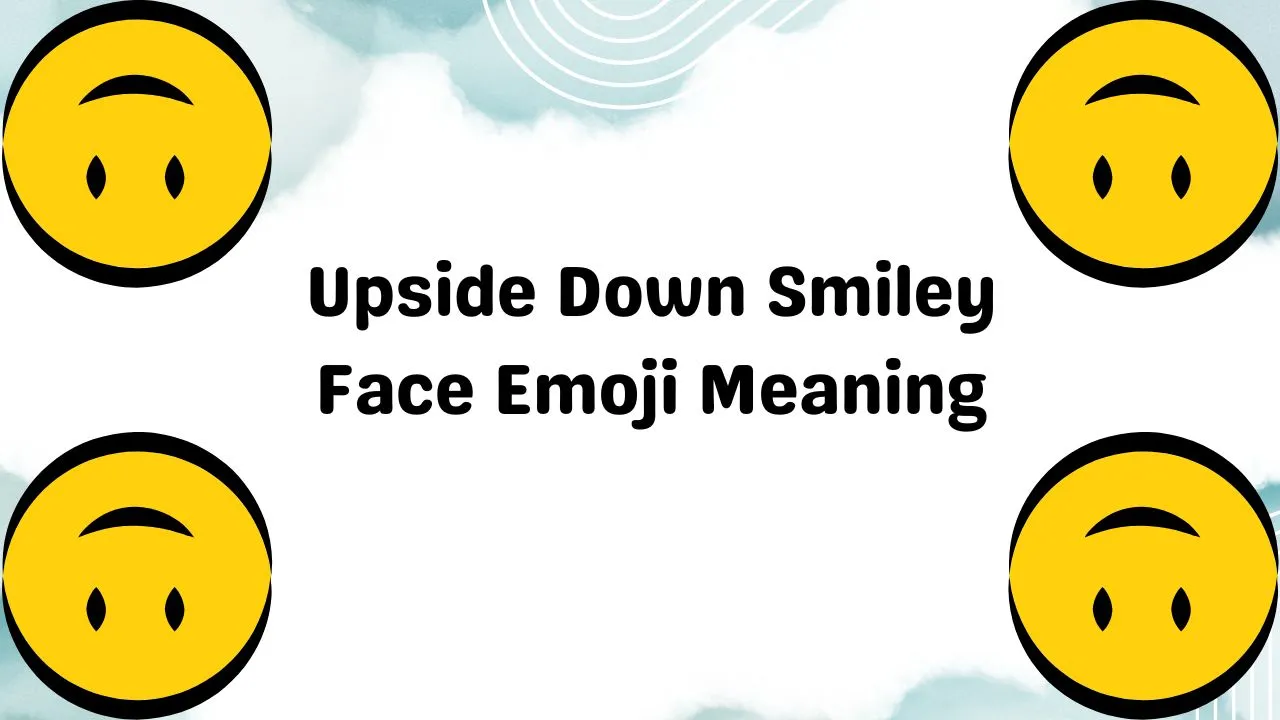
The Upside Down Smiley Face Emoji 🙃 is commonly used to express sarcasm, irony, awkwardness, silliness, or a playful reaction. Although it looks like a smiling face turned upside down, its message is not always cheerful.
People often use 🙃 when something feels funny, strange, uncomfortable, or frustrating but they want to respond in a lighthearted way. In texting, it can sometimes mean “I’m fine” when the situation is actually far from fine, adding a subtle sense of humor or emotional irony.
The meaning can also change depending on who sends it and what was said before it. A friend might use 🙃 to tease you, while a girl or guy may send it to show playful sarcasm or awkwardness.
What Is the Upside Down Smiley Face Emoji?
The official Unicode name for 🙃 is “Upside-Down Face.” It was added to the Unicode Standard in 2015 as part of Unicode 8.0 and Emoji 1.0. On most platforms it appears as a simple yellow face with a slight smile, eyes, and sometimes a bit of shading, rotated 180 degrees.
Many designs are literally the Slightly Smiling Face 🙂 flipped upside down. That visual inversion is the key to its meaning. A normal smile usually signals friendliness or positivity. Turning it upside down signals that the message should not be taken at face value.
Common Meanings of the Upside Down Smiley Face Emoji
The upside down smiley face emoji meaning is flexible. Context, relationship, and the words around it all shape how people interpret it. Here are the most frequent uses:
Sarcasm and Irony
This is the top reason people reach for 🙃. It acts like a visual “just kidding” or “not really.”
Example: “Can’t wait for another three-hour meeting on a Friday afternoon 🙃”
Playfulness and Silliness
Sometimes it simply means the sender is being goofy or lighthearted.
Example: “I just tried to put my keys in the fridge 🙃”
Awkwardness or Embarrassment
It softens uncomfortable moments without making them too serious.
Example: “Sorry, that text was meant for someone else 🙃”
Mild Frustration or Resignation
People use it when things go wrong but they don’t want to sound dramatic. It often carries the feeling of “this is fine” while everything is clearly not fine.
Example: “My laptop died right before the deadline 🙃”
Passive-Aggressive Undertone
In some conversations the emoji can feel a little pointed. A single 🙃 as a reply can signal quiet annoyance without open confrontation.
How People Use 🙃 in Everyday Conversations
The emoji works best as a tone marker at the end of a sentence. It rarely stands alone unless the context is already clear.
In group chats and casual texts
It keeps things light when someone is sharing bad luck or mild irritation.
On social media
It often appears in captions that mix humor with complaint: “Another day of adulting 🙃”
In dating or flirty messages
Some people use it to keep compliments or teasing from sounding too intense. It can also signal playful awkwardness.
At work
Use caution. In professional settings the upside down face can come across as dismissive or unprofessional if the recipient doesn’t share the same sense of humor.
Upside Down Smiley vs Other Similar Emojis
| Emoji | Common Feel | When to Choose It Instead of 🙃 |
| 🙂 Slightly Smiling Face | Polite, neutral, sometimes forced | When you want mild positivity without irony |
| 😏 Smirking Face | Smug, flirtatious, or knowing | When you want a more confident or suggestive tone |
| 🙄 Face with Rolling Eyes | Clear annoyance or disbelief | When the irritation is more obvious |
| 🤷 Person Shrugging | “I don’t know / what can you do?” | When the feeling is closer to pure resignation |
| 😬 Grimacing Face | Visible discomfort or awkwardness | When the situation feels more tense |
The upside down face sits in a unique middle ground—lighter than eye-rolling, more ironic than a regular smile.
Tips for Using the Upside Down Smiley Face Emoji Well
- Match it to the relationship. Close friends will usually get the joke. Newer contacts or coworkers might not.
- Pair it with clear wording if the sarcasm could be missed.
- Avoid overusing it. Too many 🙃 in a row can dilute the effect or make messages feel passive-aggressive.
- Notice how others in your circle use it. Local group norms often shape the exact shade of meaning.
Frequently Asked Questions (FAQs)
What does the upside down smiley face emoji mean in text?
It most often signals sarcasm, irony, silliness, or mild frustration. The surrounding words usually make the exact intent clear.
Is 🙃 a passive-aggressive emoji?
It can be. When used alone or after a polite-sounding statement, it sometimes carries a passive-aggressive edge. Context decides.
What does 🙃 mean from a girl?
Many people interpret it the same way regardless of gender: playful, ironic, or lightly resigned. Personal style matters more than gender.
When was the upside down face emoji released?
It was approved in Unicode 8.0 in 2015 and became widely available that year, though earlier versions existed on some platforms like Gmail.
Can 🙃 mean something positive?
Yes. When the conversation is already light and playful, it can simply mean the sender is being silly or joking around.
Is the upside down smiley the same as the upside down face?
Yes. “Upside down smiley face,” “upside down face,” and “🙃” all refer to the same emoji.
How do I type the upside down smiley face emoji?
On most phones, open the emoji keyboard and search “upside down” or look under the smiley faces category. On computers you can often type “:upside_down_face:” in supported apps or copy and paste it.
Conclusion
The upside down smiley face emoji meaning centers on inversion. By flipping a normal smile, it lets people express sarcasm, irony, awkwardness, or quiet resignation in a compact, visually clear way. It softens difficult moments, flags jokes, and adds emotional texture that plain text often lacks.
Like most emojis, its power comes from shared understanding. Once you recognize the common patterns, 🙃 becomes an easy tool for clearer, more nuanced digital conversations. The next time you see one, you’ll know the sender is probably saying more than the words alone suggest.

I am Daniel Harris, a passionate writer and content creator dedicated to sharing valuable, informative, and engaging articles with readers. I am focused on researching topics deeply and presenting ideas in a simple, clear, and helpful way. I am passionate about delivering accurate information that helps people learn, grow, and make better decisions.