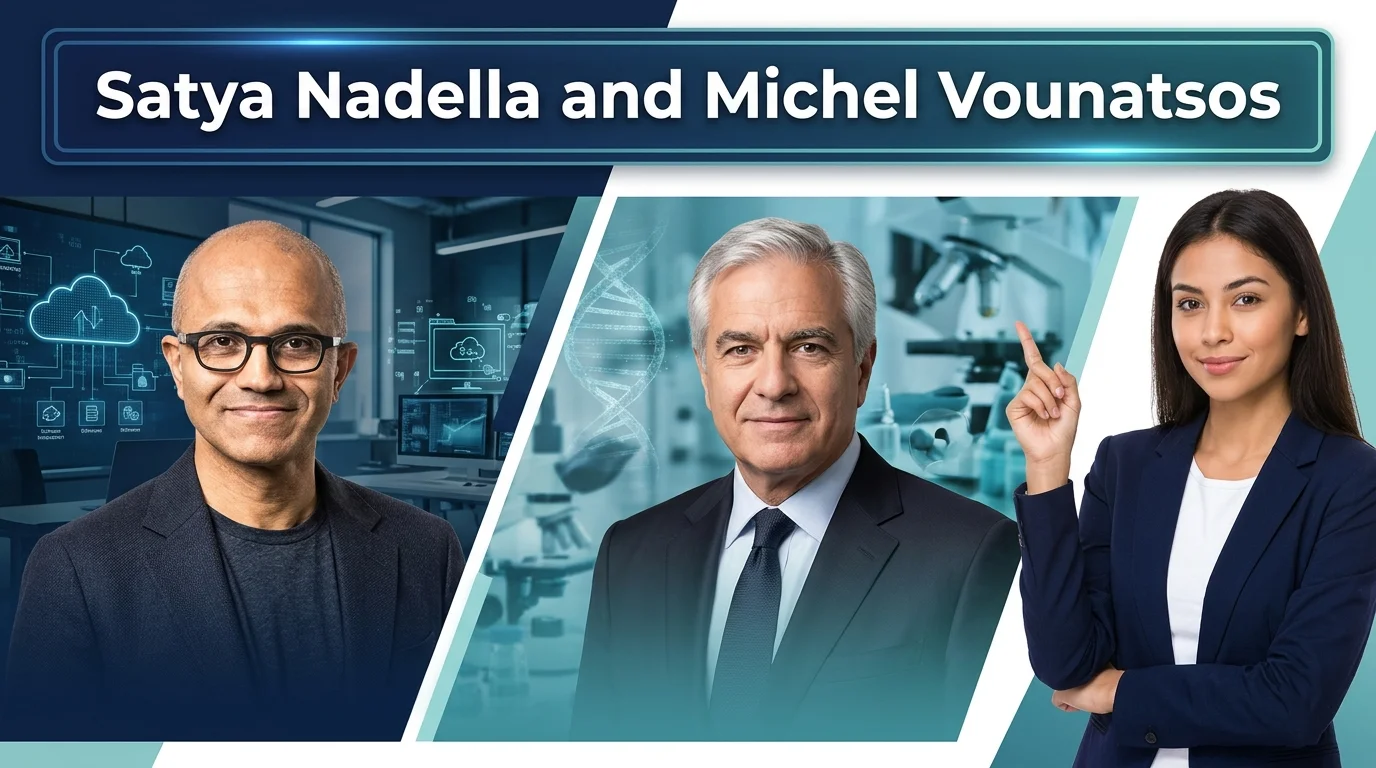
Why do Satya Nadella and Michel Vounatsos appear together in discussions about business leadership and sustainability? The answer lies in a public commitment that brought executives from the technology and healthcare industries together in 2021. Although these two business leaders built their careers in different sectors, both became associated with an initiative supporting the United Kingdom’s National Health Service (NHS) and its goal of reducing carbon emissions.
Satya Nadella and Michel Vounatsos have different professional backgrounds. Nadella is the chairman and CEO of Microsoft, a global technology company known for software, cloud computing, and artificial intelligence. Vounatsos served as CEO of Biogen, a biotechnology company specializing in treatments for serious diseases, from 2017 to 2022.
Their shared connection is specific and documented. Both appeared among the leaders associated with the International Leadership Group for a Net Zero NHS, which supported efforts to reduce emissions across the healthcare supply chain. A November 2021 report in The BMJ lists both executives as participants in the initiative. Read the original report in The BMJ.
This article explores the Satya Nadella and Michel Vounatsos connection, their biographies, professional achievements, leadership approaches, and roles in their respective industries. It also explains what their shared sustainability commitment means and why it should not be confused with an unverified business partnership.
Who Are Satya Nadella and Michel Vounatsos?
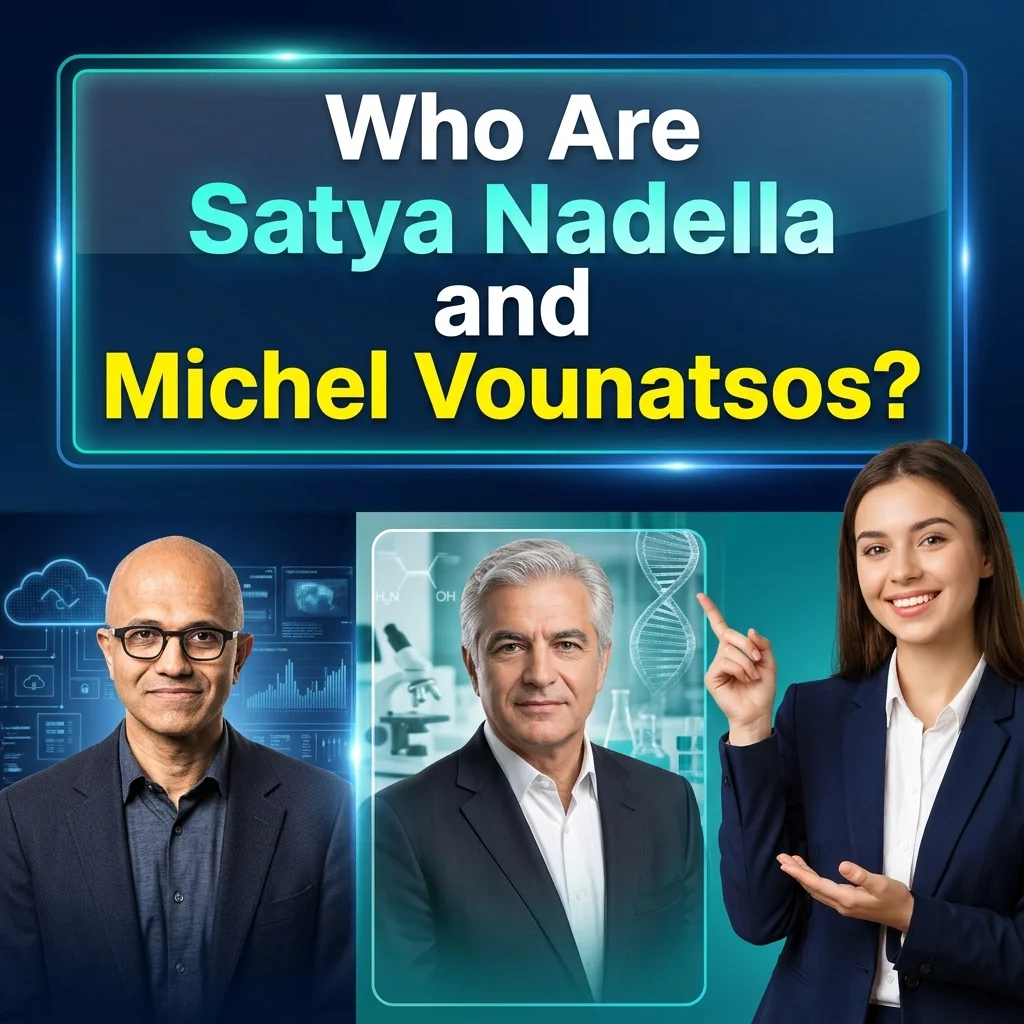
Satya Nadella and Michel Vounatsos are senior business executives who have led major international organizations. Their careers demonstrate two different approaches to managing complex businesses: one centered on technology and digital transformation, and the other on pharmaceutical commercialization and biotechnology.
Nadella joined Microsoft in 1992 and became its CEO in February 2014. Before taking the position, he held several leadership roles, including responsibility for Microsoft’s cloud and enterprise business. His experience helped prepare him to guide the company through changes in cloud computing, enterprise software, and AI. Microsoft’s official biography of Satya Nadella provides details about his education and career.
Vounatsos joined Biogen in 2016 as executive vice president and chief commercial officer. The company appointed him CEO effective January 6, 2017, following his approximately 20-year career at Merck. He remained in the position until November 2022. Biogen’s official appointment announcement documents his appointment and previous experience.
Although the two executives have not followed the same career path, their professional histories share several themes:
- International business experience and responsibility for large organizations.
- Strategic decision-making in competitive global markets.
- Leadership of companies that depend on specialized knowledge.
- The challenge of balancing commercial goals with wider responsibilities.
- Participation in a public initiative supporting healthcare sustainability.
The final point explains their most clearly documented connection. The remaining similarities offer a useful way to compare their careers without assuming that the two men have a direct personal or commercial relationship.
Satya Nadella Biography and Early Career
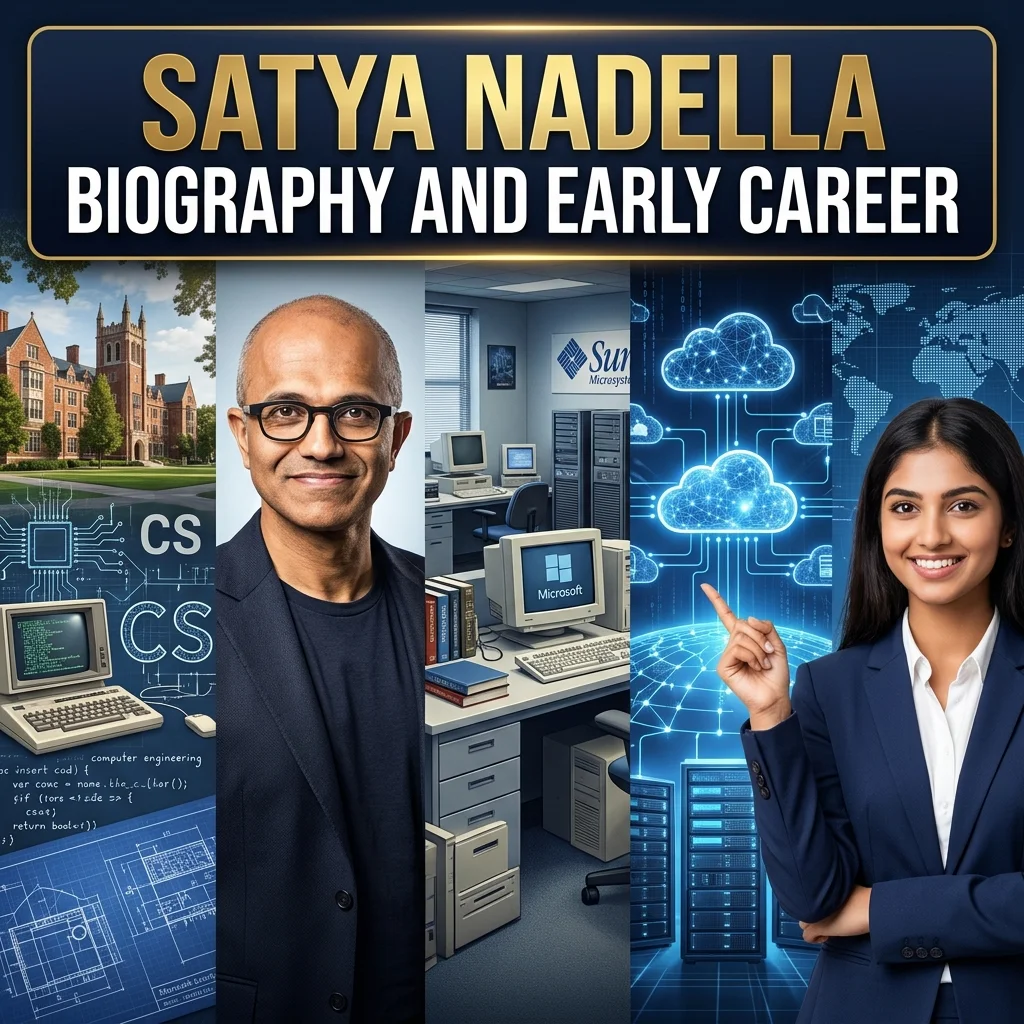
Satya Nadella is one of the best-known technology executives in the world. His rise to Microsoft’s top leadership position followed years of technical work, business experience, and increasing responsibility within the company.
Education and Early Professional Experience
Nadella was born in Hyderabad, India. He studied electrical engineering at Mangalore University before moving to the United States for postgraduate education.
He earned a master’s degree in computer science from the University of Wisconsin–Milwaukee and an MBA from the University of Chicago. This combination gave him a foundation in engineering, computing, and business management.
Before joining Microsoft, Nadella worked at Sun Microsystems. He joined Microsoft in 1992 and began building a career within an organization that was expanding its influence in personal computing and business software.
His progress did not depend on a single breakthrough. Instead, he developed experience across several areas of the company, including enterprise software, online services, and server technologies.
These responsibilities helped him understand how technical products, customer expectations, and business strategy interact. That knowledge later became valuable as Microsoft moved toward cloud-based services.
Satya Nadella’s Rise at Microsoft
Before becoming CEO, Nadella led Microsoft’s Cloud and Enterprise group. In that role, he helped develop the company’s cloud infrastructure and services business.
Cloud computing allows organizations to access computing power, storage, databases, and software over the internet rather than managing every resource on their own premises. This model has become important for businesses that need flexible systems and the ability to scale their operations.
Microsoft’s cloud business became a central part of its strategy under Nadella. The company continued investing in Azure, enterprise services, productivity tools, and developer platforms.
On February 4, 2014, Microsoft announced Nadella’s appointment as CEO. He succeeded Steve Ballmer and became the company’s third chief executive. Microsoft’s original announcement explains the appointment and highlights his previous cloud leadership.
Satya Nadella’s Leadership Style
Satya Nadella’s leadership style emphasizes collaboration, empathy, customer needs, and continuous learning.
One concept frequently associated with his approach is the growth mindset. In a business environment, this means encouraging employees to learn from experience, accept constructive feedback, and develop new skills instead of treating existing knowledge as sufficient.
This approach fits an industry where customer needs and technology can change quickly. A company that relies entirely on previous successes may struggle when new platforms or business models emerge.
Nadella has also supported a more collaborative approach to technology. Microsoft has worked with a broad range of developers, enterprise customers, and technology providers, recognizing that organizations often use products from several companies.
His leadership has coincided with Microsoft’s increased focus on cloud computing and AI. However, these developments reflect the work of many employees, researchers, customers, and partners rather than the decisions of one person alone.
The broader lesson from Nadella’s career is that technical knowledge can support executive leadership when it combines with organizational experience, customer understanding, and the ability to adapt.
Michel Vounatsos Biography and Career History
Michel Vounatsos built his career in the pharmaceutical industry, where business leaders must understand international markets, commercial operations, scientific developments, and regulatory requirements.
His professional history includes approximately two decades at Merck, followed by senior leadership responsibilities at Biogen. These experiences placed him at the intersection of commercial strategy and biotechnology.
Education and Career at Merck
Vounatsos earned an MBA from HEC School of Management in Paris, France. He also received a Certificate of Clinical and Therapeutic Synthesis from Université Victor Segalen Bordeaux II.
He joined Merck in 1996 and held positions with increasing responsibility across international markets. His experience included leadership work in Europe and China, as well as commercial responsibilities in the United States.
At Merck, he developed expertise in pharmaceutical sales, market strategy, and customer-focused operations. These responsibilities required an understanding of how healthcare systems, physicians, patients, and commercial organizations interact.
International experience can be particularly important in pharmaceuticals. Different countries have different regulatory frameworks, healthcare funding systems, reimbursement policies, and treatment needs. A strategy that works in one market may require substantial changes in another.
Vounatsos’s career at Merck gave him exposure to these differences before he moved to Biogen.
Michel Vounatsos as Biogen CEO
Vounatsos joined Biogen in April 2016 as executive vice president and chief commercial officer. The company appointed him CEO effective January 6, 2017.
Biogen is a biotechnology company with a significant focus on neuroscience and neurological diseases. Its work involves developing treatments for serious medical conditions, a process that requires substantial research investment and careful evaluation of clinical evidence.
As CEO, Vounatsos had to consider research priorities, product commercialization, financial performance, regulatory decisions, and patient needs.
His tenure included the company’s efforts to develop and commercialize treatments for neurological conditions. One especially significant episode involved Aduhelm, a treatment for Alzheimer’s disease that received accelerated approval from the US Food and Drug Administration in June 2021.
The approval generated extensive debate about the available evidence, the treatment’s potential benefits, its price, and access through healthcare systems. The episode illustrated the challenges pharmaceutical leaders face when scientific, regulatory, commercial, and public expectations do not align easily.
Vounatsos left the CEO role in November 2022, when Biogen appointed Christopher Viehbacher as his successor. Biogen’s announcement of the leadership change confirms the transition.
His career remains relevant to discussions about international pharmaceutical management, commercial strategy, and the challenges of leading biotechnology organizations.
What Connects Satya Nadella and Michel Vounatsos?
The Satya Nadella and Michel Vounatsos connection is documented through their association with the International Leadership Group for a Net Zero NHS.
In November 2021, The BMJ published a report describing a commitment by major healthcare and technology companies to support the NHS’s goal of reducing carbon emissions throughout its supply chain. The report lists Satya Nadella as Microsoft’s CEO and Michel Vounatsos as Biogen’s CEO among the participating leaders.
The initiative brought together executives from different companies, healthcare-related trade bodies, and independent organizations. Its purpose was to encourage suppliers to support the NHS’s sustainability goals.
This is the strongest documented explanation for why their names appear together in this context.
What Was the International Leadership Group for a Net Zero NHS?
The International Leadership Group for a Net Zero NHS supported the NHS’s ambition to reduce the environmental impact of healthcare.
The NHS announced targets for achieving net zero carbon emissions from the activities it directly controls by 2040 and from its wider supply chain by 2045.
Supply chains matter because healthcare organizations depend on products and services from thousands of suppliers. Medicines, medical devices, technology systems, transportation, equipment, and facilities all contribute to the resources required to deliver healthcare.
A healthcare system cannot address its entire environmental impact by changing hospital operations alone. It also needs suppliers to examine their manufacturing processes, energy use, transportation, and other activities.
The group’s November 2021 commitment encouraged NHS suppliers to work toward net zero emissions by 2045 or earlier across their value chains. The commitment also emphasized cooperation, research, innovation, and the sharing of good practices.
For the original announcement and the names of participating executives, see The BMJ’s report on the NHS supply-chain commitment.
Why Were Microsoft and Biogen Relevant to the Initiative?
Microsoft and Biogen operate in different industries, but both have business activities connected to healthcare and large supply chains.
Microsoft supplies technology and digital services used by organizations across many sectors, including healthcare. Its products can support communication, data management, business operations, and digital infrastructure.
Biogen operates in biotechnology and develops treatments for serious diseases. Pharmaceutical companies depend on research facilities, manufacturing processes, packaging, transportation, and distribution networks.
Both types of businesses therefore have reasons to consider their environmental impact. Their participation in the same initiative reflected a shared public sustainability objective, not necessarily a shared commercial strategy.
The distinction is important. A technology company and a biotechnology company can support the same environmental goal while continuing to operate independently.
Did Satya Nadella and Michel Vounatsos Work Together Directly?
A common search question is whether Satya Nadella and Michel Vounatsos worked together.
The available evidence establishes that their names appeared in connection with the same 2021 sustainability initiative. It does not, by itself, establish that they jointly managed a project, negotiated a business agreement, or developed a personal friendship.
Nadella’s executive career has centered on Microsoft, while Vounatsos built his career at Merck and Biogen. The two men led different organizations with different products and business priorities.
It is therefore more accurate to describe their connection as a shared public commitment than to call them business partners.
This distinction also matters for SEO content. When two names appear together in search results, writers should investigate the original source instead of assuming that the people have a deeper relationship.
Satya Nadella and Michel Vounatsos: Leadership Comparison
Comparing Satya Nadella and Michel Vounatsos provides insight into how leadership responsibilities change across industries.
Nadella’s work has centered on technology platforms, digital infrastructure, enterprise services, and organizational culture. Vounatsos’s experience has focused on pharmaceutical commercialization, international business operations, and biotechnology.
Their careers share some general leadership challenges, but their industries require different forms of expertise.
| Comparison | Satya Nadella | Michel Vounatsos |
| Main industry | Technology | Biotechnology and pharmaceuticals |
| Best-known executive role | Microsoft chairman and CEO | Former Biogen CEO |
| Microsoft or Biogen leadership period | Microsoft CEO since 2014 | Biogen CEO from 2017 to 2022 |
| Professional background | Engineering, computer science, business management | Pharmaceutical commercial leadership and international management |
| Major business focus | Cloud computing, enterprise software, AI | Biotechnology strategy, neuroscience, commercial operations |
| Important leadership challenge | Adapting to technology shifts and changing customer needs | Navigating clinical, regulatory, commercial, and patient-access challenges |
| Documented shared connection | 2021 Net Zero NHS initiative | 2021 Net Zero NHS initiative |
This comparison highlights their different professional responsibilities without suggesting that one executive’s approach is automatically better than the other’s.
How Their Leadership Approaches Differ
Nadella’s career demonstrates the importance of understanding technology and recognizing when customer needs are changing. Cloud computing and AI have created new opportunities for Microsoft, while also raising questions about security, reliability, privacy, and responsible use.
Vounatsos’s career illustrates the complexity of commercial leadership in pharmaceuticals. A drug’s success depends on more than sales performance. Scientific evidence, regulatory approval, clinical acceptance, pricing, and patient access can all influence the outcome.
These differences show why business leadership cannot follow a single formula. Effective decisions depend on the industry, the organization’s capabilities, and the needs of the people affected by its products.
Sustainability in Technology and Biotechnology
The connection between Nadella and Vounatsos also provides an opportunity to examine the role of sustainability in corporate leadership.
Businesses increasingly assess the environmental effects of their facilities, energy consumption, manufacturing, transportation, and supply chains. These issues are particularly important when companies operate at a global scale.
Environmental Considerations for Microsoft
Technology companies depend on computing infrastructure, hardware, electricity, and extensive supplier networks.
Cloud services and AI require computing resources. Data centers need electricity and cooling, while the production of computers and other equipment requires materials, manufacturing, and transportation.
Technology companies can address these challenges through measures such as improving energy efficiency, using lower-carbon electricity, reducing waste, and working with suppliers to understand emissions.
These steps require measurement and long-term planning. A public sustainability commitment establishes a direction, but the company’s actual progress must be assessed through evidence about its operations and results.
Environmental Considerations for Biogen
Biotechnology companies also have environmental responsibilities. Laboratories, manufacturing facilities, packaging, transportation, and pharmaceutical distribution all use energy and resources.
However, pharmaceutical products must meet strict safety and quality requirements. Some treatments require temperature-controlled storage and transportation, which can limit the available options for reducing their environmental impact.
Companies must therefore identify improvements that support sustainability without compromising product quality or patient safety.
The Net Zero NHS initiative recognized that suppliers from different industries have a role to play in reducing healthcare-related emissions. It also demonstrated why collaboration across a supply chain can be useful when no single organization controls every stage of production and delivery.
Understanding Scope 1, Scope 2, and Scope 3 Emissions
The sustainability discussion often refers to three categories of greenhouse gas emissions.
- Scope 1: Direct emissions from sources a company owns or controls, such as fuel burned in its facilities.
- Scope 2: Indirect emissions associated with purchased electricity, heating, or cooling.
- Scope 3: Other indirect emissions across the value chain, including many supplier, transportation, and product-related activities.
Scope 3 emissions can be difficult to measure because they involve organizations and activities outside a company’s direct control. Businesses often need information from suppliers and other partners to understand their full environmental footprint.
That complexity helps explain why the NHS initiative focused on supply-chain cooperation. Healthcare providers and their suppliers need to work together to identify emissions and develop practical ways to reduce them.
Challenges in Their Executive Careers
A balanced discussion of Satya Nadella and Michel Vounatsos should consider the challenges associated with their roles rather than focusing only on achievements.
Challenges for Satya Nadella and Microsoft
Microsoft operates in competitive markets that include cloud computing, enterprise software, cybersecurity, gaming, and artificial intelligence.
Its growing involvement in AI brings opportunities alongside difficult questions about data protection, copyright, accuracy, competition, and responsible development. The company’s size also means that its decisions can affect businesses, developers, public institutions, and individual users.
Nadella’s leadership must therefore address more than revenue and product innovation. Microsoft also needs to maintain customer trust, manage security risks, and respond to regulatory and public expectations.
These challenges are common to major technology companies, but the decisions and outcomes vary by product and market.
Challenges for Michel Vounatsos and Biogen
Vounatsos’s tenure at Biogen included difficult questions about drug development, commercialization, and the relationship between scientific evidence and market expectations.
Aduhelm became a prominent example. Its accelerated approval in 2021 attracted attention because of debates about clinical evidence, potential benefits, cost, and access.
This episode highlighted a broader challenge for pharmaceutical leaders. Regulatory approval does not automatically guarantee broad clinical acceptance, widespread reimbursement, or commercial success.
Biotechnology companies must balance investment in innovation with the responsibility to evaluate evidence carefully and consider the needs of patients. Their decisions also take place within a wider system involving researchers, regulators, physicians, insurers, and healthcare providers.
These factors should be considered when evaluating Vounatsos’s leadership, rather than attributing complex industry outcomes to one executive alone.
What Business Leaders Can Learn From Their Careers
The careers of Satya Nadella and Michel Vounatsos offer several practical lessons for managers, entrepreneurs, and professionals.
Develop Expertise Before Taking on Greater Responsibility
Nadella spent years in technical and management positions at Microsoft before becoming CEO. Vounatsos developed international commercial experience through his work at Merck and Biogen.
Their paths show the value of understanding an organization’s products, customers, operations, and risks. Senior leadership requires more than a title. It demands the ability to make informed decisions across different parts of a business.
Adapt When Markets Change
The technology industry continues to evolve through cloud computing, AI, and new digital services. Biotechnology faces its own changes through scientific advances, clinical research, and evolving healthcare needs.
Leaders who continue learning are better positioned to evaluate new opportunities and recognize when an established strategy needs to change.
Adaptability does not mean pursuing every trend. It means examining evidence, understanding risks, and deciding which developments matter to the organization’s long-term goals.
Connect Strategy With Evidence
A clear business strategy needs practical execution and measurable results.
Technology companies need to build useful and reliable products. Biotechnology companies need to connect research and commercial planning with clinical evidence, regulatory requirements, and patient access.
In both industries, decision-makers benefit from setting priorities, allocating resources carefully, and evaluating whether their actions produce the intended results.
Consider Stakeholders Beyond Investors
Businesses operate within broader communities. Technology products affect customers and employees, while pharmaceutical decisions can influence patients and healthcare professionals.
Leaders need to consider these stakeholders when making decisions about innovation, pricing, safety, privacy, and sustainability.
The shared Net Zero NHS initiative offers a specific example of executives publicly supporting a goal that extended beyond the immediate interests of their individual companies.
Frequently Asked Questions
Who are Satya Nadella and Michel Vounatsos?
Satya Nadella is Microsoft’s chairman and CEO. Michel Vounatsos is a pharmaceutical executive who served as Biogen’s CEO from 2017 to 2022. Both have led major international organizations in different industries.
What connects Satya Nadella and Michel Vounatsos?
Their documented connection is their association with the International Leadership Group for a Net Zero NHS. A November 2021 report in The BMJ lists both executives among the leaders supporting the NHS’s supply-chain sustainability goals.
Did Satya Nadella and Michel Vounatsos work at the same company?
No. Nadella built his executive career primarily at Microsoft, while Vounatsos held senior roles at Merck and Biogen. Their shared initiative does not mean they worked for the same employer.
Are Satya Nadella and Michel Vounatsos business partners?
The public record cited here establishes their association with the same sustainability initiative. It does not independently establish a direct business partnership between the two executives.
What is Satya Nadella best known for?
Nadella is best known for leading Microsoft as CEO from 2014 onward and helping guide its strategy in cloud computing, enterprise services, and AI. He joined Microsoft in 1992.
What is Michel Vounatsos best known for?
Vounatsos is best known for serving as Biogen’s CEO from January 2017 until November 2022. Before Biogen, he spent approximately 20 years at Merck in commercial and management roles.
What was the Net Zero NHS initiative?
The International Leadership Group for a Net Zero NHS encouraged healthcare suppliers to support emissions reductions across the NHS supply chain. Its 2021 commitment called on suppliers to work toward net zero emissions by 2045 or earlier.
How do their leadership backgrounds differ?
Nadella’s experience centers on technology, cloud services, and organizational transformation. Vounatsos’s background centers on pharmaceutical commercialization, international management, and biotechnology strategy.
Why do people search for Satya Nadella and Michel Vounatsos together?
Their names appear together in reporting about the 2021 Net Zero NHS initiative. This shared public commitment provides a documented explanation for the search association.
Conclusion
Satya Nadella and Michel Vounatsos have built their careers in different industries, but their names are connected through a specific public sustainability commitment. Nadella has led Microsoft through developments in cloud computing, enterprise software, and AI. Vounatsos served as Biogen’s CEO from 2017 to 2022 after building a long career in pharmaceutical management.
The Satya Nadella and Michel Vounatsos connection is best understood through their shared association with the International Leadership Group for a Net Zero NHS in 2021. The initiative encouraged suppliers to support efforts to reduce emissions throughout the healthcare supply chain. It does not, by itself, establish a personal friendship or a direct commercial partnership.
I am Daniel Harris, a passionate writer and content creator dedicated to sharing valuable, informative, and engaging articles with readers. I am focused on researching topics deeply and presenting ideas in a simple, clear, and helpful way. I am passionate about delivering accurate information that helps people learn, grow, and make better decisions.