The term AudioDisplayed can be confusing when it appears in a text conversation, exported message, or digital transcript. You might wonder whether it means someone played your voice message, whether an audio recording was opened, or whether it is simply a technical label.
In simple terms, AudioDisplayed is a context-dependent label that appears to indicate the presence or presentation of audio content in a digital interface or text representation. However, it is not a universally recognised texting abbreviation, standard English expression, or confirmed status used across messaging platforms.
The exact meaning depends on where you found it. For example, a transcript may use an audio marker to show where a voice recording appeared, while a software application might use a similar expression as a custom identifier.
One important distinction is that displaying audio does not necessarily mean playing it. An audio player can appear on a screen without anyone listening to the recording.
This guide explains the possible meaning of AudioDisplayed, how to interpret it in conversations, how it differs from other audio terms, and what you should check when you encounter it.
Quick Answer:
AudioDisplayed generally suggests that an audio-related element has been shown or represented within a digital environment. It may refer to a voice recording, audio attachment, media player, or placeholder in a transcript.
Here is a quick overview:
| Question | Answer |
| What does AudioDisplayed mean? | A context-dependent audio-related label |
| Is it common texting slang? | No |
| Is it a standard English word? | No |
| Is it an abbreviation? | No established expansion |
| Does it mean audio was played? | Not necessarily |
| Does it confirm someone listened? | No |
| Can it appear in transcripts? | It may appear as a media placeholder |
| Is it an official WhatsApp status? | No established universal status by this name |
The safest interpretation is to treat AudioDisplayed as a label whose meaning must be determined from its original source.
Understanding the Two Parts of AudioDisplayed
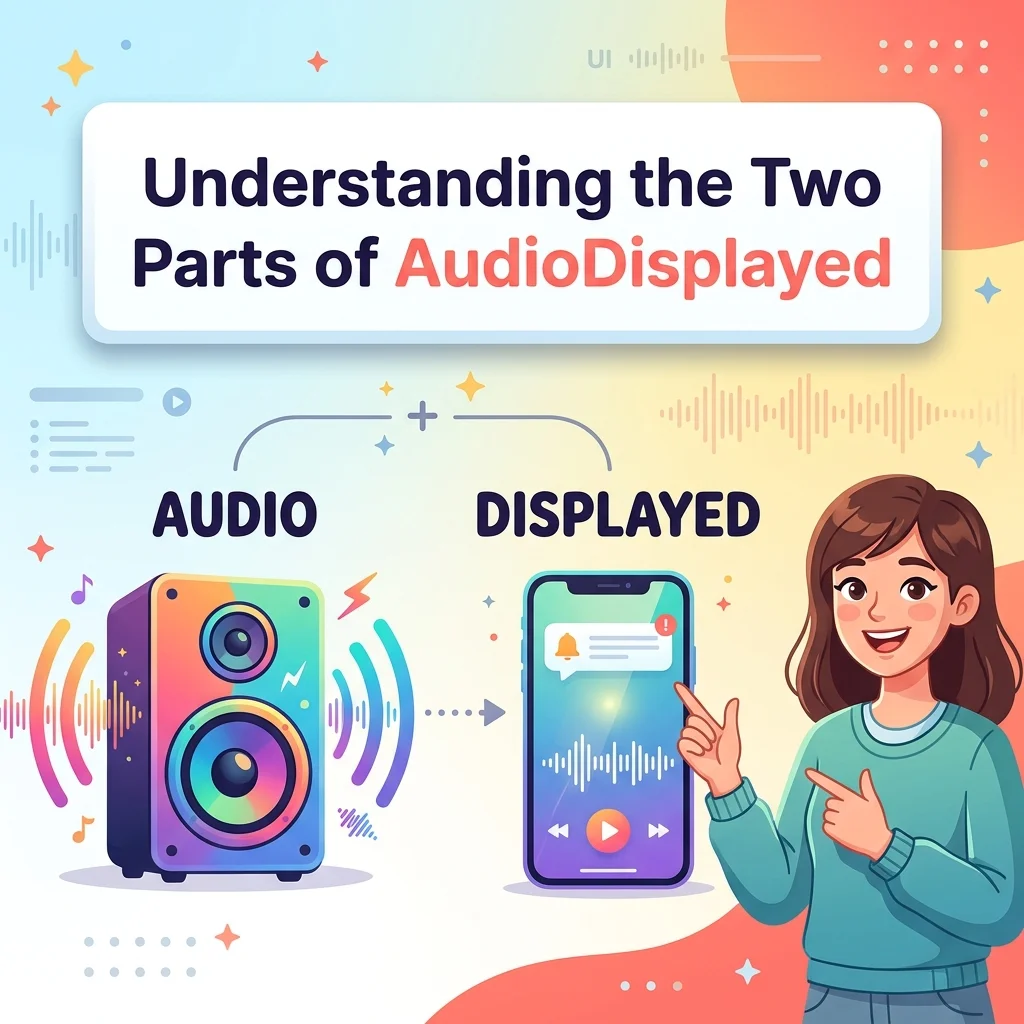
The expression combines two familiar English words.
- Audio: Sound-based content, including speech, music, voice recordings, and sound effects.
- Displayed: Something that has been shown, presented, or made visible.
Together, they suggest that an audio-related item has been presented or represented somewhere.
However, the combined expression is not a standard dictionary entry. It should not be treated as an officially defined technical term without knowing which application or system produced it.
For example, imagine that you receive a voice message in a messaging application. You open the conversation and see an audio player with a waveform and play button.
The player is visible, but you have not necessarily started playback.
A similar distinction applies when reading a text transcript. A marker might show where an audio attachment appeared without including the recording itself.
This is why understanding the source is more important than relying on the wording alone.
What Does AudioDisplayed Mean in a Text Message?
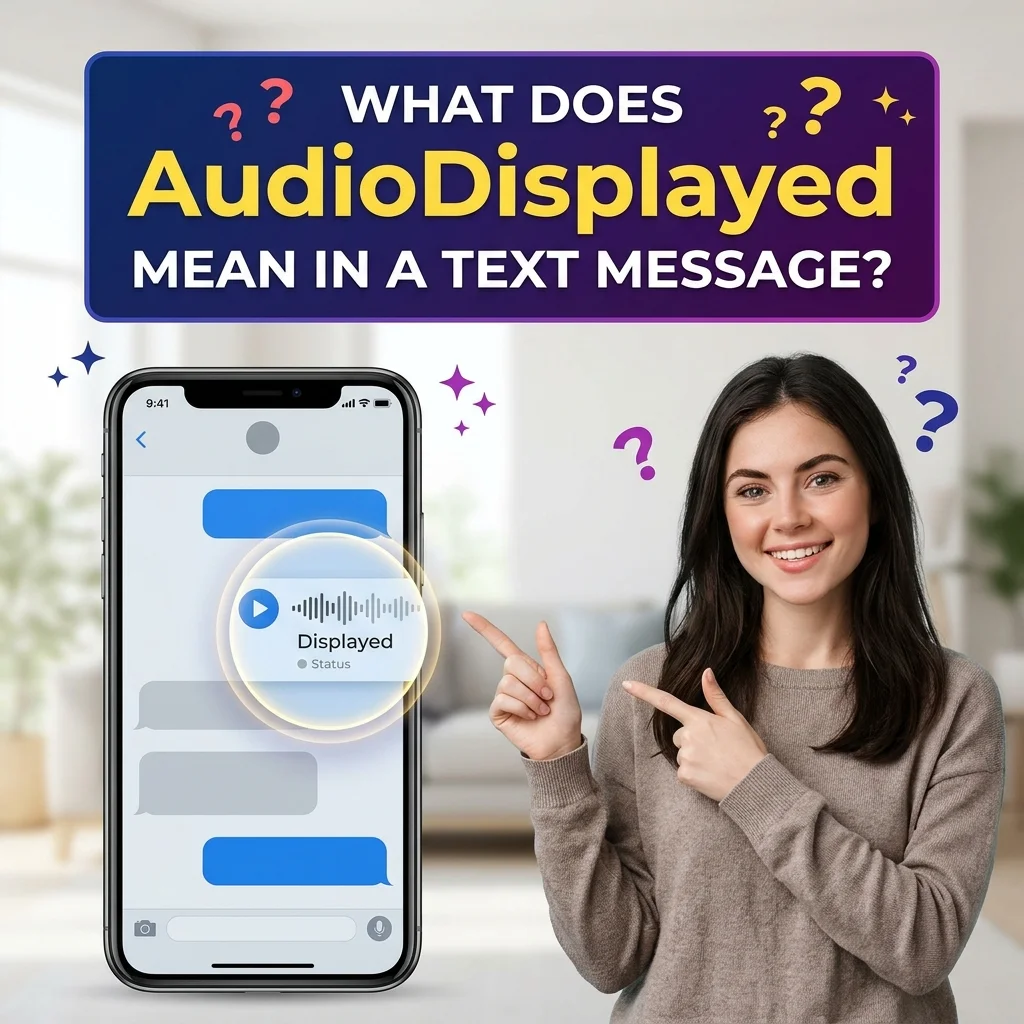
When AudioDisplayed appears in a text-based conversation, its meaning depends on whether someone typed it or an application inserted it.
There are two important possibilities.
1. Someone typed the expression manually.
If a person sends you AudioDisplayed as an ordinary message, it could be copied technical text, an unusual label, or a reference to an audio-related feature.
It does not have a recognised romantic, emotional, or conversational meaning.
2. A system inserted the expression automatically.
If you find something like <<AudioDisplayed>> between two messages, it may be a placeholder representing an audio item.
Consider this hypothetical example:
Alex: I recorded something for you.
Alex: <<AudioDisplayed>>
Sam: I will check it later.
The marker identifies a position where audio content may have appeared in the original material.
It does not reveal what Alex said, how long the recording was, or whether Sam listened to it.
A text document can preserve the order of a conversation without preserving every original attachment.
For this reason, an audio marker should not be confused with an ordinary written message.
What Does <<AudioDisplayed>> Mean in a Transcript?
The formatting of the expression can provide useful clues.
When a word appears between angle brackets, it may be functioning as a placeholder rather than ordinary conversation text.
For example:
User: Can you hear this recording?
<<AudioDisplayed>>
Assistant: I can help you understand the audio.
In this hypothetical transcript, the marker represents an audio-related item at that point in the conversation.
It is not the actual recording and does not contain the spoken words.
There are three different things to understand:
An audio recording: The original sound captured by a microphone or another recording device.
An audio placeholder: A text label that represents the location or presence of audio content.
These are not interchangeable.
A transcript may contain the original spoken words, an audio placeholder, or both. Its format depends on the system that created it.
For example, a speech-recognition tool might convert a recording into the sentence:
Are you coming to the meeting tomorrow?
A different text-processing system might simply insert:
<<AudioDisplayed>>
The first example provides the spoken content. The second only identifies an audio-related element.
If you need to know what someone actually said, you must locate the recording or obtain a proper transcription.
Why Does AudioDisplayed Appear in a Chat Export?
A chat export is a saved copy of a conversation. It may include written messages and, depending on the export settings, attached media.
When you export a conversation, the resulting document may not look exactly like the original messaging interface.
For example, the original conversation might contain:
- Written messages.
- Voice notes.
- Photographs.
- Videos.
- Documents.
- Audio attachments.
A plain-text export cannot reproduce all these items as ordinary written sentences.
An application or third-party conversion tool may therefore represent multimedia content using placeholders.
A simplified example might look like this:
10:15 AM – Alex: Listen to this recording.
10:16 AM – Alex: <<AudioDisplayed>>
10:18 AM – Sam: I will listen after work.
The marker helps preserve the conversation’s structure.
However, it does not necessarily mean the original audio was deleted, damaged, or played.
You should check whether the exported conversation includes separate media attachments.
Does WhatsApp Use AudioDisplayed?
There is an important distinction between WhatsApp’s official features and labels introduced by other tools.
WhatsApp provides an option to export chat history with or without media. Its official Help Center explains that exported conversations are text files rather than restorable backups.
WhatsApp Help Center
WhatsApp also provides specific voice-message playback indicators. Its documentation explains that green microphone icons identify voice messages that have not been played, while blue microphone icons identify messages that have already been played.
WhatsApp Help Center
However, these official explanations do not establish <<AudioDisplayed>> as a universal WhatsApp status.
If you see this exact expression in a WhatsApp-related transcript or exported document, consider whether another tool inserted it during processing.
To investigate:
- Open the original WhatsApp conversation.
- Find the message corresponding to the marker.
- Check whether a voice message or audio attachment is present.
- Check whether you selected the option to include media when exporting.
- Look for separately saved audio files.
Do not assume that the placeholder itself contains the recording.
AudioDisplayed Meaning on Instagram
Instagram supports direct messages and different forms of multimedia communication, including voice messages.
However, AudioDisplayed is not an established universal Instagram messaging status or recognised Instagram abbreviation.
If you encounter the term in copied Instagram messages, a downloaded record, or a transcript, it may have been introduced by an external processing tool.
For example, someone might export or copy a conversation containing a voice message. A text-processing application could represent the audio using a placeholder.
The resulting document may not preserve the original Instagram interface.
Keep these distinctions in mind:
- A voice message is recorded audio sent through a conversation.
- A transcript is written text representing spoken content.
- An audio placeholder identifies an audio-related item.
- A message read receipt provides information about message visibility.
These features provide different types of information.
If you are trying to determine whether someone heard your Instagram voice message, AudioDisplayed alone cannot answer that question.
AudioDisplayed Meaning on Snapchat
Snapchat supports multimedia conversations, including text, pictures, videos, and other shared content.
You might encounter unfamiliar audio-related labels when saving, copying, or processing information from these conversations.
However, AudioDisplayed is not a recognised universal Snapchat slang expression or standard message status.
If the expression appears in a transcript, it may represent an audio item that was present in the original conversation.
For example:
Jamie: I have something to show you.
<<AudioDisplayed>>
Taylor: Okay, send it over.
This example illustrates how a text document could represent missing audio content.
It does not establish that Snapchat itself uses this exact notation.
If you want to understand the original message, return to the source conversation and check the available media.
AudioDisplayed Meaning on TikTok
TikTok uses sound as an important part of its video content.
Users can create videos with music, voiceovers, original recordings, and sound effects. The platform also displays information about sounds associated with videos.
However, AudioDisplayed is not a recognised universal TikTok slang term or official notification.
If you see it in a transcript or technical record, the expression may relate to an audio element represented by another application.
For example, a tool processing video content might include a marker where an audio segment appeared.
That marker would not necessarily tell you which song was used or what someone said.
You should check the original video, caption, and sound information to understand the content.
AudioDisplayed Meaning on Discord
Discord supports text channels, voice communication, multimedia sharing, bots, and integrations.
Because different servers use different bots and tools, users may encounter custom technical labels in messages or exported records.
A label such as audioDisplayed could be used by a particular developer or integration.
For example:
let audioDisplayed = true;
This is a hypothetical JavaScript example. It shows how a developer could create a variable to describe an audio-related interface state.
It is not a standard Discord command or official Discord status.
If you encounter the expression in a Discord server, check whether it came from a bot, integration, transcript, or custom application.
Does AudioDisplayed Mean Someone Played Your Voice Message?
No. Seeing AudioDisplayed does not automatically prove that another person played or listened to your voice message.
This is one of the most important differences to understand.
Displaying an audio element and playing a recording are separate actions.
Imagine that you send your friend a 30-second voice message.
Your friend opens the conversation and sees the recording. The audio player appears with a play button, but your friend does not press it.
In this situation, the audio player is visible, but playback has not necessarily started.
The same principle applies to websites and digital media players. A browser can display audio controls without the recording playing.
The Mozilla Developer Network (MDN) documents separate media events for actions such as loading audio, starting playback, pausing, and finishing a recording.
MDN+2
Here is a simple comparison:
| Action | Meaning |
| Audio displayed | An audio element is shown |
| Audio loaded | Audio data has become available |
| Audio downloaded | An audio file has been saved |
| Audio played | Playback has started |
| Audio paused | Playback has stopped temporarily |
| Audio completed | Playback has reached the end |
| Audio transcribed | Spoken words have been converted into text |
Even a playback indicator does not necessarily prove that someone paid attention to the recording. The device could be muted, or the person might not be listening carefully.
Therefore, do not use AudioDisplayed alone as proof that someone heard your message.
Difference Between AudioDisplayed, AudioPlayed, and AudioTranscribed
These expressions may look similar, but they describe different audio-related activities.
Understanding the differences helps you interpret technical labels and conversation transcripts.
| Term | Meaning | Example |
| AudioDisplayed | Audio content is represented or shown | An audio player appears |
| AudioPlayed | Audio playback has started | Someone presses Play |
| AudioTranscribed | Spoken content becomes written text | A voice note becomes a sentence |
| AudioRecorded | Sound has been captured | Someone records a voice note |
| AudioUploaded | An audio file is transferred to a platform | A recording is sent online |
| AudioDownloaded | An audio file is saved to a device | Someone saves an MP3 |
| AudioPaused | Playback is temporarily stopped | Someone presses Pause |
Consider three simple situations.
Example 1: AudioDisplayed
You open a webpage and see a podcast player. The player is visible, but you have not pressed Play.
Example 2: AudioPlayed
You press Play, and the podcast begins producing sound.
Example 3: AudioTranscribed
A speech-recognition tool converts the podcast’s spoken words into a written document.
Each situation describes a different action.
You should not use these expressions interchangeably when explaining what happened to an audio recording.
Difference Between AudioDisplayed and Seen
Another possible misunderstanding involves the word “Seen.”
Messaging platforms sometimes provide read receipts or message statuses to show whether a message has been opened.
AudioDisplayed does not provide the same information.
| Feature | Seen | AudioDisplayed |
| Main purpose | Indicates message visibility | Indicates audio representation |
| Related to | Reading or opening messages | Audio-related content |
| Confirms playback? | Not necessarily | No |
| Can appear as a system label? | Yes | Possible |
| Confirms someone understood the content? | No | No |
For example, someone may open a conversation containing several voice messages.
The conversation could show a read status, but that does not necessarily prove that every recording was played.
Similarly, an audio placeholder does not establish that someone opened or listened to the original recording.
The two expressions should be interpreted separately.
Is AudioDisplayed a Programming Term?
AudioDisplayed can look like a programming term because it resembles common naming conventions used in software development.
Developers often combine words when creating variables, properties, database fields, and interface identifiers.
For example:
let audioDisplayed = true;
if (audioDisplayed) {
console.log(“The audio element is visible.”);
}
This example demonstrates a possible use of a custom variable.
Here is what each part means:
- let declares a variable.
- audioDisplayed is the variable’s name.
- true represents a Boolean value.
- The if statement checks whether the value is true.
A developer might use this variable to track whether an audio player has appeared in an application.
However, AudioDisplayed is not a built-in JavaScript keyword or a universal programming instruction.
Another developer could use a different name or define the same identifier differently.
If you find AudioDisplayed in source code, inspect the surrounding functions and documentation before deciding what it does.
Why Is AudioDisplayed Written in Different Formats?
You may encounter several spelling variations of AudioDisplayed.
These differences often relate to formatting rather than meaning.
| Format | Example |
| Lowercase | audiodisplayed |
| Camel case | audioDisplayed |
| Pascal case | AudioDisplayed |
| Snake case | audio_displayed |
| Hyphenated | audio-displayed |
| Placeholder | <<AudioDisplayed>> |
Each format has a different appearance.
Lowercase: Both words appear without capital letters. This format is common in simple text labels.
Camel case: The second word starts with a capital letter. Developers often use this style for variables.
Pascal case: Both words begin with capital letters. It is frequently used for class names and software identifiers.
Snake case: An underscore separates the words. This style is common in databases and programming projects.
Hyphenated: A hyphen makes the expression easier to read.
Placeholder format: Special characters may indicate that the expression represents an item rather than ordinary text.
These are general formatting conventions. They do not prove that AudioDisplayed has an official definition in every application.
Does AudioDisplayed Have a Hidden or Romantic Meaning?
No established romantic or emotional meaning is associated with AudioDisplayed.
If someone sends you this expression, you should not automatically interpret it as flirting, affection, rejection, or a secret message.
It is different from familiar internet expressions such as:
- ILY: I love you.
- LOL: Laughing out loud.
- TBH: To be honest.
- IDK: I don’t know.
- BRB: Be right back.
- NGL: Not going to lie.
These expressions have recognisable conversational meanings.
AudioDisplayed does not have a similarly established emotional interpretation.
If someone uses it in a personal conversation, the surrounding messages may help explain why they included it. However, the term itself does not communicate a clear romantic intention.
Why Does AudioDisplayed Appear?
There are several possible reasons why you might encounter this expression.
The correct explanation depends on the source.
1. An Audio Item Was Represented in a Transcript
A transcript may contain a placeholder instead of the original recording.
This allows the document to preserve the position of an audio attachment without reproducing its sound.
2. A Conversation Was Exported
An exported conversation may not preserve all multimedia content in its original form.
Some media may be saved separately, while a text document preserves only written messages and descriptions of other items.
3. A Third-Party Tool Inserted a Label
A transcription, conversion, or data-processing tool may create its own labels.
These labels do not necessarily come from the original messaging application.
4. A Software Interface Used a Custom Identifier
A developer might use audioDisplayed to represent the visibility of an audio component.
This is a possible programming use rather than a universal definition.
5. The Text Was Copied Between Applications
Copying information between applications can change formatting.
A voice message, media attachment, or interface element may become a text placeholder when transferred into a plain-text document.
6. The Original Audio Was Not Included in the Export
A text file may show where an audio attachment appeared without including the original sound file.
This does not automatically mean the recording was deleted. It may simply be stored separately or excluded from the export.
How to Identify What AudioDisplayed Means
If you encounter AudioDisplayed and cannot understand its purpose, follow these steps.
Step 1: Identify the source.
Check whether the expression appeared in a messaging application, exported conversation, website, transcript, or software log.
Step 2: Examine its formatting.
Does it appear as AudioDisplayed, audioDisplayed, or <<AudioDisplayed>>?
The formatting may provide clues about whether it is ordinary text or a technical placeholder.
Step 3: Read the surrounding messages.
Look for references to voice notes, recordings, sound effects, or audio attachments.
Step 4: Check the original conversation.
If the label appeared in an exported chat, return to the original application and look for the corresponding media.
Step 5: Check the media files.
Look for separate audio attachments, downloaded recordings, or archive folders.
Step 6: Consult the relevant documentation.
If the expression appears in software, check the documentation for the application or tool that generated it.
Step 7: Avoid making assumptions.
Do not assume that the audio was played, deleted, or listened to simply because a marker appeared.
Following these steps can help you identify the source without confusing a technical label with an actual message status.
Is AudioDisplayed an Error or a Warning?
Not necessarily.
An unfamiliar audio-related expression does not automatically indicate a problem with your device or application.
It could be:
- A placeholder in a text document.
- A custom software identifier.
- A media-related label.
- A processing artifact.
- A description of an audio element.
However, if the audio itself is missing or cannot be played, investigate the original application separately.
For example, check whether the recording is still available, whether the file was included in the export, and whether the application can access the media.
The label alone does not diagnose a technical problem.
Can You Remove AudioDisplayed From a Text File?
Yes, you can remove a text placeholder if you no longer need it. However, consider why it is present before editing the document.
If it represents an audio attachment, deleting the marker could remove the only visible indication that the recording existed in the conversation.
Before making changes:
- Save an untouched copy of the original document.
- Check whether the original audio file is available.
- Decide whether you need to preserve the conversation’s structure.
- Remove the placeholder only if it is unnecessary.
- Keep important media attachments separately.
If you are editing a document for personal use, replacing the marker with a clearer description such as [Audio message] may improve readability.
If the document is an important record, preserve the original version.
Frequently Asked Questions About AudioDisplayed Meaning
1. What does AudioDisplayed mean in simple words?
AudioDisplayed generally refers to an audio-related item being shown or represented in a digital environment. Its exact meaning depends on the application, transcript, or software that produced it.
2. What does <<AudioDisplayed>> mean?
It may be a placeholder indicating that an audio item appeared at a particular position in a transcript or conversation. It does not necessarily contain the original recording or spoken words.
3. Is AudioDisplayed a real English word?
No. AudioDisplayed is not a commonly recognised standard English word. It combines the words audio and displayed into a technical-looking expression.
4. Is AudioDisplayed slang?
No. It is not established internet slang or a common texting abbreviation. Its meaning is more closely connected to digital audio and technical labels.
5. Does AudioDisplayed mean someone listened to my voice message?
No. The expression alone does not prove that someone played or listened to your voice message. You need to check the original application’s playback indicators.
6. Is AudioDisplayed an official WhatsApp status?
There is no confirmed universal WhatsApp status with this exact name. If you find it in a WhatsApp-related text export, it may have been introduced by a transcript or conversion tool.
7. What does AudioDisplayed mean in a transcript?
It may identify where an audio item appeared in the original material. The marker does not necessarily provide the recording or its spoken content.
8. What is the difference between AudioDisplayed and AudioPlayed?
AudioDisplayed generally refers to an audio element being represented or shown. AudioPlayed refers to playback starting. They describe different actions.
9. Can AudioDisplayed appear on Instagram?
You may encounter the expression in copied or processed Instagram-related content. However, it is not a recognised universal Instagram message status.
10. Does AudioDisplayed mean my recording was deleted?
No. The expression alone does not indicate whether an audio file was deleted, damaged, or saved separately.
11. Is AudioDisplayed a programming keyword?
No. It is not a standard programming keyword. However, a developer could use audioDisplayed as a custom variable or identifier.
12. Does AudioDisplayed contain the actual spoken words?
Not necessarily. An audio placeholder is different from a transcription. You need the original recording or a separate transcript to know what was said.
13. Why does AudioDisplayed appear in an exported chat?
A conversion or export process may use a placeholder to represent multimedia content that is not included in the text document. Check the export settings and associated media files.
14. Can AudioDisplayed appear on TikTok or Snapchat?
You might encounter similar wording in third-party transcripts or processed records. However, it should not be treated as an established official status on either platform.
15. How can I find the original audio?
Check the original conversation, exported media folder, attachments, and available backups. A text placeholder alone cannot recreate a missing recording.
Final Thoughts
The AudioDisplayed meaning is best understood as a context-dependent expression associated with audio content being presented or represented in a digital environment. It may appear in transcripts, exported conversations, software interfaces, or other systems that process multimedia information. However, it is not recognised as common internet slang, a standard English word, or a universal messaging status.
The most important distinction is that displaying audio does not mean someone has played or listened to it. A text placeholder may simply identify where a recording appeared without including its original sound or spoken words. If you encounter AudioDisplayed in a conversation or document, check the original source before drawing conclusions. Understanding where the label came from will help you interpret it accurately.

I am Daniel Harris, a passionate writer and content creator dedicated to sharing valuable, informative, and engaging articles with readers. I am focused on researching topics deeply and presenting ideas in a simple, clear, and helpful way. I am passionate about delivering accurate information that helps people learn, grow, and make better decisions.