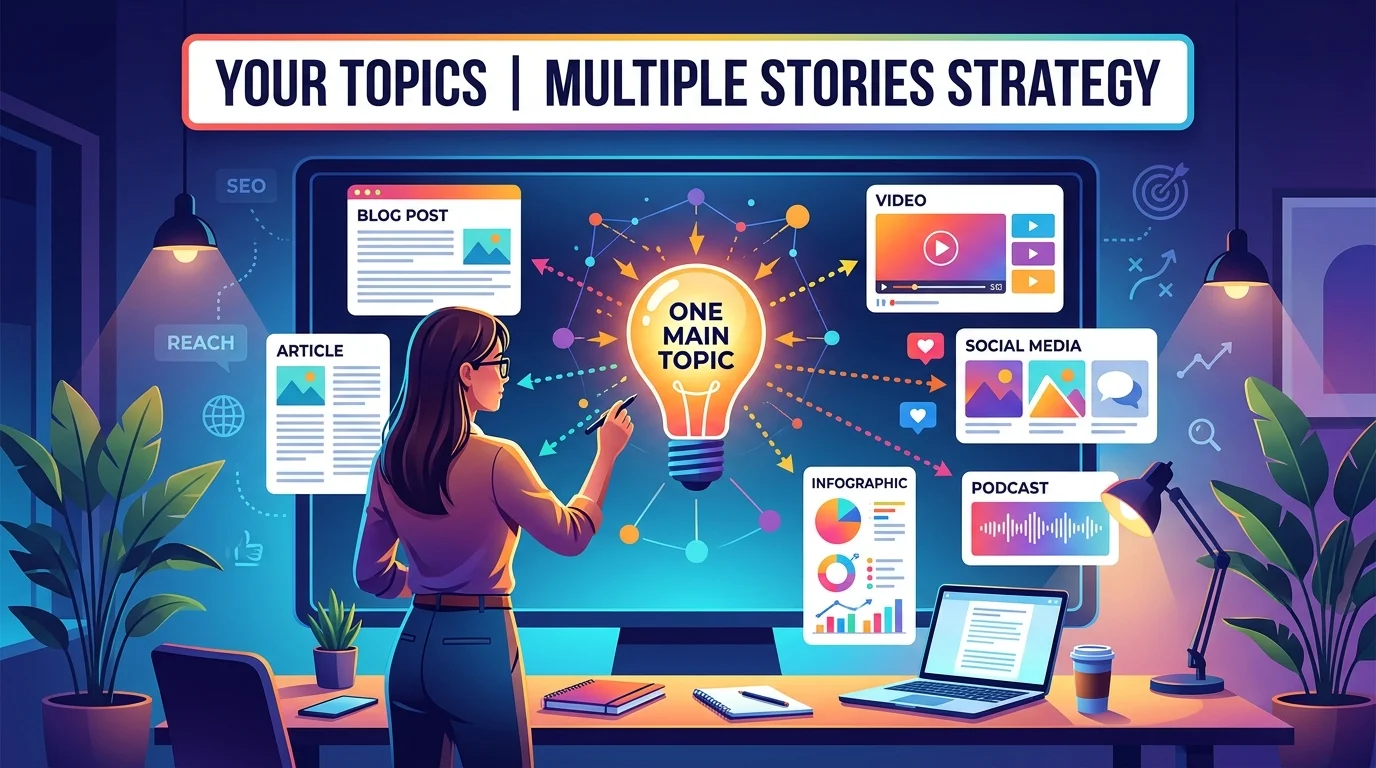
Creating fresh content consistently can be challenging. Bloggers, publishers, businesses, and digital creators often spend hours searching for new ideas. They may publish an article about one subject and then struggle to decide what to write next. However, a single subject can provide many opportunities when explored from different perspectives.
This is where the Your Topics | Multiple Stories Strategy becomes useful. It is a topic-based content strategy that helps creators turn one central idea into several meaningful stories. Instead of discussing a subject from only one angle, you explore its different questions, challenges, experiences, and practical applications.
For example, a website covering technology could publish one introductory article about artificial intelligence and then explore its applications in education, business, healthcare, entertainment, and everyday life. Each article addresses a different reader interest while remaining connected to the central subject.
The purpose is not simply to increase the number of published pages. It is to develop a useful collection of original information that readers can explore according to their needs.
In this guide, you will discover what the Your Topics | Multiple Stories Strategy means, how it works, how to find new story ideas, and how to apply it to a real website. You will also learn about topic clusters, search intent, content planning, AI-assisted research, and ways to measure results.
What Is the Your Topics | Multiple Stories Strategy?
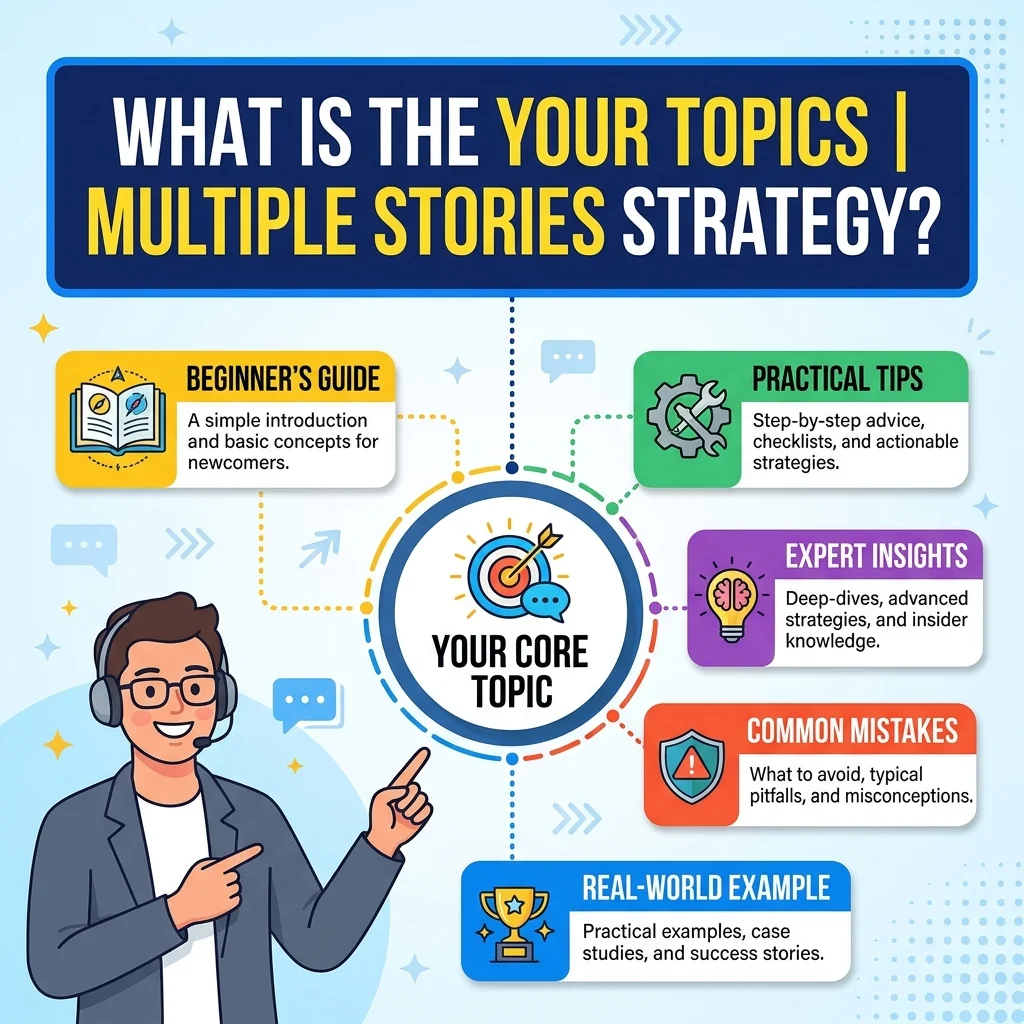
The Your Topics | Multiple Stories Strategy is an approach to content creation that starts with one main subject and develops several distinct stories around it.
Every story explores a different part of the subject. One might introduce the basic concept, another could explain a common problem, and another might provide practical instructions or real-world examples.
Think of a central topic as the trunk of a tree. Its branches represent smaller subjects, and each branch can produce several useful stories.
For example, consider the main topic of online business.
You could develop these individual stories:
- How to start an online business.
- How to select a profitable business idea.
- What beginners should know about startup costs.
- How to attract the first customers.
- Common mistakes made by new business owners.
- How to manage an online business.
- How to improve customer satisfaction.
All these articles relate to online business, but they answer different questions.
This is the foundation of a multiple stories content strategy. It allows creators to build depth around a subject without publishing repetitive material.
Is It an Official Google Strategy?
It is important to understand the terminology correctly.
The phrase Your Topics | Multiple Stories can describe a content development and storytelling approach. However, it is not an officially named Google ranking system or a guaranteed SEO technique.
Google News also uses a feature called “Your topics” in its personalised news experience. It presents news subjects selected through algorithms and personalisation. That feature is different from the content planning method discussed in this article. Similarly, multiple stories should not be confused with Google Web Stories. Web Stories are a separate visual storytelling format designed around pages containing images, videos, and short text.
Understanding these differences prevents misunderstandings and helps creators choose the right approach.
How Does the Multiple Stories Strategy Work?
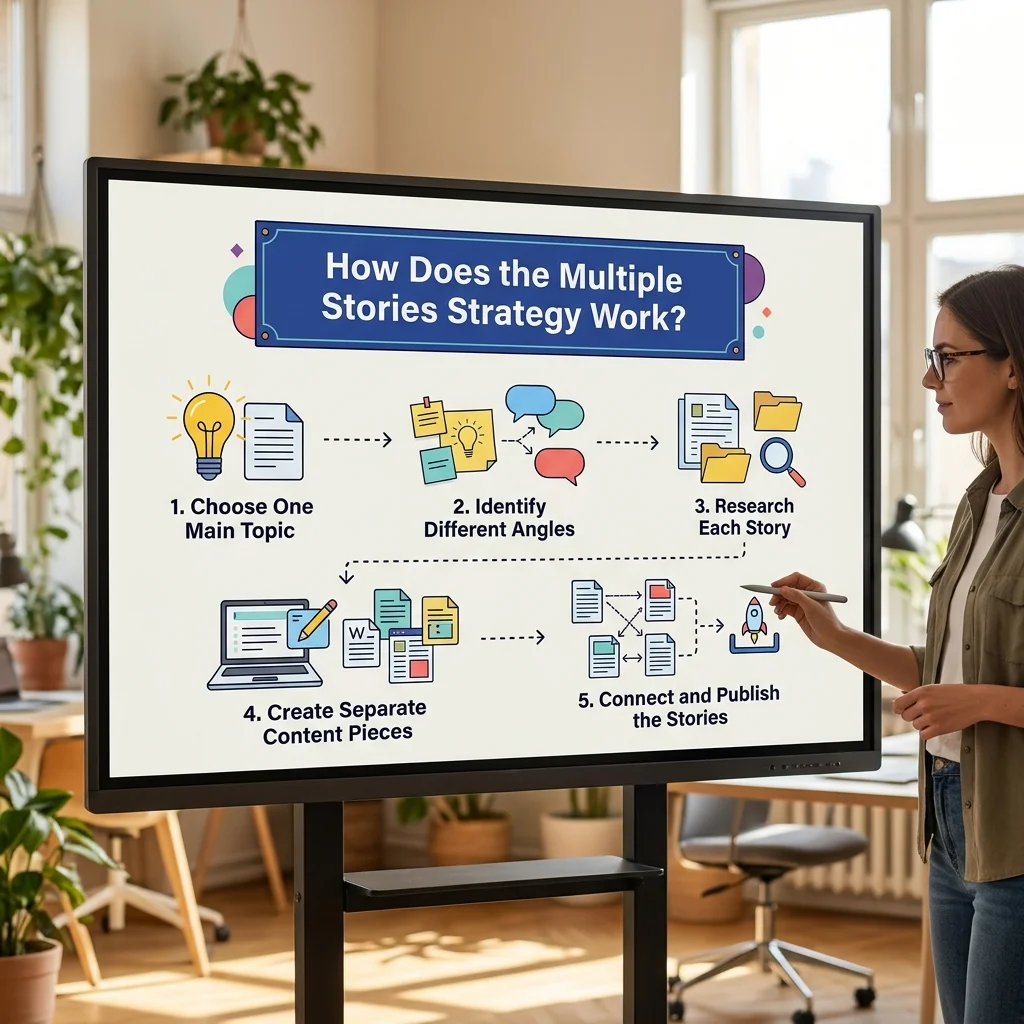
The process begins with a broad topic and gradually turns it into a collection of focused articles.
Each story should have a clear purpose, a defined audience, and enough original information to justify its existence.
<escape> </escape>
1. Select a Central Topic
Start with a subject that matches your website’s purpose and your audience’s interests.
For example, a fitness website might focus on weight management, while a technology publication could choose artificial intelligence.
Your central topic should have enough depth to support different discussions. However, it should not be so broad that the website loses its direction.
Good examples include:
- Personal finance.
- Digital marketing.
- Technology.
- Education.
- Health and fitness.
- Travel.
- Food and cooking.
- Online business.
Choose a subject that you can research properly and cover with reliable information.
2. Divide the Main Topic Into Smaller Subjects
After selecting your central topic, identify its major subtopics.
Imagine that you manage a website about digital marketing.
Your main categories could include:
| Main subject | Supporting subjects |
| Search engine optimization | Keyword research, technical SEO, on-page SEO |
| Social media marketing | Platform selection, content planning, engagement |
| Email marketing | Newsletters, subscriber growth, campaigns |
| Content marketing | Blogging, storytelling, content distribution |
| Paid advertising | Campaign planning, budgeting, performance |
Each supporting subject creates opportunities for individual stories.
This process helps you develop a more organised content planning strategy.
3. Identify the Questions Readers Ask
A topic becomes more valuable when you connect it to real audience questions.
For example, someone interested in personal finance may want to understand budgeting, saving, debt management, investing, and financial planning.
A beginner may search for a simple explanation. Another reader may want a practical guide or comparison.
Research these questions using:
- Google search suggestions.
- People Also Ask results.
- Search Console queries.
- Customer feedback.
- Relevant online discussions.
- Keyword research platforms.
- Comments on existing articles.
Do not assume that every possible question deserves its own article. Choose questions that have distinct purposes and enough information to support a useful answer.
4. Give Every Story a Unique Angle
This is one of the most important parts of the multiple storytelling approach.
A new article should contribute something different rather than repeat information already available on your website.
For example, consider the subject of email marketing.
You could create:
- An introductory guide explaining email marketing.
- A practical tutorial about building an email list.
- A comparison of email marketing platforms.
- A guide to writing effective newsletters.
- An article about common campaign mistakes.
Each story serves a separate purpose.
5. Organise and Connect Your Stories
Once you have developed several articles, organise them into meaningful categories.
Use internal links when one article naturally supports another.
For example, an introductory guide to email marketing could link to a separate newsletter-writing tutorial. The tutorial could then link back to the main guide.
These connections help visitors discover relevant information without making navigation confusing.
Why Is the Multiple Stories Content Strategy Useful?
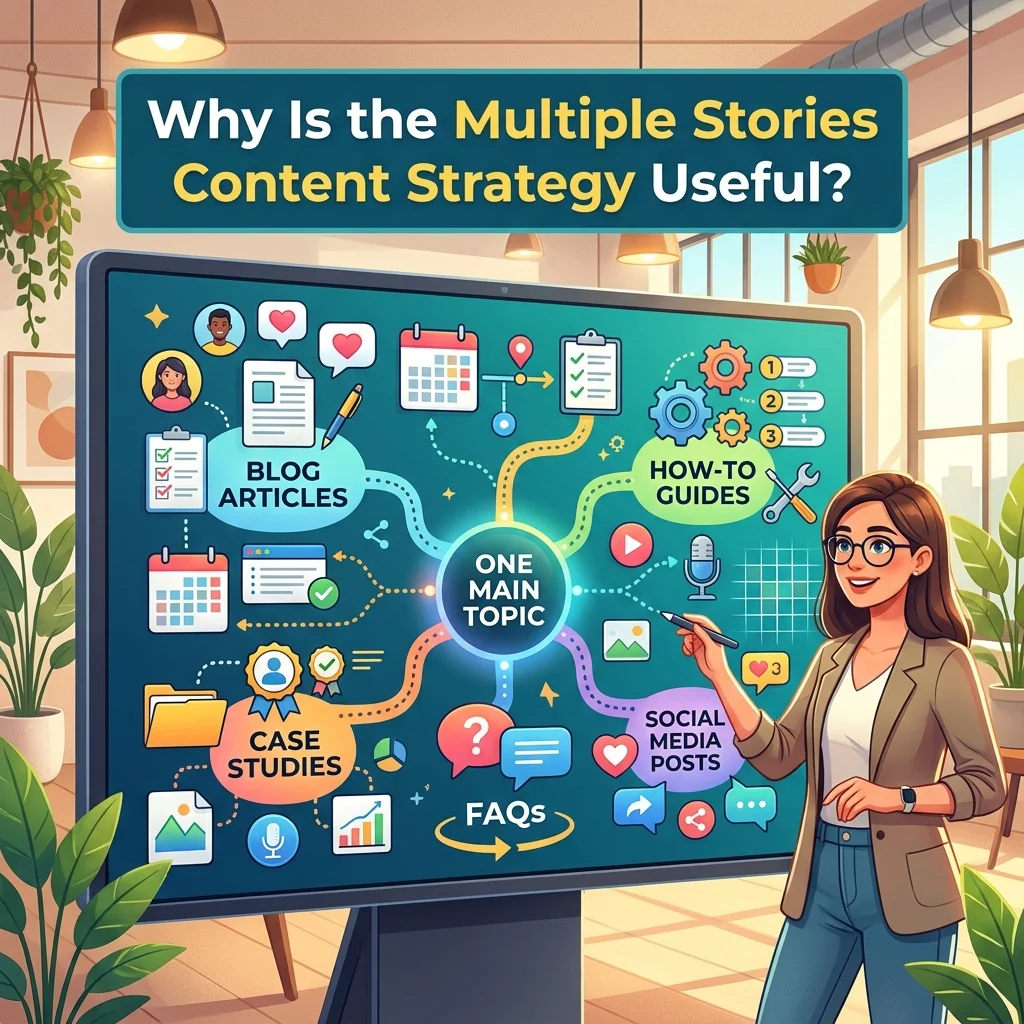
A well-planned collection of stories offers several advantages. However, these benefits depend on the usefulness and originality of the individual articles.
More Complete Topic Coverage
One article cannot always explain every part of a complicated subject.
Consider a website covering travel in Japan. A general destination guide might introduce the country, but readers may also need information about transportation, accommodation, food, local customs, budgets, and sightseeing.
Separate articles allow you to explain these subjects in greater detail.
Better Reader Experiences
Different readers have different questions.
A beginner might want a basic explanation, while an experienced visitor may need a detailed comparison.
The multiple stories strategy gives readers more opportunities to find information that matches their interests.
More Content Ideas
Many creators struggle with content planning because they believe every new article must introduce a completely different subject.
This strategy changes that process.
Instead of constantly searching for unrelated ideas, you can investigate different questions within a subject you already cover.
Stronger Website Organisation
A connected collection of articles can make your website easier to navigate.
Visitors can move from a general guide to specific tutorials, comparisons, and examples.
This creates a more logical content experience than publishing unrelated pages without a clear structure.
More Opportunities for Different Content Formats
A central subject can support blog posts, videos, interviews, social media discussions, and newsletters.
However, each format should offer a suitable experience. A tutorial may work better as a demonstration video, while a detailed comparison may be easier to understand in a written table.
How to Find Multiple Stories Around One Topic
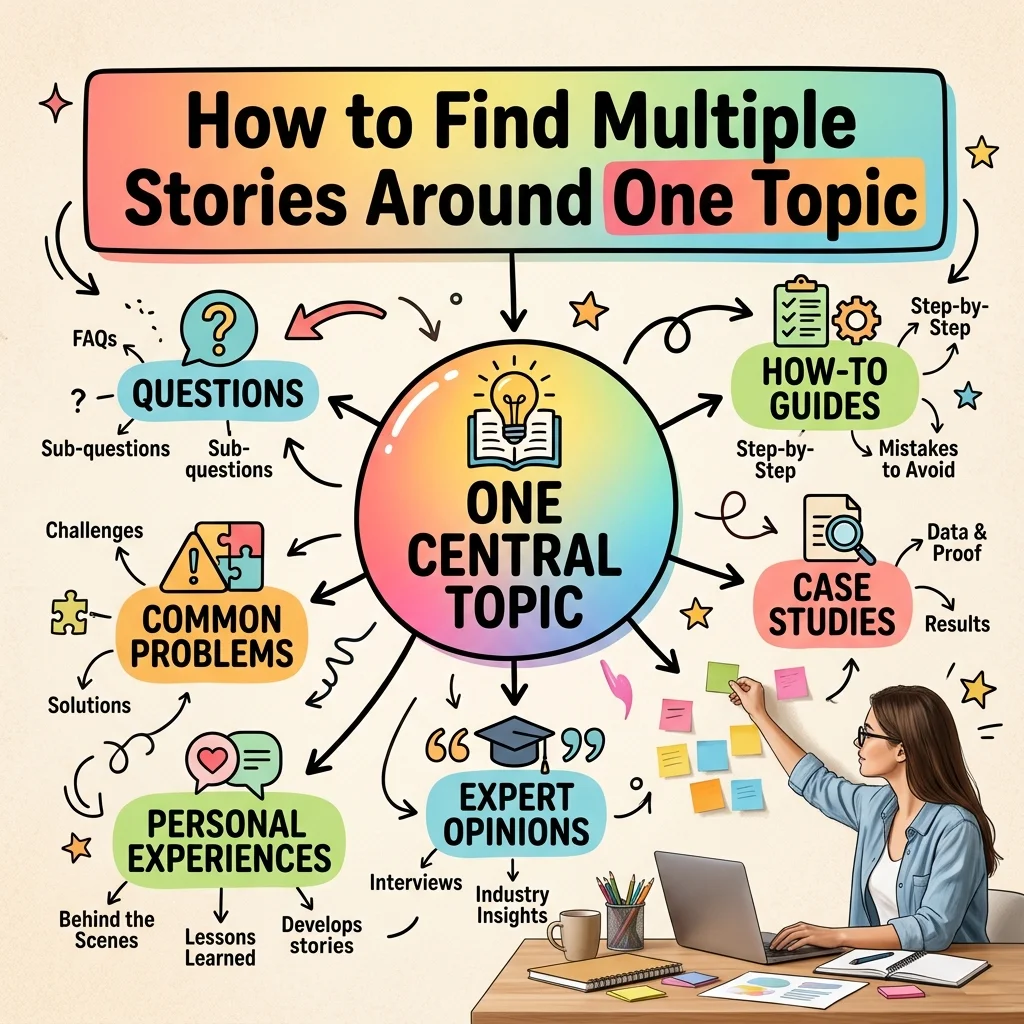
Finding useful ideas requires more than changing article titles. You need to discover different information needs and decide which ones deserve separate coverage.
Use the Five-Angle Research Method
One practical way to generate ideas is to examine a subject through five angles.
| Angle | Question to explore | Example: Online business |
| Explanation | What should readers understand? | What is an online business? |
| Problem | What difficulties exist? | Why do new businesses struggle? |
| Solution | How can readers take action? | How to attract customers |
| Experience | What happens in practice? | A beginner’s business journey |
| Comparison | What choices are available? | Online business models compared |
This method provides a starting point for a topic-based storytelling plan.
You can apply it to almost any subject.
Research Long-Tail Keywords
Long-tail keywords are more specific search phrases that often reveal what people want to learn.
For example, the broad keyword “digital marketing” may produce many possible directions.
More specific phrases include:
- Digital marketing for small businesses.
- How to create a digital marketing plan.
- Social media marketing mistakes.
- SEO strategies for new websites.
- How to measure digital marketing results.
Tools such as Ahrefs and Google Keyword Planner can help you explore related search terms.
Remember that keyword data is only one part of your decision. A keyword should also match your website, audience, and ability to provide a useful answer.
Study Competitor Content
Review websites that cover similar subjects.
Look for:
- Questions they have not answered.
- Topics that receive only superficial explanations.
- Outdated information.
- Missing examples.
- Unclear comparisons.
- Opportunities for original research.
Do not copy their article structure or rewrite their paragraphs. Your research should help you identify a reader need that you can address independently.
Listen to Your Audience
Your existing readers can provide valuable story ideas.
Pay attention to comments, emails, customer questions, and recurring discussions.
For example, if several visitors ask how to choose an affordable laptop, that may indicate an opportunity for a detailed buying guide.
Real audience questions are often more useful than randomly selecting popular keywords.
A Real-World Example: Applying the Strategy to a Website
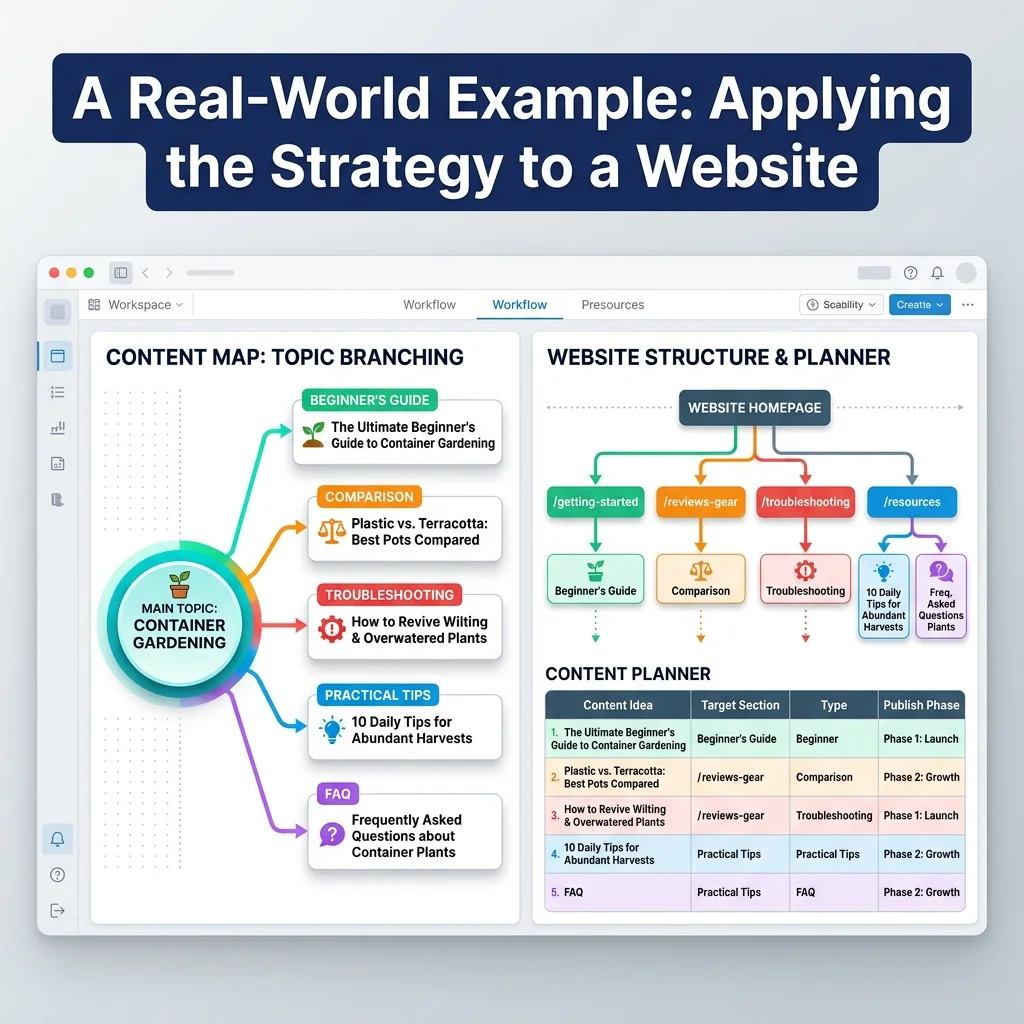
Suppose you own a website that publishes educational articles about technology.
You decide to build a content collection around artificial intelligence.
Instead of publishing one general article and moving to another topic, you develop a structured collection.
<escape> </escape>
Main Topic: Artificial Intelligence
Story 1: Understanding Artificial Intelligence
Explain what AI means, how it works at a basic level, and where people encounter it in everyday life.
Story 2: AI Tools for Students
Discuss research assistance, study planning, writing support, and the limitations of AI-generated information.
Story 3: How Businesses Use AI
Explore customer support, data analysis, automation, and other business applications.
Story 4: Advantages and Limitations of AI
Provide a balanced discussion of efficiency, accessibility, errors, privacy, and human oversight.
Story 5: Common AI Misconceptions
Explain misunderstandings about AI capabilities, accuracy, and independence.
Story 6: Responsible AI Use
Discuss fact-checking, privacy, transparency, and appropriate human review.
The result is a collection of connected articles that serves several reader interests.
How the Articles Work Together
| Article | Target reader | Main purpose |
| Understanding AI | Beginners | Learn the basics |
| AI Tools for Students | Students | Explore educational applications |
| AI for Businesses | Business owners | Understand practical uses |
| AI Advantages and Limitations | General readers | Compare benefits and risks |
| AI Misconceptions | Curious readers | Correct misunderstandings |
| Responsible AI Use | All users | Learn safe practices |
This example demonstrates how one central idea can support multiple stories without repeating the same article.
Multiple Stories vs Topic Clusters vs Content Repurposing
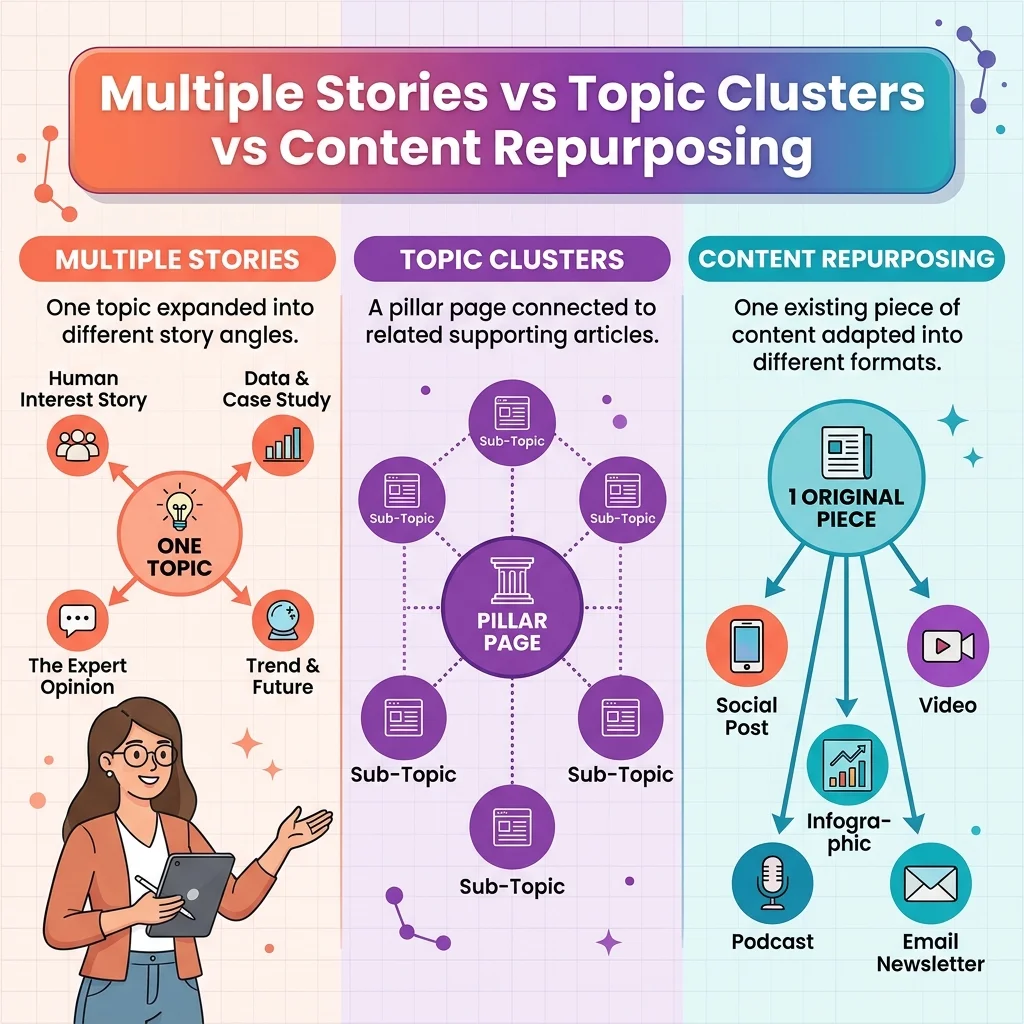
These concepts are related, but they are not identical.
Understanding the differences helps you develop a more effective content strategy.
| Approach | Main purpose | Example |
| Multiple stories | Explore different angles of one subject | Six articles about artificial intelligence |
| Topic clusters | Organise related pages around a central pillar page | An AI guide connected to supporting articles |
| Content repurposing | Adapt existing content into another format | Turning an AI article into a video |
| Storytelling | Present information through a narrative or experience | Explaining AI through a business owner’s experience |
You can use all four approaches together.
For example, you might create six original articles about artificial intelligence, organise them into a topic cluster, and turn selected information into videos and social media posts.
The important distinction is that a new story should provide a genuinely different perspective or answer a different question. Simply changing the format or wording does not automatically create new information.
How to Use the Strategy
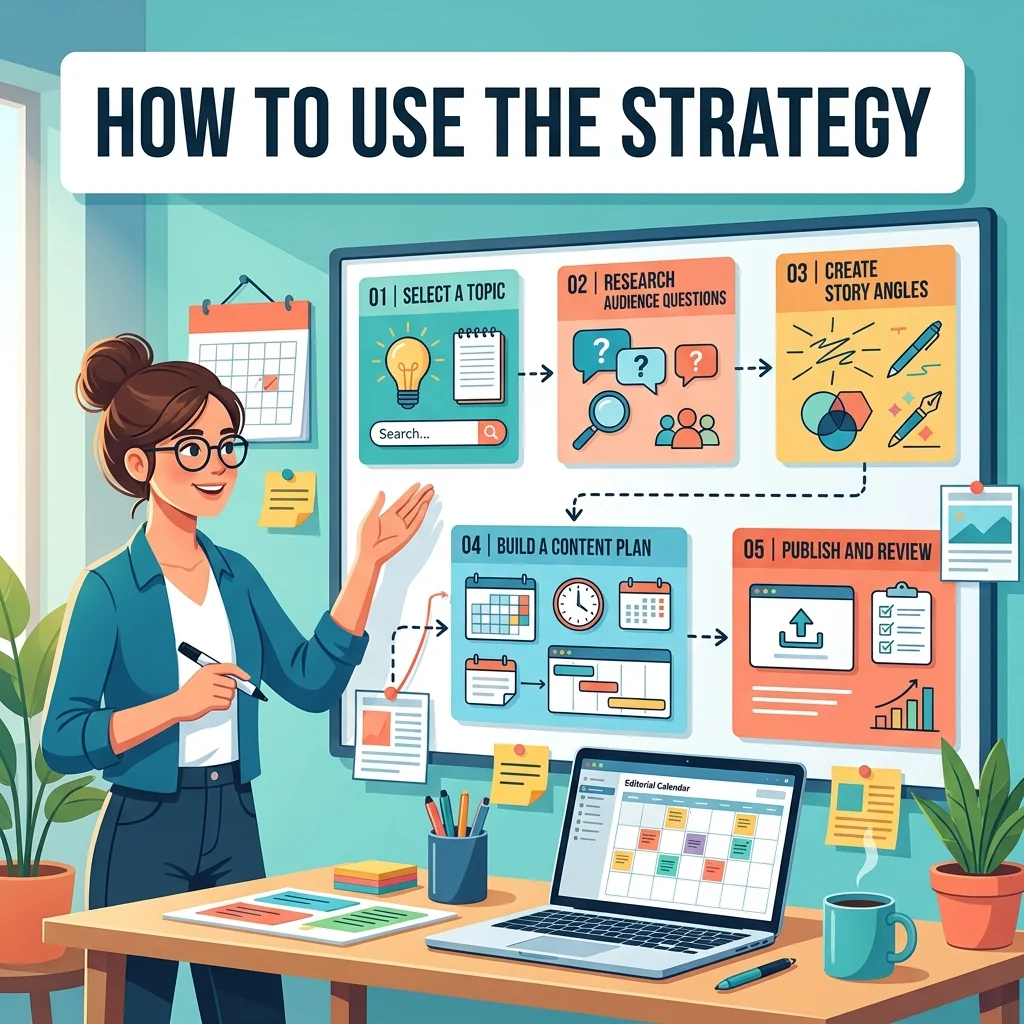
The multiple stories content strategy can support SEO when it helps readers find relevant information and makes your website easier to navigate.
However, it does not guarantee rankings or automatically create topical authority.
Create a Pillar Page
A pillar page introduces a broad subject and links to more detailed supporting articles.
For example, a website covering personal finance could create a main guide to financial planning.
Supporting articles might explore budgeting, saving, debt repayment, emergency funds, and financial goals.
The main guide should provide a meaningful overview rather than simply listing links.
Match Each Article to Search Intent
Search intent describes what a person wants when searching online.
The four commonly discussed categories are:
- Informational: The reader wants to learn something.
- Navigational: The reader wants to find a particular website or page.
- Commercial: The reader wants to compare products or services.
- Transactional: The reader is ready to take an action.
For example, someone searching for “what is email marketing” needs an explanation. Someone searching for “best email marketing software” is more likely to want a comparison.
Your article should answer the question behind the search rather than simply include the keyword.
Prevent Keyword Cannibalisation
Publishing multiple pages about one subject does not automatically cause keyword cannibalisation.
The problem can occur when several pages compete for substantially the same search intent.
Imagine publishing these three articles:
- Benefits of email marketing.
- Advantages of email marketing.
- Why email marketing is useful.
If all three provide nearly identical information, maintaining separate pages may not be worthwhile.
Instead, consider combining overlapping content into one stronger article.
Then create genuinely different supporting guides, such as newsletter writing, subscriber growth, and campaign measurement.
Use Natural Internal Links
Internal links help readers discover related information.
For example, an article about building an email list could link to a separate guide about newsletter design.
Use descriptive anchor text that explains what the destination page covers.
Avoid forcing links into unrelated paragraphs or adding excessive links that interrupt the reading experience.
Focus on Original, Helpful Information
Google’s guidance encourages publishers to create helpful, reliable, people-first content rather than pages designed mainly to attract search traffic.
Its guidance also encourages original information, useful analysis, clear sourcing, and meaningful expertise.
You can review the official Google helpful content guidance and SEO Starter Guide.
These principles are more important than publishing a particular number of stories or reaching an arbitrary word count.
How to Use AI to Generate Multiple Story Ideas
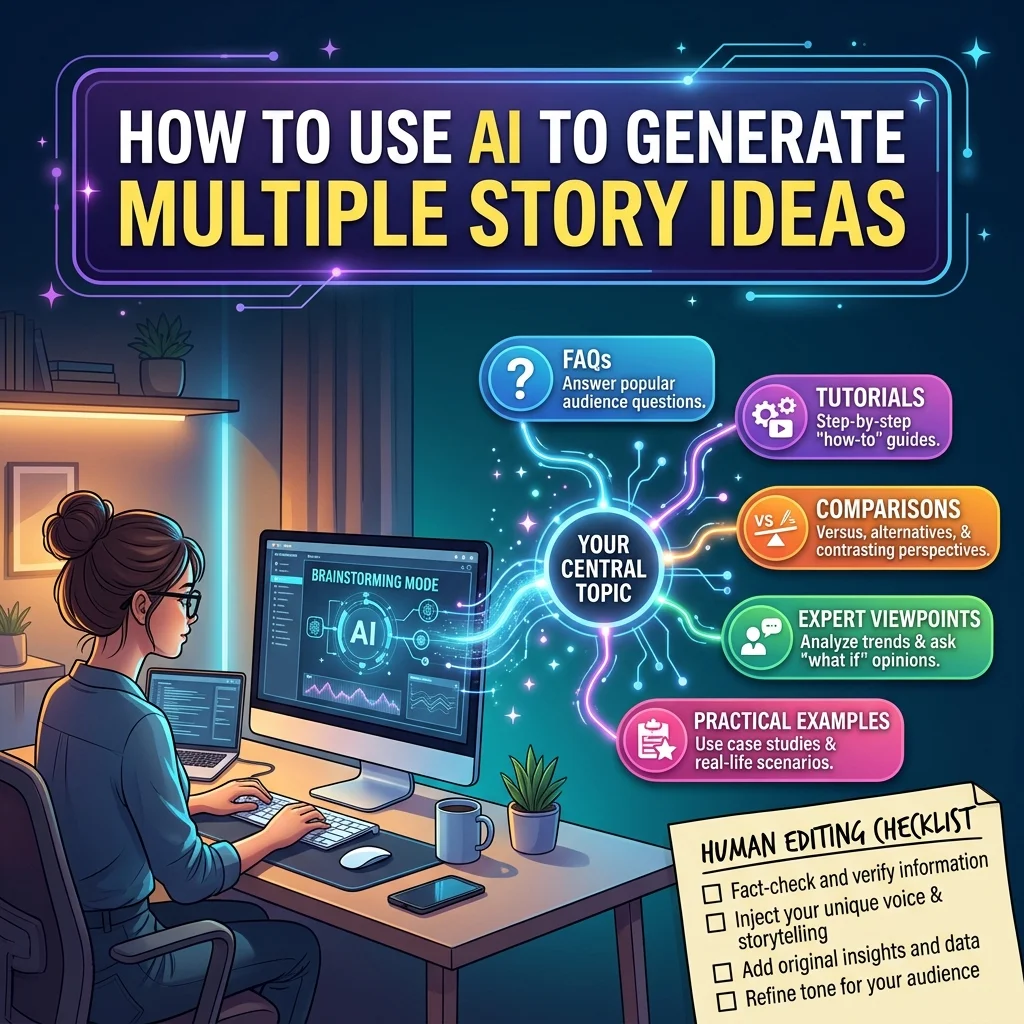
AI tools can help with brainstorming and organising content research.
However, AI-generated ideas should be treated as starting points rather than verified facts or automatic publishing instructions.
Generate Different Content Angles
Start with a main subject and ask an AI tool to identify different reader questions.
For example, you could use this prompt:
“Generate 20 distinct article ideas about email marketing. Organise them into beginner guides, practical tutorials, common problems, comparisons, and advanced topics. Avoid repetitive ideas and give every article a different search intent.”
Review the results and remove suggestions that overlap.
Build an Article Outline
Once you select a story, ask AI to create a logical outline.
Check whether the proposed headings answer the reader’s question in a useful order.
Add your own research, examples, and expertise before writing the complete article.
Find Content Gaps
You can also use AI to compare your existing article titles and identify potential overlap.
For example, provide a list of your published articles and ask which topics appear too similar.
Verify the suggestions manually before merging or deleting pages.
Fact-Check AI-Generated Information
AI systems can produce incorrect statistics, outdated details, and invented references.
Check factual claims against reliable sources. Never publish an invented case study or present a hypothetical experience as a real customer story.
AI should support your content development strategy, not replace editorial responsibility.
A Practical 30-Day Multiple Stories Content Calendar
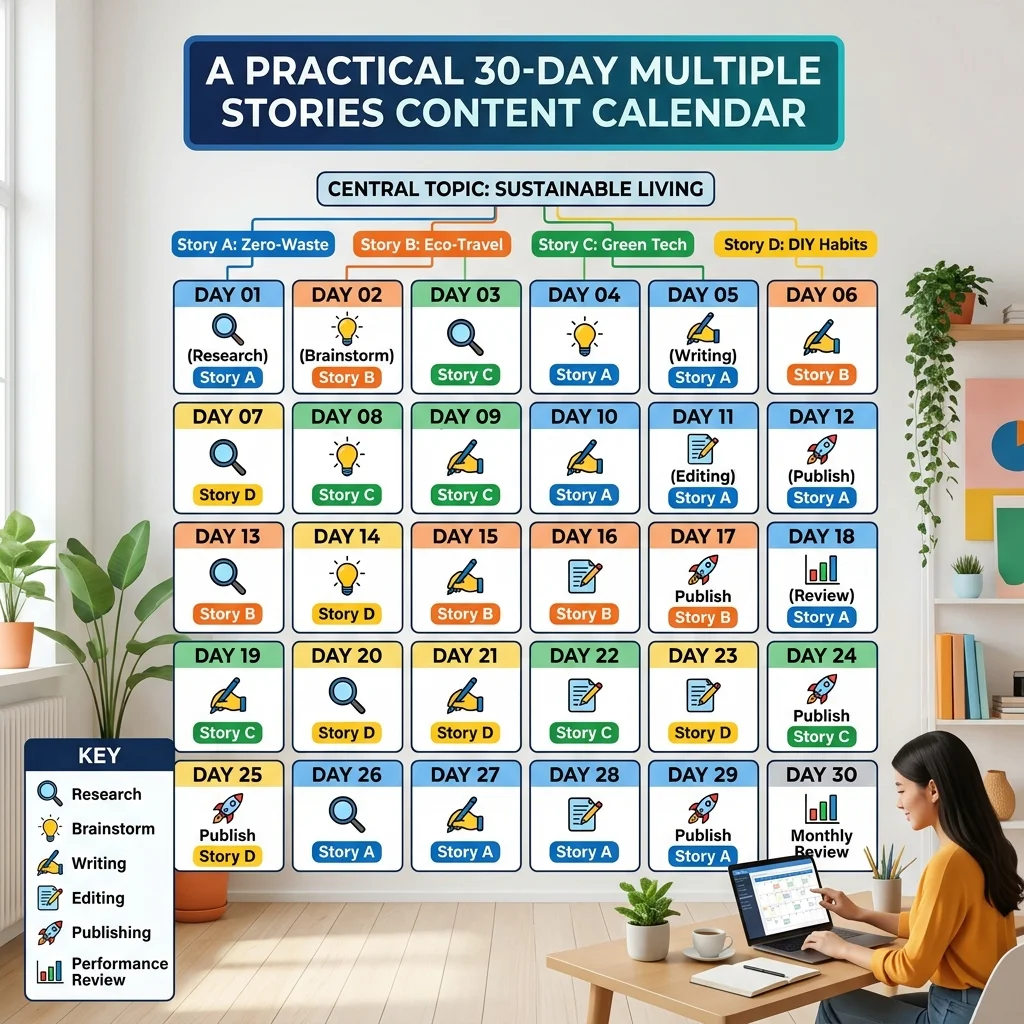
A publishing calendar helps turn ideas into a manageable workflow.
Here is an example for a website covering digital marketing.
| Day | Content task |
| 1 | Choose the central topic |
| 2 | Research audience questions |
| 3 | Identify relevant keywords |
| 4 | Review competitor content |
| 5 | Create a topic map |
| 6 | Select the first five stories |
| 7 | Prepare the pillar article outline |
| 8 | Research the main subject |
| 9 | Draft the pillar article |
| 10 | Edit and fact-check |
| 11 | Publish the pillar article |
| 12 | Research the first supporting story |
| 13 | Draft the first supporting article |
| 14 | Edit and publish |
| 15 | Research the second supporting story |
| 16 | Draft the second supporting article |
| 17 | Review examples and sources |
| 18 | Publish the second supporting article |
| 19 | Plan a third supporting article |
| 20 | Draft the third article |
| 21 | Edit and publish |
| 22 | Review internal linking |
| 23 | Create a related social media post |
| 24 | Develop a short video |
| 25 | Share the new content |
| 26 | Review search indexing |
| 27 | Check early performance data |
| 28 | Identify missing information |
| 29 | Improve relevant existing pages |
| 30 | Prepare the next month’s plan |
This is an illustrative schedule, not a requirement. A small website can spread the same work across several months.
The objective is to create a sustainable publishing process rather than rush out articles.
How to Measure the Results
Publishing stories is only one part of the process. You should also examine whether the content is useful and reaching the intended audience.
Organic Search Performance
Google Search Console provides information about impressions, clicks, search queries, and average search positions.
Review which articles appear in search results and whether they attract relevant visitors.
Do not judge an article’s success solely by its position. Consider whether the search traffic matches your intended audience.
Reader Engagement
Analytics tools can help you understand how visitors interact with your website.
Useful measurements include:
- Engaged sessions.
- Average engagement time.
- Returning visitors.
- Page views.
- Newsletter subscriptions.
- Relevant internal link clicks.
Interpret these metrics in context. A visitor who quickly finds a direct answer may have had a successful experience even if the visit was short.
Content Quality
Review each article manually.
Ask whether it answers the intended question, provides accurate information, includes useful examples, and offers something that is not already explained elsewhere on your website.
If a page is incomplete, improve its information rather than adding unnecessary paragraphs.
Content Gaps and Updates
Your audience’s needs may change over time.
Review existing articles to identify outdated information, broken links, missing explanations, and opportunities for more useful examples.
Update pages when you have something meaningful to improve.
Common Mistakes to Avoid
Even a well-planned multiple stories strategy can fail when content creators prioritise publishing volume over reader value.
Repeating the Same Information
Changing an article title does not create a new story.
Every article should have a distinct purpose, search intent, and useful contribution.
If two articles answer the same question in almost identical ways, consider combining them.
Choosing Unrelated Topics
Your supporting stories should have a clear relationship with the central subject.
A website about cooking can reasonably cover recipes, ingredients, meal preparation, and kitchen techniques.
Adding unrelated subjects without an editorial reason may confuse readers.
Ignoring Accuracy
A collection of stories is only as useful as the information it contains.
Check statistics, dates, product information, technical explanations, and references.
For subjects such as health, finance, and law, use appropriate authoritative sources and avoid presenting general information as individual professional advice.
Overusing Keywords
Do not repeat your primary keyword in every heading or paragraph.
Use relevant secondary keywords when they fit naturally.
Your priority should be answering the reader’s question clearly.
Publishing Without a Content Plan
Random publishing can create overlapping articles and inconsistent coverage.
Maintain a simple editorial calendar with article titles, target audiences, research sources, publication dates, and content status.
Treating Google Discover as a Guaranteed Traffic Source
Some publishers hope that multiple stories will automatically generate Google Discover traffic.
That is not a reliable assumption.
Google Discover is a personalised content experience, and appearing there is not guaranteed by using a particular article structure.
Create useful, original content and follow Google’s publishing guidance rather than promising a specific traffic result.
How Google News, Google Discover, and Multiple Stories Differ
These terms are sometimes discussed together, but they describe different things.
Your Topics in Google News: Google News uses personalised topic and story-selection features to help readers discover news based on their interests and other signals.
Google Discover: Discover is a personalised feed that can display content to users without requiring them to enter a search query.
Multiple Stories Strategy: This is the content planning approach discussed in this article. It involves developing several distinct stories around one central subject.
Google Web Stories: These are visual, mobile-friendly storytelling experiences that use images, videos, and short text.
A publisher may use a multiple stories content strategy while producing standard blog posts, news articles, videos, or visual stories. However, these formats and platforms have separate requirements.
For official information, see Google News Help, Google’s Web Stories guidance, and Google’s Discover documentation.
Best Tools for Managing a Multiple Stories Content Strategy
You do not need expensive software to get started. A few practical tools can help you research, plan, publish, and measure your work.
| Tool | How it helps |
| Ahrefs | Research keywords and competing content |
| Google Keyword Planner | Discover search terms |
| Google Trends | Explore changes in search interest |
| Google Search Console | Monitor search performance |
| Google Analytics 4 | Understand website activity |
| Notion | Organise story ideas and research |
| Trello | Manage editorial tasks |
| WordPress | Publish and organise articles |
Start with tools that solve an actual problem. You can add more advanced software as your content operation grows.
Is the Multiple Stories Strategy Suitable for Small Websites?
Yes. Small websites can benefit from this approach because it does not require a large publishing team or an extensive budget.
Imagine a small website covering home gardening.
Instead of publishing a single general gardening guide, the owner could create separate articles about:
- Choosing suitable plants for beginners.
- Understanding soil types.
- Watering indoor plants.
- Growing herbs in small spaces.
- Common gardening mistakes.
- Seasonal plant care.
These articles can be published gradually.
The owner can connect them through relevant internal links and organise them under a gardening category.
This creates a useful resource that grows over time.
Small publishers should focus on subjects they understand and can research properly. Expanding into unrelated areas simply to publish more articles is unlikely to provide a sustainable advantage.
Final Thoughts
The Your Topics | Multiple Stories Strategy offers a practical way to turn one central subject into a collection of useful, connected stories. Its strength comes from exploring different reader questions rather than repeating the same information under different titles. By combining audience research, keyword planning, original examples, and thoughtful organisation, creators can develop a stronger content library.
Start with one subject that fits your website. Identify the questions readers ask, select distinct story angles, and create articles that provide genuine answers. Connect related pages naturally and review their performance after publication. You can also use AI tools to brainstorm ideas, prepare outlines, and identify possible content gaps. However, research, accuracy, and editorial judgement should remain part of the process.
Frequently Asked Questions
1. What does Your Topics | Multiple Stories mean?
It describes a content development approach in which one central subject is explored through several distinct stories. Each story answers a different question, introduces a new perspective, or provides a practical example.
2. Is Your Topics | Multiple Stories an official Google feature?
The phrase can describe a content strategy, but it is not the official name of a Google ranking system. Google News does have a personalised feature called Your topics, which is separate from this content planning approach.
3. How does the Multiple Stories Strategy work?
You choose a central subject, identify related questions, select different story angles, and create individual articles. You then organise the articles into relevant categories and connect them with useful internal links.
4. How many stories should I create for one topic?
There is no universal number. The right amount depends on the subject’s depth, audience needs, and available information. Start with a few distinct stories and expand when you discover additional questions worth answering.
5. Can the Multiple Stories Strategy improve SEO?
It can support SEO by helping publishers cover relevant subjects, organise related pages, and satisfy different search intents. However, it does not guarantee rankings or traffic. Content quality and usefulness remain essential.
6. What is the difference between multiple stories and content repurposing?
Multiple stories explore different aspects of a central subject. Content repurposing adapts existing information into another format, such as turning a blog post into a video or newsletter.
7. Can beginners use this content strategy?
Yes. Beginners can start with a familiar subject, research common questions, and create a small collection of useful articles. A complicated publishing system is not necessary.
8. Can AI help create multiple stories?
AI can assist with brainstorming, outlining, grouping related questions, and identifying possible content gaps. However, its suggestions should be checked for accuracy, originality, and relevance before publication.
9. Does publishing several articles about one subject cause keyword cannibalisation?
Not automatically. The risk arises when multiple pages target similar search intent and provide overlapping information. Give each article a distinct purpose and consolidate pages when necessary.
10. What is a topic cluster?
A topic cluster is a group of related web pages organised around a central pillar page. The supporting pages explore narrower subjects and link to the central guide where appropriate.
11. Is the Multiple Stories Strategy useful for businesses?
Yes. Businesses can develop customer stories, tutorials, product explanations, case studies, industry guides, and problem-solving articles around subjects relevant to their customers.
12. Can multiple stories be published on social media?
Yes. You can develop separate social media posts, short videos, educational carousels, and discussions around different aspects of one central subject. Each piece should provide its own useful takeaway.
13. What is the biggest mistake when using this approach?
The biggest mistake is confusing more articles with better coverage. Repetitive content, unrelated subjects, weak research, and unnecessary keyword repetition can reduce the value of your content library.
14. How can I measure the success of multiple stories?
Review organic search performance, relevant website engagement, reader feedback, internal link activity, and content quality. Use these findings to improve existing articles and identify worthwhile new topics.
15. Is there a difference between Google Discover and Google News Your Topics?
Yes. Google Discover provides personalised content recommendations, while Google News offers a news-focused experience with personalised sections and topics. Neither should be confused with the general multiple stories content strategy.

I am Daniel Harris, a passionate writer and content creator dedicated to sharing valuable, informative, and engaging articles with readers. I am focused on researching topics deeply and presenting ideas in a simple, clear, and helpful way. I am passionate about delivering accurate information that helps people learn, grow, and make better decisions.