How much does a cow weigh? It is a common question among farmers, cattle owners, livestock buyers, and people interested in animal agriculture. The answer depends on several factors, including the cow’s breed, age, gender, genetics, nutrition, and overall health.
The average cow weight generally ranges from 900 to 1,800 pounds (408 to 816 kilograms) for many mature cattle breeds. However, some smaller breeds weigh considerably less, while larger cattle can exceed this range. Dairy cows, beef cows, bulls, and young calves also have different average weights.
Knowing how much an average cow weighs is important for more than simply understanding its size. Farmers use cattle weight measurements to plan feeding programs, monitor animal growth, manage breeding, calculate veterinary medication dosages, and estimate livestock market value.
For example, a Jersey cow is generally smaller than a Holstein, while Charolais and Simmental cattle are known for their larger body frames. Similarly, a mature bull usually weighs more than a female cow of the same breed.
In this comprehensive guide, we will explain the average weight of a cow by breed, age, and gender. We will also cover dairy and beef cattle weights, newborn calf weights, feeding requirements, weight measurement methods, and the difference between live weight and carcass weight.
What Is the Average Weight of a Cow?
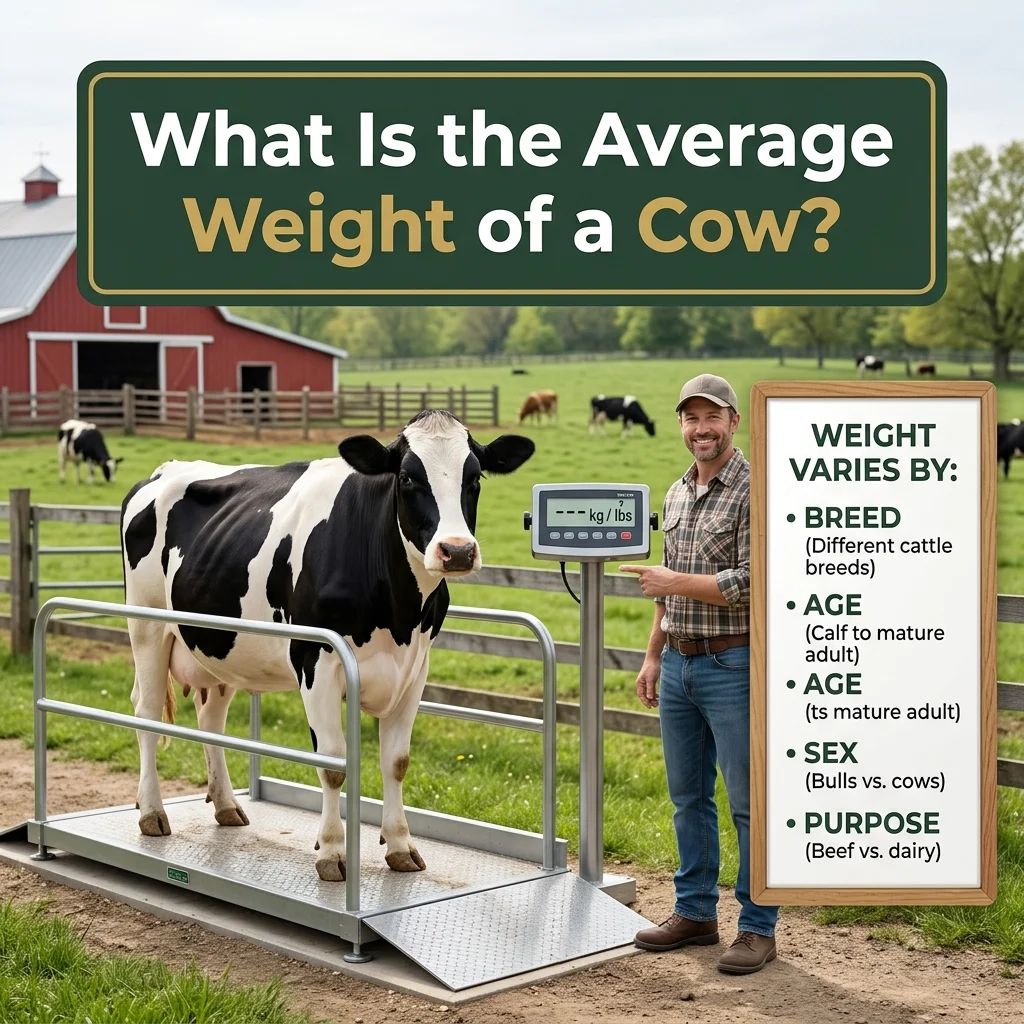
The average weight of an adult cow is approximately 900 to 1,800 pounds (408 to 816 kilograms), although individual animals can fall outside this range.
Cow weight varies because cattle breeds have different genetic characteristics and body structures. Some breeds are naturally smaller, while others develop larger frames and more muscle.
For example, a mature Jersey cow may weigh approximately 900 to 1,200 pounds, whereas a mature Holstein cow may weigh around 1,300 to 1,700 pounds.
The purpose for which cattle are raised also matters. Dairy cows are selected primarily for milk production, while beef cows are generally selected for reproductive performance, growth characteristics, and meat production.
Average Cow Weight Chart
The following table provides general weight estimates for different cattle categories.
| Type of cattle | Approximate weight in lbs | Weight in kg |
| Newborn calf | 60–100 | 27–45 |
| Three-month-old calf | 150–250 | 68–113 |
| Six-month-old calf | 300–500 | 136–227 |
| One-year-old cattle | 500–800 | 227–363 |
| Growing heifer | 400–900 | 181–408 |
| Mature dairy cow | 900–1,700 | 408–771 |
| Mature beef cow | 1,000–1,800 | 454–816 |
| Mature bull | 1,600–2,600 | 726–1,179 |
These are broad illustrative ranges, not universal breed standards or guaranteed growth targets. The actual weight of an animal depends on its breed, sex, age, nutrition, and body condition.
Average Cow Weight by Breed
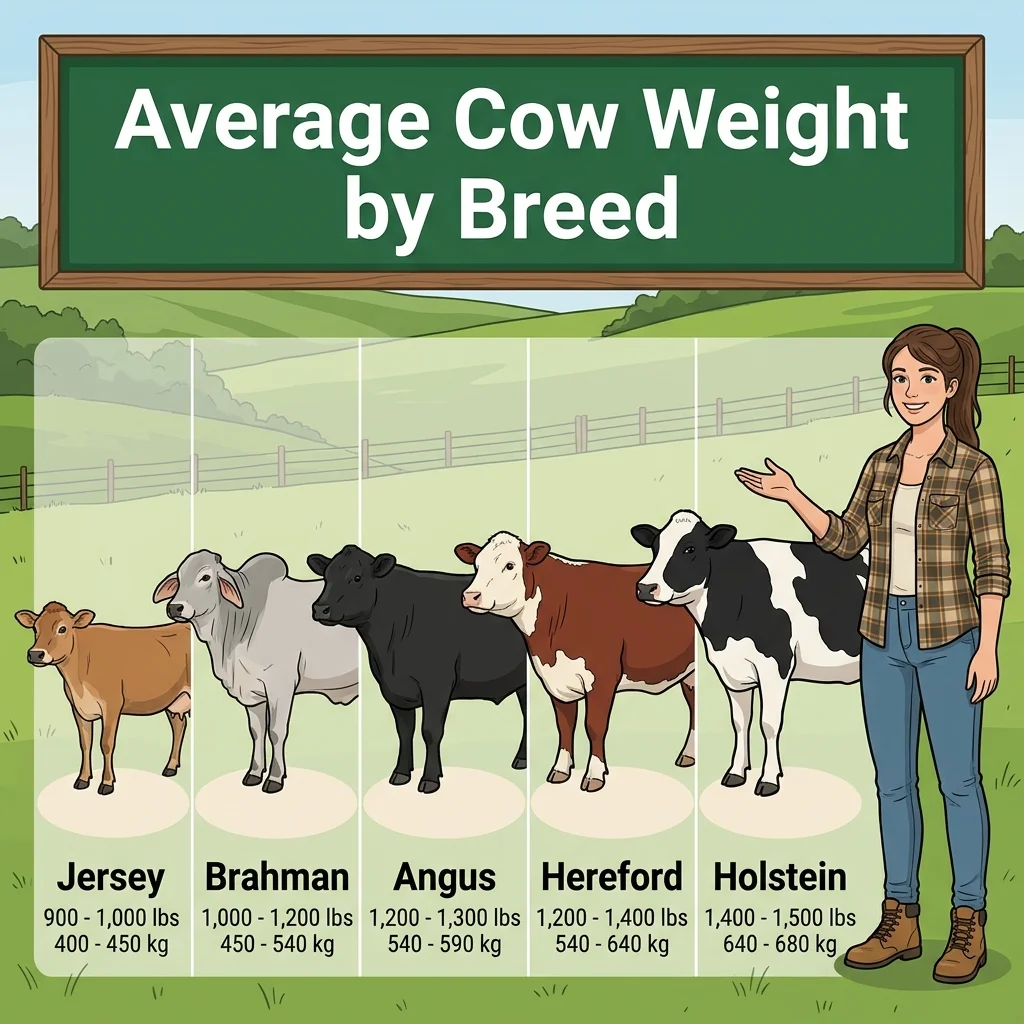
Cow weight by breed is one of the most important considerations when comparing cattle. Different breeds have been developed for specific agricultural purposes, including milk production, beef production, and adaptability to different climates.
Some cattle breeds have smaller bodies and require less feed for maintenance. Others have larger frames and greater potential for muscle development.
Let’s explore the average mature female weight of several popular cattle breeds.
Holstein Cow Weight
Holstein cattle are among the most recognizable dairy breeds in the world. They are famous for their distinctive black-and-white markings and high milk production.
A mature Holstein cow commonly weighs approximately 1,300 to 1,700 pounds (590 to 771 kilograms).
Holsteins have relatively large body frames and need appropriate nutrition to maintain their body condition while producing milk.
Their weight can vary according to genetics, age, reproductive stage, and feeding practices.
Important characteristics:
- Large body structure.
- High milk-producing potential.
- Recognizable black-and-white coat.
- Relatively high feed requirements.
Jersey Cow Weight
Jersey cows are smaller dairy animals known for producing milk with relatively high butterfat content.
A mature Jersey cow generally weighs around 900 to 1,200 pounds (408 to 544 kilograms).
Despite their smaller body size, Jersey cows are efficient milk producers. Their manageable size can make them suitable for farms with limited space or feed resources.
Important characteristics:
- Smaller body frame.
- Golden, fawn, or light-brown coat.
- Milk with high butterfat content.
- Relatively low maintenance requirements compared with larger dairy breeds.
Angus Cow Weight
Angus cattle are popular beef animals recognized for their black coats, muscular bodies, and desirable meat characteristics.
A mature Angus cow generally weighs approximately 1,100 to 1,500 pounds (499 to 680 kilograms).
Angus cattle are widely used in commercial beef production because of their growth characteristics, meat quality, and maternal abilities.
Their actual weight depends on genetics, age, feeding conditions, and breeding practices.
Hereford Cow Weight
Hereford cattle are recognized by their reddish-brown bodies and distinctive white faces.
A mature Hereford cow generally weighs around 1,100 to 1,500 pounds (499 to 680 kilograms).
They are valued for their hardiness, grazing ability, and adaptability to different environments.
Hereford cattle are commonly raised for beef production and are also used in crossbreeding programs.
Charolais Cow Weight
Charolais cattle originated in France and are known for their white or cream-colored coats and large muscular frames.
A mature Charolais cow may weigh approximately 1,300 to 1,800 pounds (590 to 816 kilograms).
This breed is popular in beef production because of its growth potential and muscular development.
Charolais bulls are generally heavier than females and can reach considerably higher body weights.
Simmental Cow Weight
Simmental cattle are a versatile breed raised for beef production and, in some breeding systems, dairy production.
A mature Simmental cow generally weighs around 1,300 to 1,800 pounds (590 to 816 kilograms).
These cattle are known for their relatively large frames, good growth potential, and strong physical structure.
Their exact weight depends on genetics, breeding lines, nutrition, and farm management.
Brown Swiss Cow Weight
Brown Swiss cattle are a popular dairy breed known for their brown or grayish coats and strong body structure.
A mature Brown Swiss cow commonly weighs approximately 1,300 to 1,700 pounds (590 to 771 kilograms).
They are valued for milk production, strong feet and legs, and adaptability to different farming environments.
Guernsey Cow Weight
Guernsey cows are medium-sized dairy animals with golden-fawn and white coats.
A mature Guernsey cow generally weighs approximately 1,000 to 1,400 pounds (454 to 635 kilograms).
They are appreciated for their milk composition, manageable body size, and calm temperament.
Cow Weight Comparison by Breed
| Cattle breed | Approximate mature female weight |
| Jersey | 900–1,200 lbs |
| Guernsey | 1,000–1,400 lbs |
| Angus | 1,100–1,500 lbs |
| Hereford | 1,100–1,500 lbs |
| Limousin | 1,200–1,600 lbs |
| Holstein | 1,300–1,700 lbs |
| Brown Swiss | 1,300–1,700 lbs |
| Charolais | 1,300–1,800 lbs |
| Simmental | 1,300–1,800 lbs |
These ranges are practical approximations for comparison. They should not be interpreted as official breed registration standards.
Average Weight of Dairy Cows
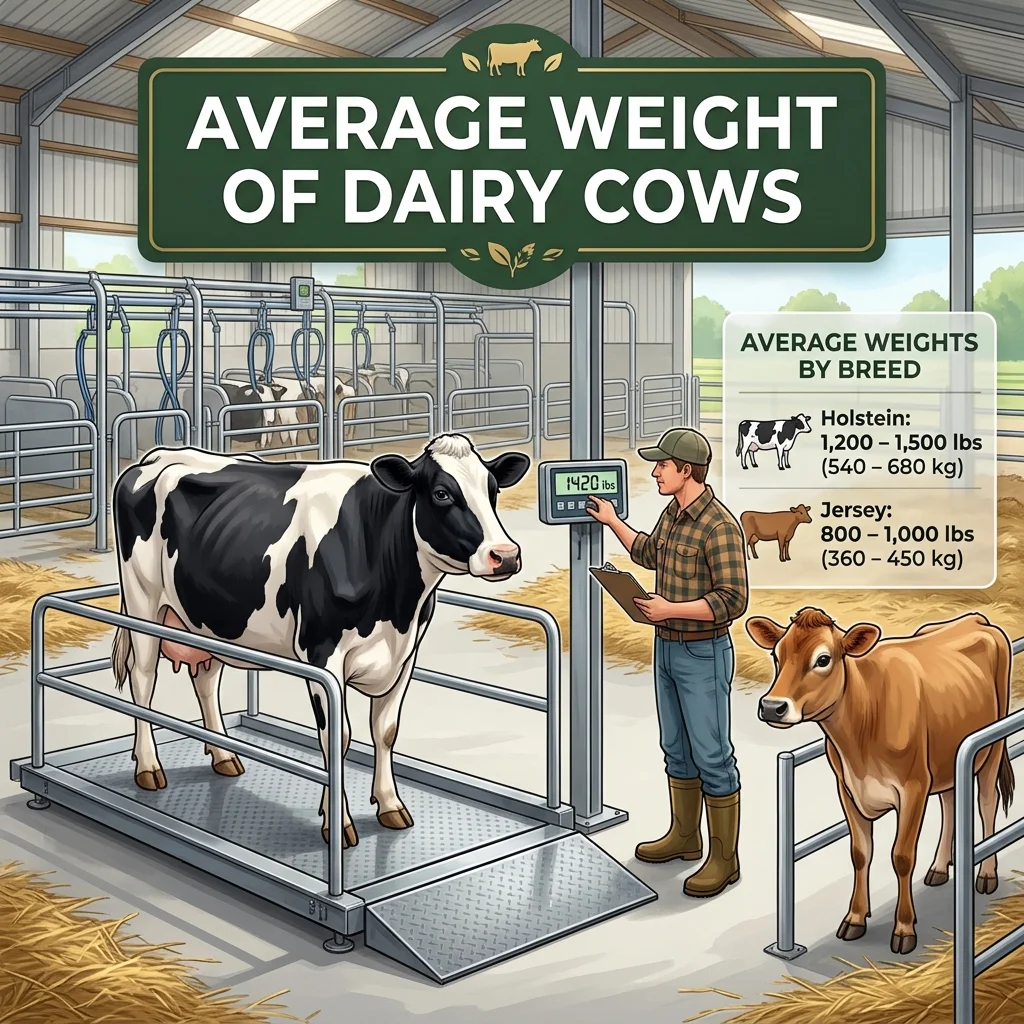
Dairy cows are raised primarily for milk production. Their body weight depends on breed, genetics, feeding, age, and stage of lactation.
The dairy cow average weight generally falls between 900 and 1,700 pounds (408 to 771 kilograms).
Holstein cows tend to be among the heavier dairy breeds, while Jersey cows are usually smaller.
Why Does Dairy Cow Weight Matter?
Monitoring dairy cow weight helps farmers understand whether their animals are maintaining an appropriate body condition.
Weight information can help with:
- Planning daily feed requirements.
- Monitoring growth and development.
- Managing pregnancy and reproductive health.
- Evaluating changes during lactation.
- Identifying unexplained weight loss.
- Improving overall herd management.
A dairy cow may experience changes in body weight throughout its production cycle. For example, a cow can lose some body reserves during early lactation when energy requirements are high.
Farmers should therefore consider body condition score alongside actual weight.
Average Weight of Beef Cows
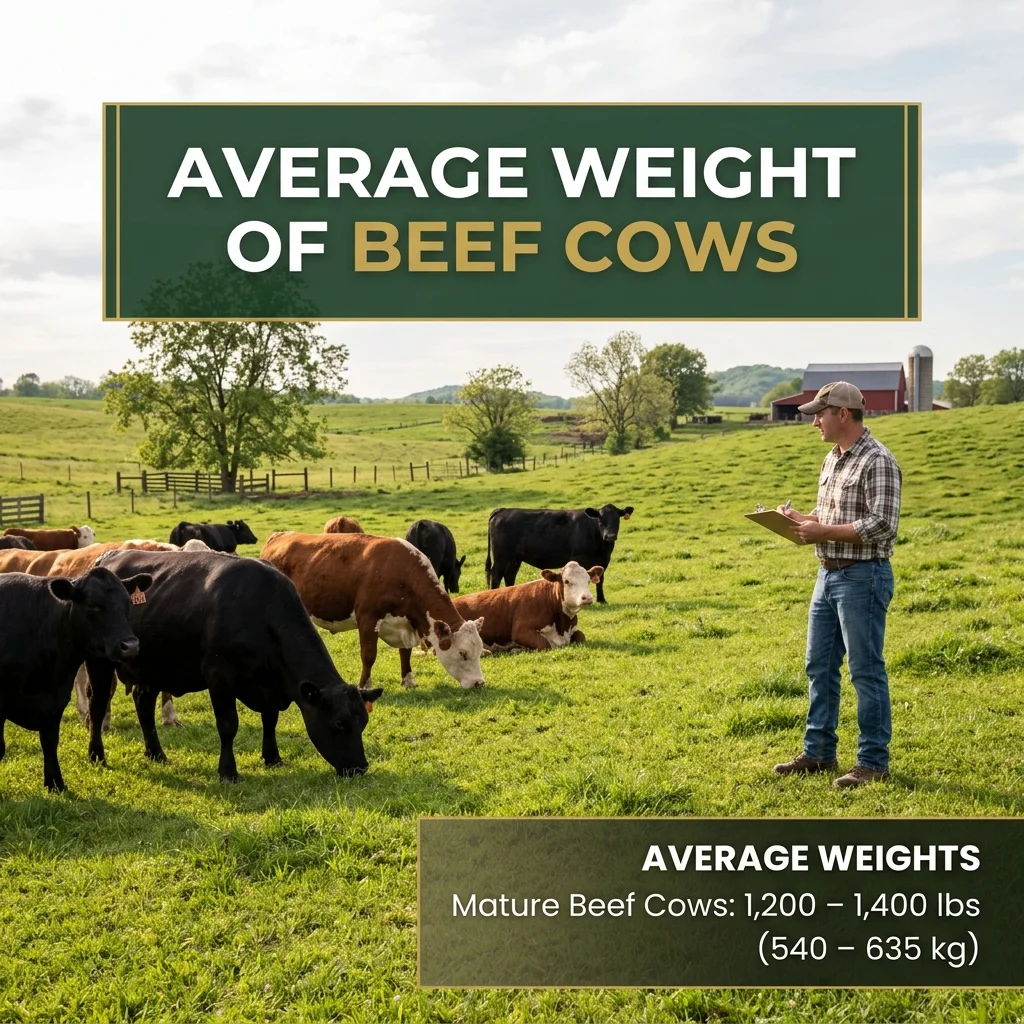
Beef cows are raised primarily to produce calves for meat production.
A mature beef cow commonly weighs approximately 1,000 to 1,800 pounds (454 to 816 kilograms), depending on its breed and genetic background.
Angus, Hereford, Charolais, and Simmental cattle are popular examples of beef breeds.
What Influences Beef Cow Weight?
Several factors influence beef cattle weight:
- Breed genetics: Some breeds naturally have larger frames and greater muscle development.
- Nutrition: Balanced feed supports healthy growth and body condition.
- Age: Mature cattle generally weigh more than growing animals.
- Health: Diseases and parasites can interfere with normal growth.
- Environment: Climate, pasture quality, and management conditions affect performance.
Farmers monitor beef cattle weight to evaluate growth, manage breeding animals, estimate feed requirements, and plan livestock sales.
Average Cow Weight by Age
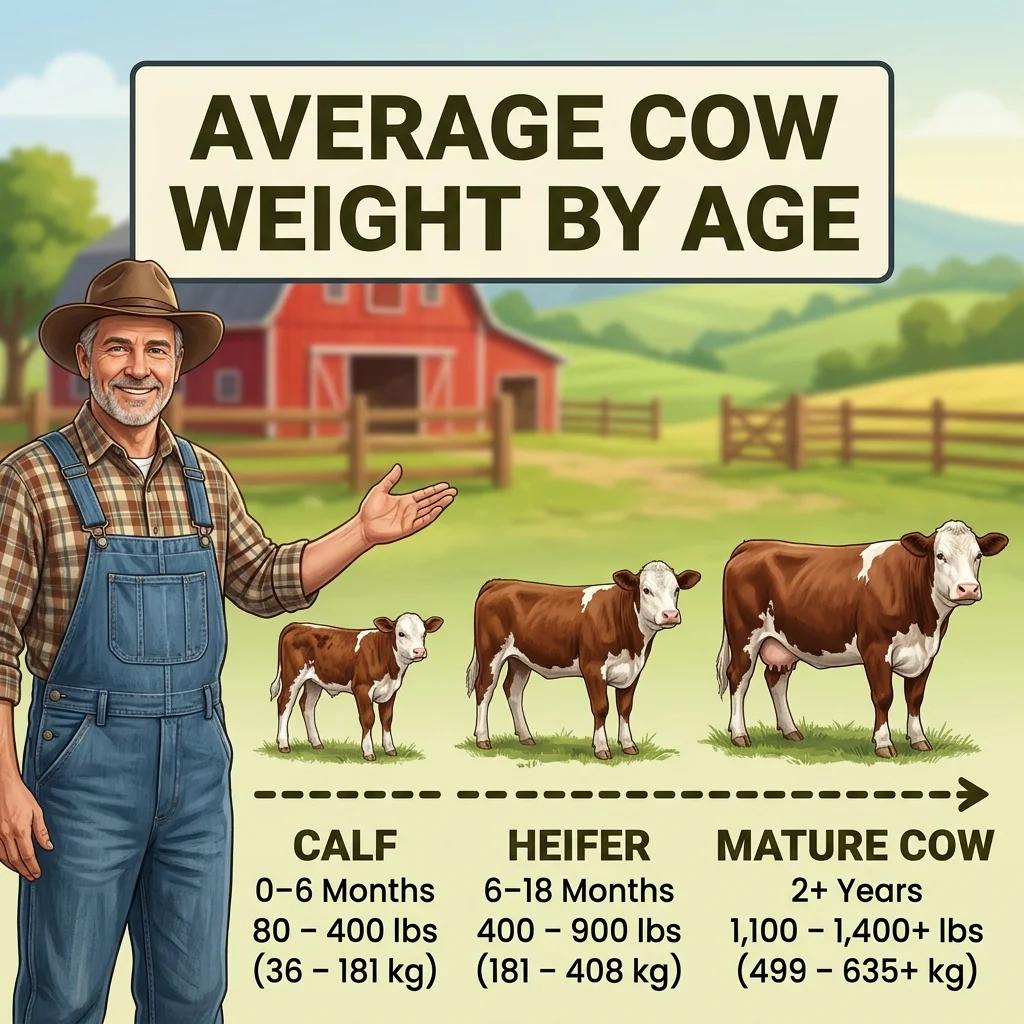
Age is another major factor affecting cattle weight.
A newborn calf weighs considerably less than a mature cow because its bones, muscles, and body structure are still developing.
However, cattle do not all grow at the same rate. Breed, gender, milk intake, feed quality, and genetics influence their development.
Cow Weight by Age Chart
| Age | Approximate weight |
| Newborn | 60–100 lbs |
| 1 month | 80–130 lbs |
| 3 months | 150–250 lbs |
| 6 months | 300–500 lbs |
| 12 months | 500–800 lbs |
| 18 months | 700–1,100 lbs |
| 24 months | 800–1,400 lbs |
| Mature adult | 900–1,800 lbs |
This is an illustrative growth chart, not a standard applicable to every breed or feeding system.
Newborn Calf Weight
A newborn calf generally weighs around 60 to 100 pounds (27 to 45 kilograms).
Birth weight depends on the breed, genetics, sex of the calf, maternal nutrition, and other factors.
Larger breeds may produce heavier calves, while smaller breeds often have lighter newborns.
The first hours after birth are especially important. Calves need adequate colostrum, which provides essential antibodies and nutrients.
Three-Month-Old Calf Weight
A three-month-old calf may weigh approximately 150 to 250 pounds (68 to 113 kilograms).
During this stage, calves continue developing their muscles and digestive systems.
Good-quality milk or an appropriate milk-feeding program, clean water, and suitable calf starter feed help support healthy growth.
Six-Month-Old Calf Weight
A six-month-old calf may weigh approximately 300 to 500 pounds (136 to 227 kilograms).
Some beef calves can weigh more depending on their breed and growth program.
Many calves are weaned around this stage, although the appropriate timing depends on their health, development, and management system.
One-Year-Old Cattle Weight
A one-year-old animal may weigh approximately 500 to 800 pounds (227 to 363 kilograms).
Beef cattle raised under intensive growth programs may weigh more, while animals with limited nutrition may weigh less.
Farmers use regular weight measurements to evaluate whether cattle are meeting their expected growth targets.
Two-Year-Old Cow Weight
By two years of age, many cattle have developed much of their adult body structure.
A two-year-old animal may weigh approximately 800 to 1,400 pounds (363 to 635 kilograms), depending on breed and management.
Some large breeds can weigh more, while smaller breeds may weigh less.
Importantly, a heifer does not become a mature cow simply because it reaches a particular weight or age. The term cow generally refers to a female bovine that has calved.
Average Weight of a Bull Compared With a Cow
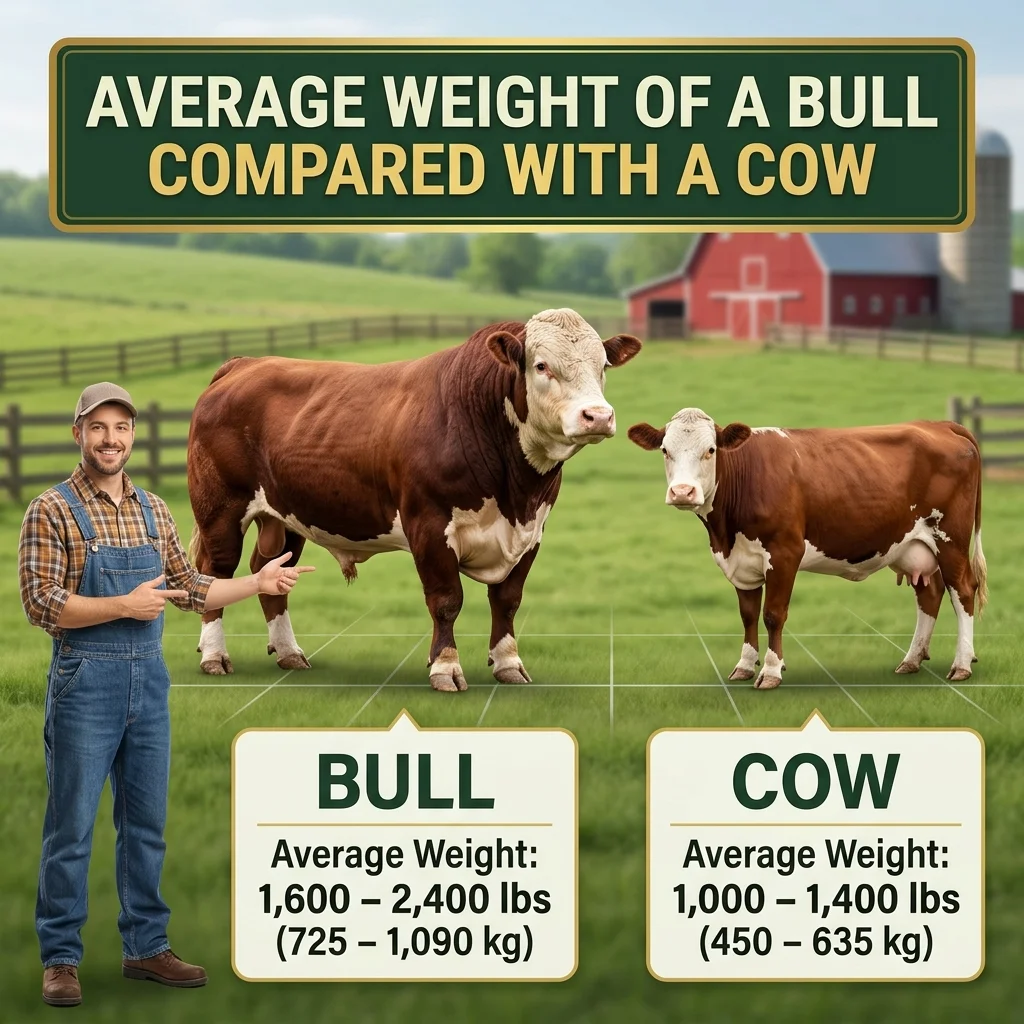
Bulls and cows have different physical characteristics, which influence their average body weights.
A bull is an adult male bovine, while a cow is an adult female that has given birth. Bulls are generally heavier and more muscular than females of comparable breeds.
A mature bull may weigh approximately 1,600 to 2,600 pounds (726 to 1,179 kilograms), although breed and individual genetics can produce considerable variation.
Bull vs. Cow Weight Comparison
| Cattle category | Approximate weight |
| Mature female cow | 900–1,800 lbs |
| Mature bull | 1,600–2,600 lbs |
| Young heifer | 400–900 lbs |
| Growing steer | 500–1,000 lbs |
A heifer is a female that has not yet calved, while a steer is a castrated male bovine.
Why Are Bulls Usually Heavier?
There are several reasons why bulls tend to weigh more than cows:
- Muscle development: Bulls generally develop more muscle mass.
- Body structure: Male cattle often have larger frames.
- Hormones: Differences in sex hormones influence muscle and body development.
- Genetics: Breeding programs often select bulls for growth and physical characteristics.
However, a large mature cow can weigh more than a small bull. Therefore, gender alone cannot determine the weight of an individual animal.
Average Weight of a Pregnant Cow
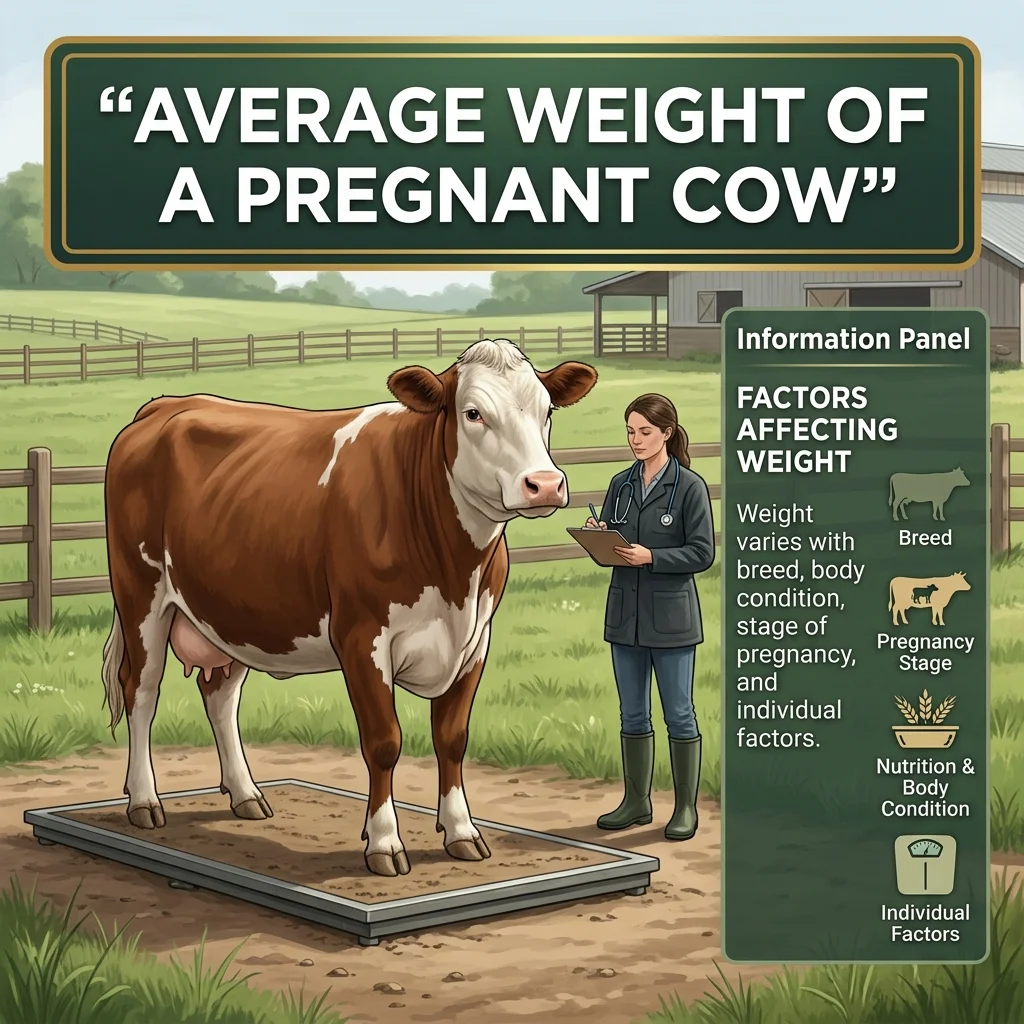
Pregnancy can influence a cow’s total body weight because the animal carries a developing calf, placenta, fluids, and additional reproductive tissues.
A pregnant cow does not have one fixed weight. Her weight depends on her breed, original body size, stage of pregnancy, and nutritional condition.
During the later stages of pregnancy, the developing calf contributes more to the cow’s total weight.
How Does Pregnancy Affect Cow Weight?
Pregnancy can affect body weight in several ways:
- The developing calf increases in size.
- Reproductive tissues and fluids contribute additional weight.
- Changes in feed intake can influence body condition.
- Nutritional requirements change as pregnancy progresses.
Farmers should monitor both weight and body condition during pregnancy.
A pregnant cow should receive sufficient energy, protein, minerals, and vitamins to support her own health and the development of her calf.
However, excessive weight gain is not necessarily beneficial. Maintaining an appropriate body condition is more important than making the animal as heavy as possible.
Average Cow Weight After Giving Birth
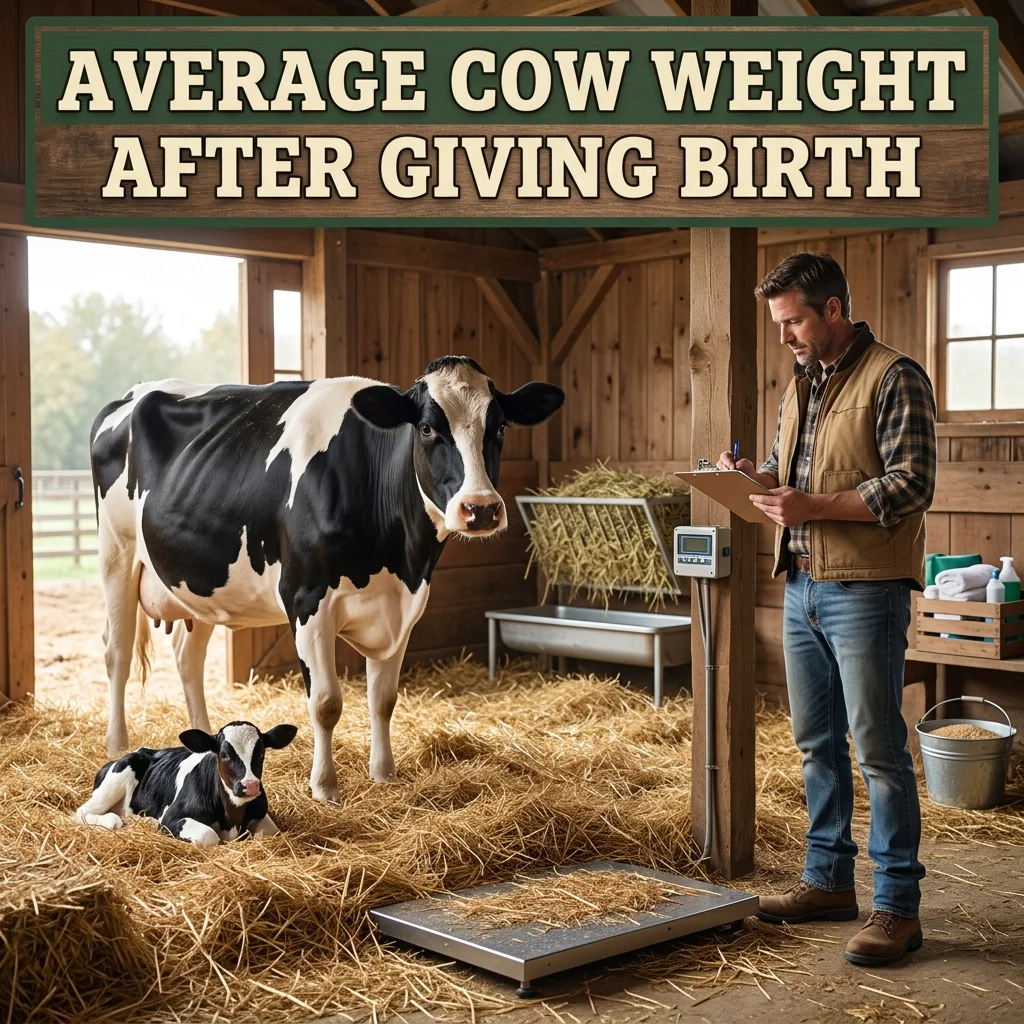
After giving birth, a cow’s weight changes because the calf, placenta, and pregnancy-related fluids are no longer part of her body.
This means a cow may weigh less immediately after calving than she did shortly before delivery.
However, the exact weight change varies between animals.
A cow may also experience temporary changes in body condition during early lactation because producing milk requires additional energy.
How Can Farmers Maintain Weight After Calving?
Farmers can support healthy weight management by:
- Providing good-quality forage.
- Offering balanced energy and protein sources.
- Ensuring constant access to clean water.
- Providing appropriate mineral supplementation.
- Monitoring body condition regularly.
- Consulting a veterinarian when unexpected weight loss occurs.
It is important to remember that a cow’s nutritional requirements can increase significantly during lactation.
Live Weight vs. Carcass Weight: What Is the Difference?
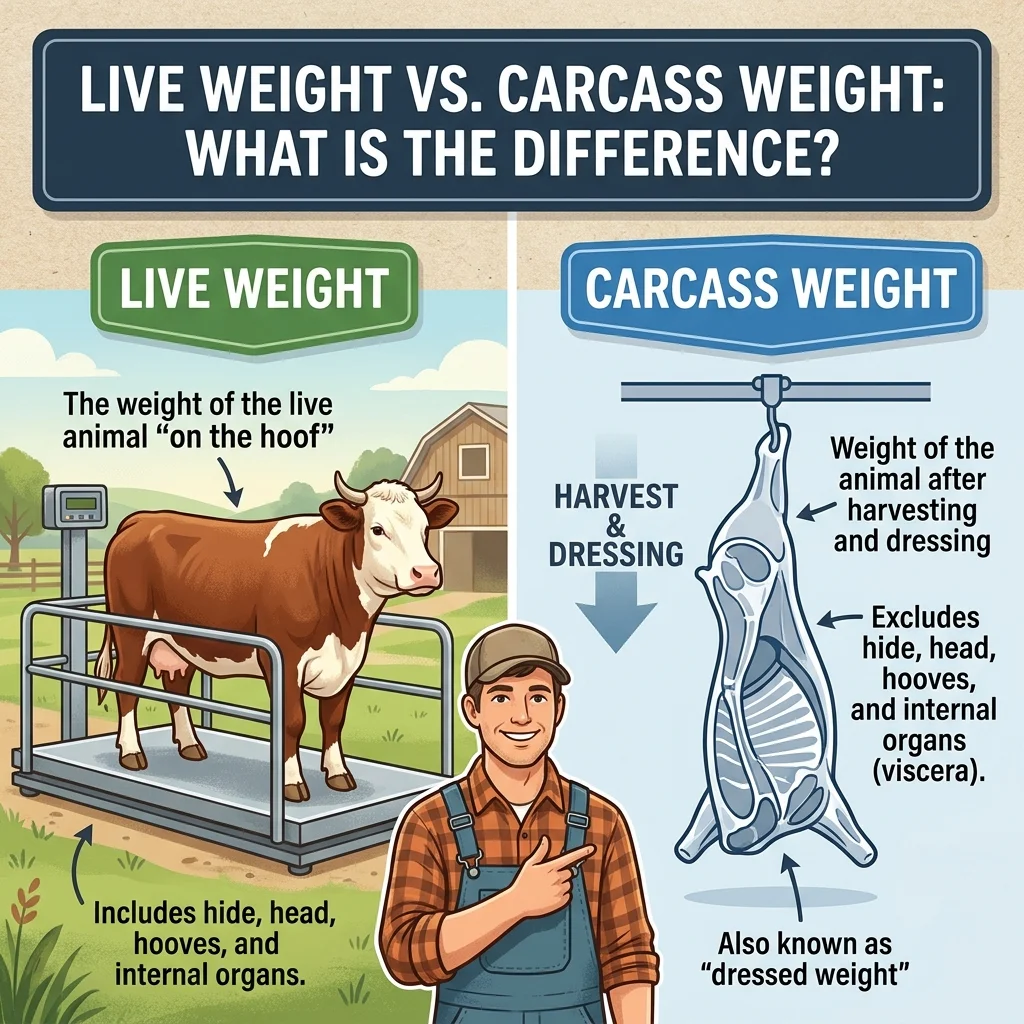
One important topic that cattle buyers and farmers should understand is the difference between live weight and carcass weight.
These two measurements are not interchangeable.
Live weight is the total weight of an animal while it is alive. It includes the hide, head, bones, muscles, organs, digestive contents, and other body tissues.
Carcass weight is the weight remaining after slaughter and the removal of the hide, head, feet, and internal organs, according to the applicable carcass measurement standard.
Live Weight vs. Carcass Weight Example
Consider a beef animal with a live weight of 1,200 pounds.
If its dressing percentage is 63%, its estimated hot carcass weight would be:
1,2000.63=756lbs
Example: 1,200-pound beef animal
1,200 lbs
Live weight
756 lbs
Hot carcass weight
Illustrative dressing percentage: 63%.
The remaining weight is not all edible meat. The carcass still contains bones, fat, and moisture, and additional weight is lost during chilling and processing.
According to Mississippi State University Extension, the average dressing percentage for beef cattle is approximately 60% to 64%, although individual results vary.
Mississippi State University Extension Service+1
What Is Dressing Percentage?
Dressing percentage measures how much of an animal’s live weight becomes hot carcass weight.
The formula is:
DressingPercentage=HotCarcassWeightLiveWeight100
This calculation is useful for comparing livestock market prices and estimating carcass weight.
Average Slaughter Weight of Cattle
Slaughter weight refers to the live weight of an animal when it is sent for processing.
There is no single slaughter weight suitable for every animal. It depends on breed, age, sex, market requirements, body condition, and production system.
For example, a beef steer weighing 1,200 pounds may produce a hot carcass weighing approximately 720 to 768 pounds at a 60% to 64% dressing percentage.
Farmers and livestock buyers should understand whether a quoted price is based on live weight, carcass weight, or another measurement.
This distinction can prevent confusion when comparing livestock transactions.
How to Measure a Cow’s Weight
Measuring cattle weight is important for farm management, veterinary care, breeding, and livestock trading.
There are several ways to measure or estimate cow weight.
Method 1: Using a Livestock Weighing Scale
A livestock weighing scale is generally the most reliable practical method for determining an animal’s actual weight.
The cow stands on a specially designed platform, and the scale displays its weight.
Digital livestock scales are commonly used on commercial farms, livestock markets, and veterinary facilities.
Advantages:
- Provides a direct weight measurement.
- Helps monitor growth accurately.
- Supports reliable livestock records.
- Helps with veterinary calculations.
- Makes buying and selling easier.
For accurate results, the scale should be properly calibrated and the animal should stand safely on the platform.
Method 2: Using a Cow Weight Tape
A cow weight tape is a practical tool for estimating cattle weight without a large weighing machine.
The tape is placed around the animal’s chest, immediately behind the front legs. This measurement is called the heart girth.
Some specially designed livestock tapes convert the measurement into an estimated body weight.
Advantages:
- Easy to carry.
- Affordable for many farmers.
- Useful for regular monitoring.
- Does not require electricity.
- Provides a quick estimate.
However, the result is not exact. Breed, body shape, pregnancy, and body condition can affect the estimate.
Method 3: Calculating Weight Using Body Measurements
Farmers can estimate cattle weight using heart girth and body length.
A commonly used livestock estimation formula is:
W=G2L300
Where:
- W = Estimated weight in pounds.
- G = Heart girth in inches.
- L = Body length in inches.
Example calculation:
Suppose a cow has:
- Heart girth: 70 inches.
- Body length: 60 inches.
The calculation is:
W=707060300
W=294,000300
W=980lbs
The estimated cow weight is approximately 980 pounds (444 kilograms).
This is a field-estimation method, not a substitute for an actual scale reading. The formula and measurement method are documented in livestock extension material associated with the University of Arizona Cooperative Extension.
Ministry of Agriculture+1
Tips for More Accurate Cow Weight Measurements
Follow these practical tips:
- Measure the animal on level ground.
- Make sure the cow is standing naturally.
- Place the tape correctly behind the front legs.
- Keep the measuring tape snug without compressing the animal.
- Measure body length from the point of shoulder to the pin bone.
- Repeat measurements to reduce measurement errors.
- Record the date and results for future comparison.
Whenever possible, use a livestock scale to verify estimated measurements.
How Much Food Does a Cow Need Based on Its Weight?
A cow’s weight is an important factor when planning its daily feeding requirements.
Larger cattle generally need more feed to maintain their body weight. However, feed requirements also depend on milk production, pregnancy, age, activity, forage quality, and environmental conditions.
A useful starting estimate for many cattle is approximately 2% to 3% of body weight per day on a dry-matter basis. Actual requirements can be lower or higher depending on the animal and its production stage.
Dry matter refers to the portion of feed remaining after removing its moisture.
Daily Dry Matter Intake by Cow Weight
| Cow weight | Estimated daily dry matter |
| 500 lbs | 10–15 lbs |
| 800 lbs | 16–24 lbs |
| 1,000 lbs | 20–30 lbs |
| 1,200 lbs | 24–36 lbs |
| 1,400 lbs | 28–42 lbs |
| 1,600 lbs | 32–48 lbs |
These figures are broad planning estimates, not individual feeding recommendations. Actual requirements should be calculated using suitable livestock nutrition guidance.
For example, 25 pounds of fresh grass does not necessarily provide 25 pounds of dry matter because fresh grass contains considerable water.
Mississippi State University Extension provides detailed beef cattle nutrient requirement tables showing how dry matter intake changes according to body weight and desired growth rate.
Mississippi State University Extension Service
Common Types of Cow Feed
Cattle diets may include:
- Fresh pasture grass.
- Hay and dried forage.
- Corn or grass silage.
- Grains and concentrates.
- Protein supplements.
- Mineral and vitamin mixtures.
The right combination depends on whether the animal is a dairy cow, beef cow, growing calf, pregnant cow, or breeding bull.
Why Is Balanced Feeding Important?
Proper feeding supports healthy growth, body condition, reproduction, milk production, and overall animal health.
Too little nutrition can lead to poor growth and weight loss, while excessive energy intake can contribute to unwanted fat accumulation.
The goal should be to maintain an appropriate body condition rather than maximize weight.
What Factors Affect the Average Cow Weight?
Even cattle belonging to the same breed can have different body weights. The following factors explain why.
1. Breed and Genetics
Genetics influence frame size, muscle development, growth rate, and mature body weight.
For example, Jersey cattle generally have smaller frames than Holsteins.
A University of Nebraska beef research publication discussing USDA Germplasm Evaluation Program data reported differences in mature weights among several beef breeds. Its 2009 comparison included Hereford, Angus, Simmental, Limousin, and Charolais cattle, demonstrating that breed weight rankings can differ from common assumptions.
UNL Beef+1
2. Age
Young cattle are still developing their bones and muscles. As they grow, their body weight increases.
Mature cattle generally weigh more than calves and young heifers.
3. Nutrition
Nutrition has a direct influence on growth and body condition.
Cattle need appropriate amounts of energy, protein, fiber, minerals, and vitamins.
Poor-quality feed or inadequate nutrition may prevent cattle from reaching their expected growth potential.
4. Gender
Mature bulls are generally heavier than females of comparable breeds because of differences in body structure and muscle development.
Heifers, cows, steers, and bulls should therefore be evaluated using appropriate weight expectations.
5. Pregnancy and Lactation
Pregnancy increases the total weight carried by a cow. After calving, some of this additional weight is lost.
Milk production can also affect body reserves because lactating cows require additional energy.
6. Health Conditions
Parasites, digestive problems, infections, and other medical conditions may reduce feed intake and cause weight loss.
Sudden weight changes should be investigated, especially when accompanied by reduced appetite, weakness, or changes in behavior.
7. Climate and Environment
Extreme heat can reduce feed intake, while cold weather may increase energy requirements.
Access to shade, shelter, clean water, and suitable pasture can support healthy cattle development.
How to Maintain a Healthy Cow Weight
Maintaining a healthy cow weight is important for animal welfare, milk production, reproductive performance, and overall farm productivity.
Farmers should focus on the animal’s body condition and nutritional needs instead of trying to make every cow as heavy as possible.
Here are some practical management recommendations.
Provide balanced nutrition: Offer good-quality forage and appropriate supplements based on the animal’s needs.
Ensure clean drinking water: Cattle need continuous access to fresh water for digestion and normal body functions.
Monitor body condition: Regularly evaluate whether animals are too thin, too heavy, or maintaining an appropriate condition.
Provide veterinary care: Schedule appropriate veterinary examinations and investigate unexplained weight changes.
Maintain comfortable housing: Provide adequate ventilation, shade, shelter, and resting space.
Keep weight records: Record measurements regularly to identify growth patterns and unusual changes.
Manage parasites: Follow a veterinarian-approved parasite control program.
Avoid unnecessary overfeeding: Excessive weight gain is not always healthy and may create reproductive and metabolic problems.
What Is Body Condition Score?
Body condition score, commonly abbreviated as BCS, is a method used to evaluate the amount of fat and muscle reserves an animal carries.
It is different from actual body weight.
Two cows may weigh the same but have different body condition scores because they have different body frames and body fat levels.
For this reason, farmers should consider both weight and body condition when evaluating cattle health.
Average Cow Weight in Pounds and Kilograms
Different countries use different measurement systems when discussing livestock weight. In the United States, pounds are commonly used, while many other countries use kilograms.
The following cow weight conversion chart makes it easier to compare measurements.
| Weight in pounds (lbs) | Weight in kilograms (kg) |
| 100 | 45.4 |
| 200 | 90.7 |
| 300 | 136.1 |
| 400 | 181.4 |
| 500 | 226.8 |
| 600 | 272.2 |
| 700 | 317.5 |
| 800 | 362.9 |
| 900 | 408.2 |
| 1,000 | 453.6 |
| 1,200 | 544.3 |
| 1,400 | 635.0 |
| 1,600 | 725.7 |
| 1,800 | 816.5 |
| 2,000 | 907.2 |
How to Convert Cow Weight From Pounds to Kilograms
You can convert cattle weight using a simple mathematical formula:
Kilograms=Pounds2.20462
For example, if a cow weighs 1,000 pounds:
10002.20462=453.6kg
Therefore, a 1,000-pound cow weighs approximately 454 kilograms.
This conversion is useful for international livestock trading, farm records, and cattle weight comparisons.
Common Mistakes When Measuring Cow Weight
Accurate cattle weight measurements are important for feeding, veterinary care, and livestock trading. However, several common mistakes can produce misleading results.
Relying Only on Visual Estimates
A cow may look large because of its body structure, thick coat, or pregnancy. Visual estimates cannot reliably determine its actual weight.
Use a livestock scale or a suitable measurement method whenever possible.
Using the Wrong Measuring Position
When measuring heart girth, placing the tape too far forward or backward can affect the result.
Always follow the correct measuring position.
Ignoring Pregnancy
Pregnancy can increase a cow’s total body weight. Comparing a pregnant animal with a nonpregnant animal without considering reproductive status can produce misleading conclusions.
Confusing Live Weight With Carcass Weight
Live weight includes the entire living animal, while carcass weight is measured after specified parts have been removed during processing.
These measurements should never be treated as interchangeable.
Ignoring Changes in Body Condition
Weight alone does not explain an animal’s overall health.
A cow may maintain a similar weight while experiencing changes in fat and muscle reserves.
Regular body condition assessments provide additional information.
Why Knowing Average Cow Weight Matters for Farmers
Understanding average cow weight provides several practical benefits for livestock owners.
Better Livestock Purchasing Decisions
Buyers can compare cattle using breed, age, body condition, and weight information.
This makes it easier to evaluate livestock prices and select suitable animals.
Improved Feeding Management
Weight measurements help farmers estimate how much dry matter cattle may need.
This can improve feed budgeting and help reduce unnecessary feeding expenses.
Better Breeding Decisions
Monitoring the weight and development of heifers helps farmers determine whether animals are approaching suitable breeding condition.
Breed-specific growth targets are more useful than relying on one universal weight.
Accurate Veterinary Management
Veterinarians use animal weight when determining medication dosages and treatment requirements.
Accurate measurements can therefore contribute to safer animal healthcare.
Better Farm Recordkeeping
Maintaining regular cattle weight records helps farmers understand growth patterns, identify problems, and evaluate management decisions.
Frequently Asked Questions About Average Cow Weight
1. What Is the Average Cow Weight?
The average weight of a mature cow generally ranges from 900 to 1,800 pounds (408 to 816 kilograms). The exact weight depends on breed, age, genetics, nutrition, and body condition.
2. How Much Does a Full-Grown Cow Weigh?
A full-grown cow commonly weighs between 900 and 1,800 pounds. Smaller breeds may weigh less, while large breeds can exceed this range.
3. How Much Does a Dairy Cow Weigh?
A mature dairy cow generally weighs approximately 900 to 1,700 pounds (408 to 771 kilograms). Holstein cows are usually heavier than Jersey cows.
4. How Much Does a Beef Cow Weigh?
A mature beef cow commonly weighs between 1,000 and 1,800 pounds (454 to 816 kilograms). Angus, Hereford, Charolais, and Simmental are popular beef breeds.
5. How Much Does a Holstein Cow Weigh?
A mature Holstein cow generally weighs approximately 1,300 to 1,700 pounds (590 to 771 kilograms).
6. How Much Does a Jersey Cow Weigh?
A mature Jersey cow usually weighs around 900 to 1,200 pounds (408 to 544 kilograms). Jersey cattle are smaller than many other dairy breeds.
7. Which Cow Breed Weighs the Most?
Chianina cattle are recognized as one of the largest cattle breeds. However, the heaviest individual animals and breed averages depend on whether you compare mature females or bulls.
8. What Is the Average Bull Weight?
A mature bull may weigh approximately 1,600 to 2,600 pounds (726 to 1,179 kilograms). Breed, genetics, and age influence its actual weight.
9. How Much Does a Newborn Calf Weigh?
A newborn calf generally weighs around 60 to 100 pounds (27 to 45 kilograms). Smaller breeds may produce lighter calves, while larger breeds may produce heavier newborns.
10. How Much Does a Pregnant Cow Weigh?
A pregnant cow’s weight depends on its breed, original body size, body condition, and stage of pregnancy. Its total weight increases as the calf develops.
11. How Can I Calculate a Cow’s Weight Without a Scale?
You can estimate a cow’s weight using a livestock weight tape or the heart-girth and body-length formula. These methods provide estimates rather than exact measurements.
12. How Much Feed Does a 1,000-Pound Cow Need?
A 1,000-pound cow may consume approximately 20 to 30 pounds of dry matter daily under a general 2% to 3% intake estimate. Actual requirements depend on its production stage, health, and diet.
13. Are Bulls Heavier Than Cows?
Yes. Mature bulls are generally heavier than female cattle of comparable breeds because they typically have larger frames and more muscle development.
14. Does a Cow Lose Weight After Giving Birth?
A cow usually loses some weight immediately after giving birth because the calf, placenta, and pregnancy-related fluids are no longer part of its body. Additional changes may occur during early lactation.
15. What Is the Difference Between Live Weight and Carcass Weight?
Live weight is the total weight of an animal before slaughter. Carcass weight is measured after the removal of specified parts, including the hide, head, and internal organs. Carcass weight is therefore lower than live weight.
Conclusion
Understanding the average cow weight is important for farmers, livestock owners, cattle buyers, and anyone interested in animal agriculture. Although many mature cows weigh approximately 900 to 1,800 pounds (408 to 816 kilograms), their actual weight varies according to breed, age, gender, genetics, nutrition, and overall health.
Dairy breeds such as Holstein and Jersey have different body sizes, while beef breeds such as Angus, Hereford, Charolais, and Simmental are selected for their meat production characteristics. Age also plays an important role. Newborn calves may weigh only 60 to 100 pounds, while mature bulls can weigh several thousand pounds.

I am Ethan Carter, a passionate writer dedicated to creating informative, engaging, and valuable content for readers around the world. I focus on delivering well-researched articles that provide clear insights, practical tips, and helpful solutions. With a strong interest in exploring new ideas and sharing knowledge, I aim to make every piece of content easy to understand and useful for my audience.